The dispersal of part of Antoine de Galbert’s collection marks a particularly rich year for Art Brut. Over 200 works help lift the veil on the meeting between extraordinary artists and an “exceptional” collector.
2025 will undoubtedly represent a true turning point in the public and institutional recognition of Art Brut in France. Two years after the historic donation by collector Bruno Decharme—nearly a thousand works—to the Centre Georges Pompidou, more than four hundred of them are on display all summer, until September 21, at the Grand Palais in Paris.
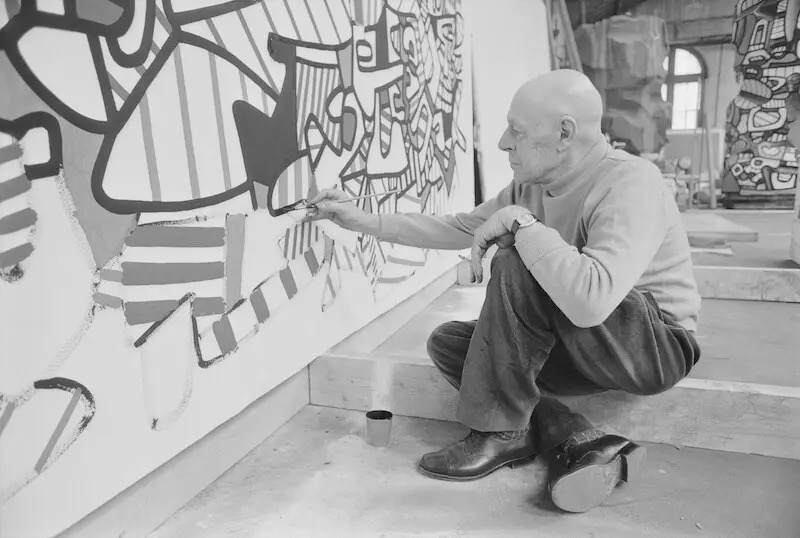
It’s a beautiful way to erase the memory of the national museums' indifference in the mid-1970s, during the failed donation attempt by Jean Dubuffet, the spiritual father of Art Brut. His collection of works by "outsider" artists—creators from a world both real and imagined—was ultimately welcomed by the city of Lausanne in 1976, which inaugurated a museum for the occasion.
“It was precisely during a visit to the Lausanne museum in the early 1980s that Antoine de Galbert experienced one of his first major aesthetic shocks,” says Florence Latieule, Director of the Modern and Contemporary Art Department at Piasa. Since then, the collector has never stopped collecting—voraciously, “coitally,” in his own words, as reported by Le Monde in 2008—works that elude all control and whose origins lie in an artistic intuition not always recognized as such by their creators.
On Wednesday, September 24, Piasa will auction, in two sessions, part of the collection of Antoine de Galbert. Around 200 lots will offer insight into the journey of the founder of La Maison Rouge, a key space for 15 years devoted to the intersection of modern and contemporary art.
The first session opens with an artist of particular importance to the collector: Philippe Dereux, who was regularly exhibited in de Galbert’s Grenoble gallery, inaugurated in 1987. Six works by the “Master of Peels,” who gained public recognition with his 2003 solo show Wisdom of Peels at the Halle Saint Pierre, will be presented. Melancholy (1974), Faun Mask (1976), and Carnival (1998)—mixed media pieces combining painting with fruit and vegetable peels—are estimated at €3,000 to €4,000 each.
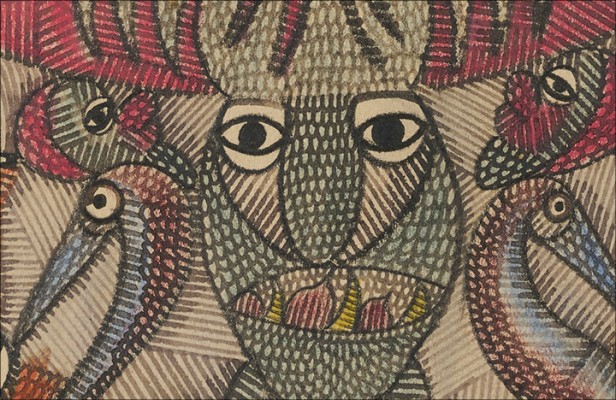
These are followed by 16 gouaches and watercolors by the Russian geneticist and painter
Eugène Gabritschevsky, diagnosed with schizophrenia in the 1930s. Rediscovered by gallerist Alphonse Chave and exhibited at La Maison Rouge in 2016, Gabritschevsky is recognized for his unique world—a naturalism haunted by ghostly figures and spectral forms (Composition, €2,000 / €3,000).
The evening sale features artists mostly already recognized by the art market. Among the most striking are the sculptures by Alfred Marié and his partner Corinne, which appear to weave connections between architecture, clockmaking, and the Palais Idéal of postman Ferdinand Cheval (La grande table, 2000, €60,000 / €90,000).
Also significant is the work of American artist Judith Scott, who was deaf, mute, and had Down syndrome, and whose deep bond with her twin sister Joyce permeates her art. Her sculptures made from woven wool take on a cocoon-like form, perhaps evoking a quest for rebirth (Untitled (Ballerina), 1995, €50,000 / €70,000).
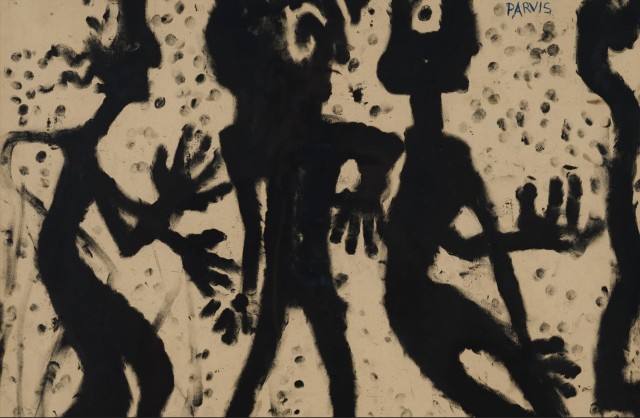
Finally, the Swiss artist Louis Soutter perfectly exemplifies the porous boundary between two worlds—the often hidden realm of Art Brut and that of contemporary artistic experimentation. Depressed and institutionalized at age 50 in a home for the elderly, but supported by his cousin Le Corbusier, Soutter embarked on a process of "unlearning" (what we might now call deconstruction), a modernity that has captivated the international Karsten Greve Gallery, which represents him today (Parvis, 1937, €300,000 / €400,000).
“Antoine de Galbert never had a strategy,” concludes Florence Latieule. “He collected artists and works that spoke to him. The adventure of La Maison Rouge allowed him to show what he loved and to share his passions with others. In this sense, this sale is nothing more than the transmission of a legacy.”