-1753862210.jpg)
-1753862266.jpg)
"Fleurir l'Amérique Président Stubborn, 1951–1960."
Oil pastels and colored pencils on stitched paper. 64 × 69 cm.
Estimate: €50,000 / €70,000
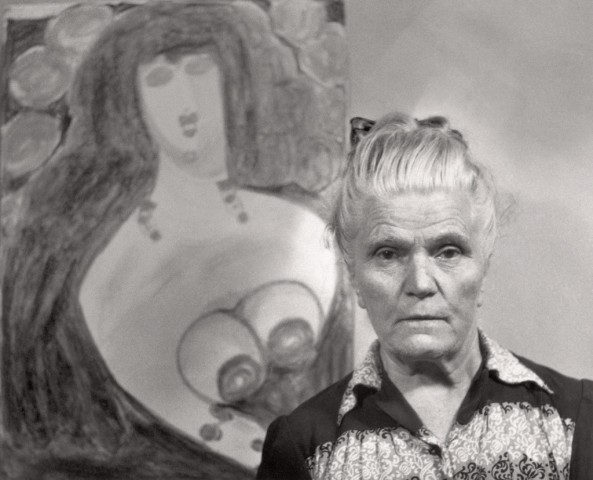
In 1941, Dr. Jacqueline Porret-Forel met Aloïse Corbaz at the La Rosière asylum in Gimel (Canton of Vaud, Switzerland), where she was institutionalized for schizophrenia. Porret-Forel became deeply passionate about the artist's approximately 2,000 writings and drawings, which she tirelessly promoted, eventually publishing a complete catalogue of her works in 2012.
Five years later, she read a letter sent by Jean Dubuffet to his cousin Oscar Forel, a psychiatrist and therapist of painter and writer Adolf Wölfli, whose work Dubuffet wanted to acquire. She decided to arrange a meeting with the theorist of Art Brut to show him some of Aloïse's drawings she had brought with her. Dubuffet quickly became fascinated by the work of the artist, who would become one of his favorites.
The piece Fleurir l'Amérique Président Stubborn is one of the major works from the artist’s third period (1951–1960). According to Jacqueline Porret-Forel:
“The woman depicted is certainly the Statue of Liberty in New York, presented in a form quite different from Aloïse’s usual portrayals of Liberty: her head is surrounded by rays, she holds a torch, and she touches a box adorned with an American flag. Moreover, the caption ‘Stubborn’ associated with the idea of making America (re)blossom appears more than once in Aloïse’s drawings. This drawing from the third period is rich with unintelligible symbols that could be identified through a broader understanding of her body of work.”