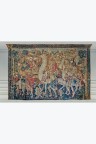
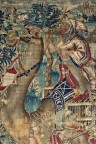
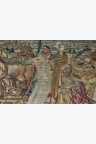
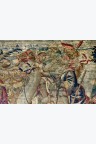
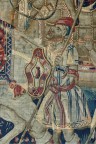
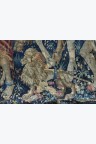
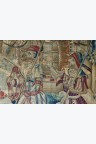
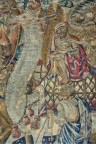
Portugal et de l’Inde’. Brussels, circa 1520-1522
L 546 × H 361 cm
(traces of wear and restorations)
Works referenced:
G. Delmarcel, "La tapisserie flamande", Paris, 1999, p. 164-165
Koninklijke Vlaamse Academie voor Wetenschappen, letteren en Schone Kunsten van
België
S. Schneelbalg-Perelman, "Un grand tapissier bruxellois Pierre d’Enghien, dit Pierre van
Aelst. L’Age d’Or de la tapisserie flamande", Colloque international, Gand, 23-25 May 1961,
Brussels, Brussel Paleis der Academiën, 1969, p. 279-323
"Tapisseries bruxelloises de la pré-Renaissance", 22 January-7 March 1976, exhibition
catalogue, Musées royaux d'art et d'histoire
This tapestry was published by Asselberghs in the catalog of the exhibition “La tapisserie tournaisienne au XVIe siècle”, 1968, but with a photo reversed left/right.
This tapestry is part of a hanging whose story begins in Tournai. It depicts, in vividly colored
scenes, the Portuguese expeditions of Vasco da Gama (1469–1524) to India.
The navigator landed on the Indian coast on May 21, 1498. He returned to Portugal in 1499
and became Admiral of the Indies. He made a second trip in 1502–1503. Upon his return in
1504, an illustrated book recounting the expedition was published in Antwerp.
At least three versions of this well documented set were produced in Tournai by the Grenier
and Poissonier workshops. The very simple borders, with only of a floral frieze, are typical
of the Tournai style.
In 1504, one of the two workshops delivered a first tapestry series to Philip the Fair
(1478–1506), before his departure for Spain. Titled ‘A la manière du Portugal et de l’Indye’,
this series was part of the dowry of Eleanor of Austria for her wedding to Manuel I of
Portugal in 1518. One of these tapestries is now held at the Nationalmuseum in Stockholm.
In 1510, a second series was commissioned from Jean Grenier by Manuel I, King of
Portugal and sponsor of Vasco da Gama’s expedition. Four of the tapestries are now kept
at the Museu de Caramulo, Fundação Abel e João de Lacerda (Portugal), one at the 13
Ricardo do Espírito Santo Silva Foundation in Lisbon, and the largest (4 m × 7.6 m),
depicting ‘L’Embarquement des animaux exotiques’, belongs to the collections of the Banco
Nacional Ultramarino in Lisbon.
Also in 1510, Maximilian I, father of Philip the Fair, commissioned the same series from
Arnould Poissonier, then titled ‘Histoire de gens d’animaux sauvages’.
A few years later, the tapestry is found in the collections of several European royal houses
and great lords. In 1541 or 1542, an inventory of Francis I, King of France and husband of Eleanor of Austria (herself the widow of Manuel I of Portugal and sister of Charles V),
mentions an ‘Histoire de la caravane’; a subsequent inventory tells us that this series
consists of five pieces.
Near Rouen, at the Château de Gaillon, built and furnished by the famous Cardinal Georges d'Amboise, a series mentioning the ‘Histoire de la caravane’ is found in 1550.
Literature suggests that this one likely came from the workshop of Antoine Grenier, brother
of Jean Grenier, who had produced the first tapestry in 1504.
Four tapestries are also held at the Louvre Museum. Looted during the Second World War,
they are part of the Musées Nationaux Récupération collection. Although the commissioner
is still unknown, they are attributed to Tournai workshops around the 1510s.
Finally, in 1522, Pierre d’Enghien, known as Pierre van Aelst, guardian of the rich imperial
collection, delivered to Emperor Charles V an ‘Histoire indienne d’éléphants et de girafes’,
also known as ‘A la manière du Portugal et de l’Inde’, composed of six panels. During these
years, receiving numerous commissions, Pierre d’Enghien called upon other workshops,
notably the Brussels branch of the van der Tommen workshop and the workshop of Jan de
Clerck.
The weaving technique and refined style of our tapestry set it apart from Tournai production
and instead mark it as Brussels-made.
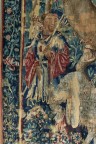
Its borders, made of floral friezes inspired by the Millefleurs and grape clusters, are of the
Brussels type. Among other examples, they are comparable to those of the tapestry series
‘Triomphe de la Renommée’, belonging to the Metropolitan Museum of Art in New York
(inv. no. 1998.205), which is known to be from Brussels.
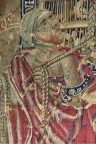
Finally, the inscriptions appearing on certain decorative elements—at the bottom of cloaks
and on the saddles of camels—use initials and reversed letters characteristic of Brussels
around 1520–1540.
According to currently available records, there are no other known Brussels commissions
for this tapestry series besides that of Charles V.
Given its technique, its style, and historical sources, it is possible to consider that our
tapestry belonged to Charles V’s commission in 1522.


