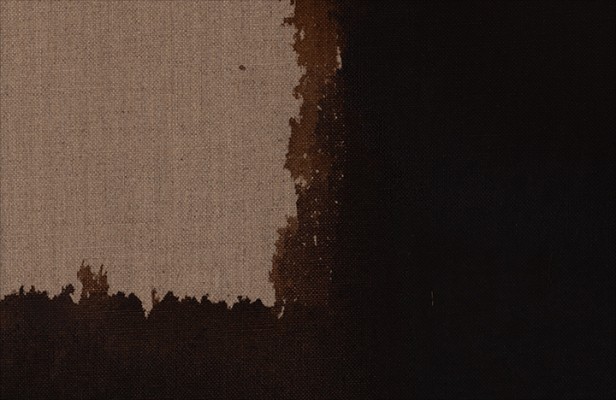
The oil on linen Burnt Umber and Ultramarine Blue (1991, €180,000/250,000) initially surprises through its presence. Three dark, asymmetrical masses rest on a linen canvas: one central and taller, the other two slightly set back, brought together in an almost architectural gesture. And yet nothing here belongs to construction as it is usually understood in abstract painting: no preliminary drawing, no plan, no sharp edge—not even contours. The heavily diluted oil has been absorbed into the linen like ink into rice paper. It spreads through capillarity, ultimately leaving an organic edge, almost in motion—at once the imprint of a gesture and the trace of a process that continues without the artist.
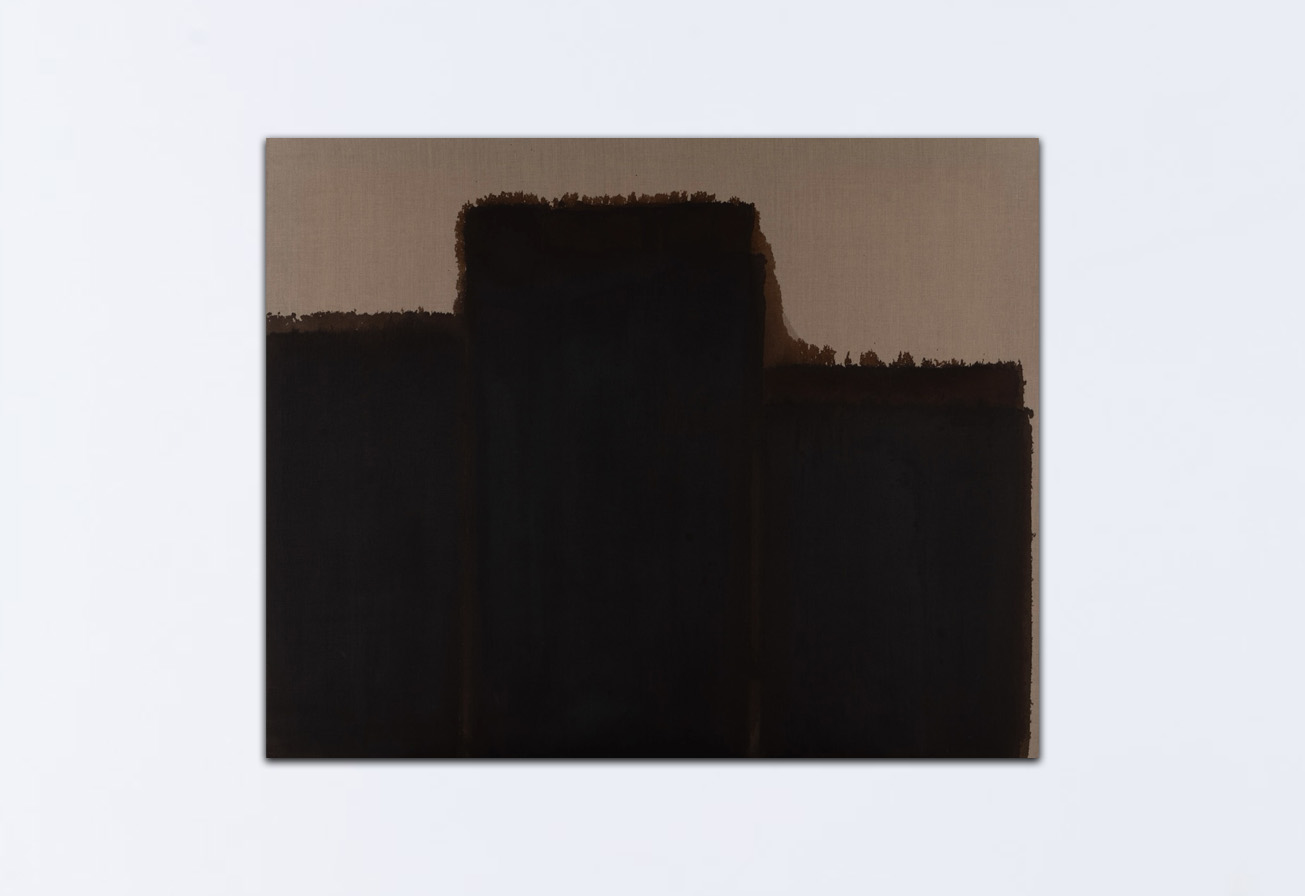 LOT 56
Burnt Umber and Ultramarine Blue is a work created at the height of Yun Hyong-Keun’s maturity. The two colors named in the title—burnt umber and ultramarine blue—were applied in successive layers over several weeks, overlapping and blending to produce the dense, deep black that dominates the surface. It is only in raking light, or at very close range, that the distinction finally emerges: brown rises at the edges, while blue persists in certain areas. “Burnt umber as the color of the earth, ultramarine blue as the color of the sky: a cosmology in two pigments that runs through all of Yun’s work,” summarizes the American critic Ben Rybczynski (Glenstone Field Guide, Glenstone Museum, Maryland).
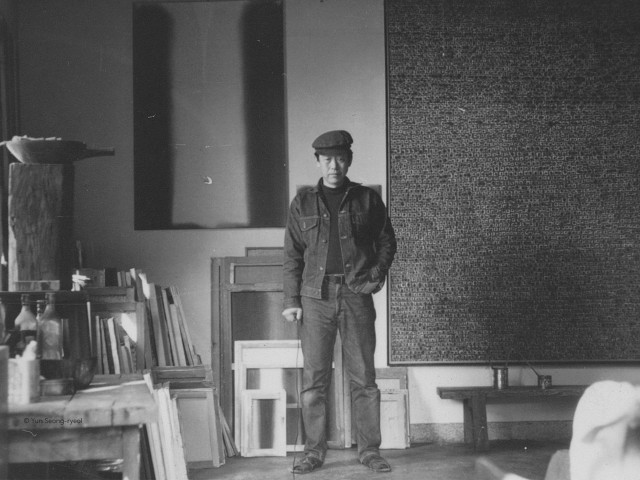
The artist is a central figure of Dansaekhwa, the Korean monochrome painting movement that emerged in the 1960s–70s in a country still scarred by war and largely isolated from international art circuits. This context of isolation was foundational: it compelled artists to establish their own rules, to rethink from scratch what painting could mean. What Dansaekhwa produced was not a local variant of Western abstraction, but an autonomous response, rooted in the traditions of calligraphy and ink painting, yet radically contemporary in its propositions. Where American Minimalism proceeds through reasoning that tends to eliminate the artist’s hand, Dansaekhwa painters work through endless repetition of gesture, through the relinquishing of control, through the collapse of the ego.
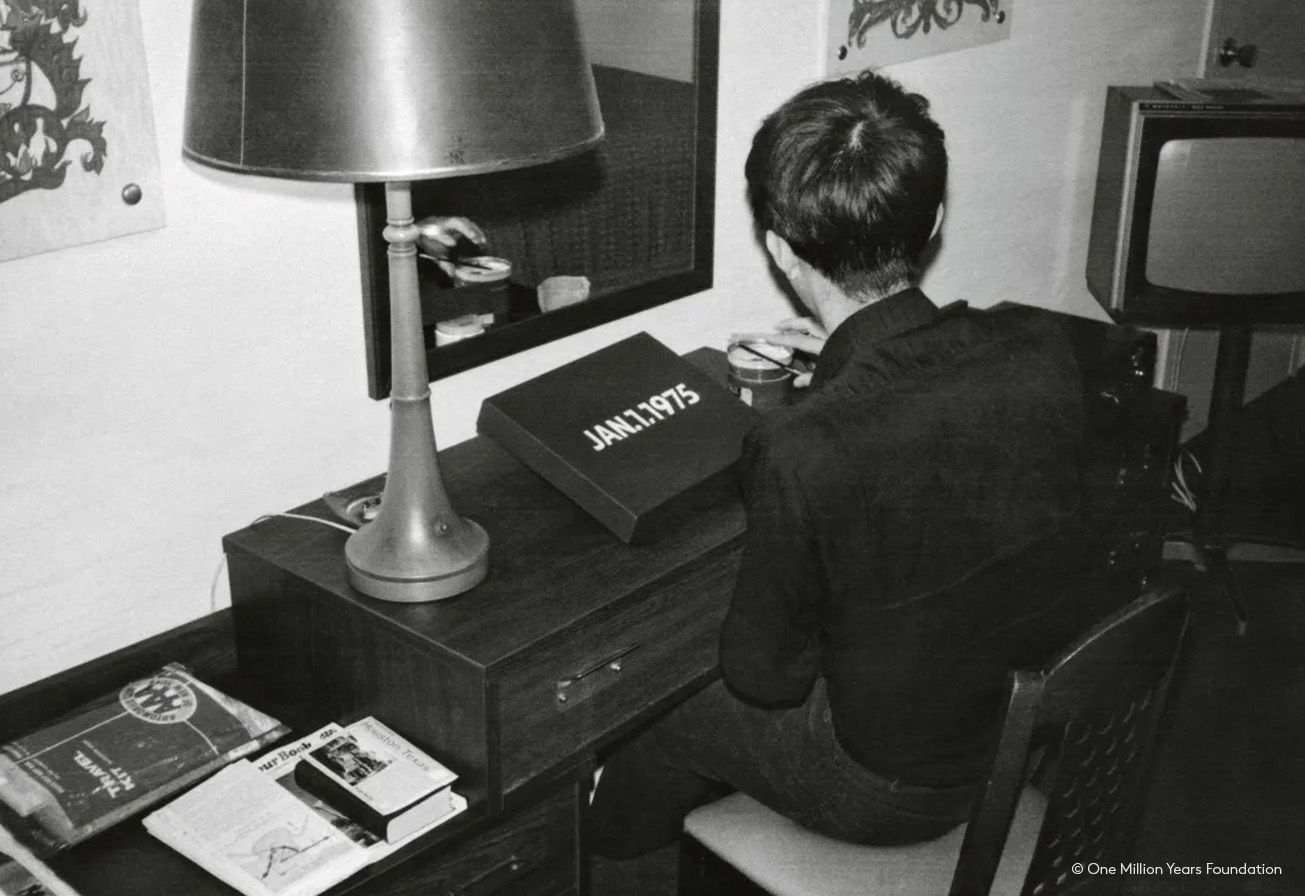
On Kawara, January 1st, 1975
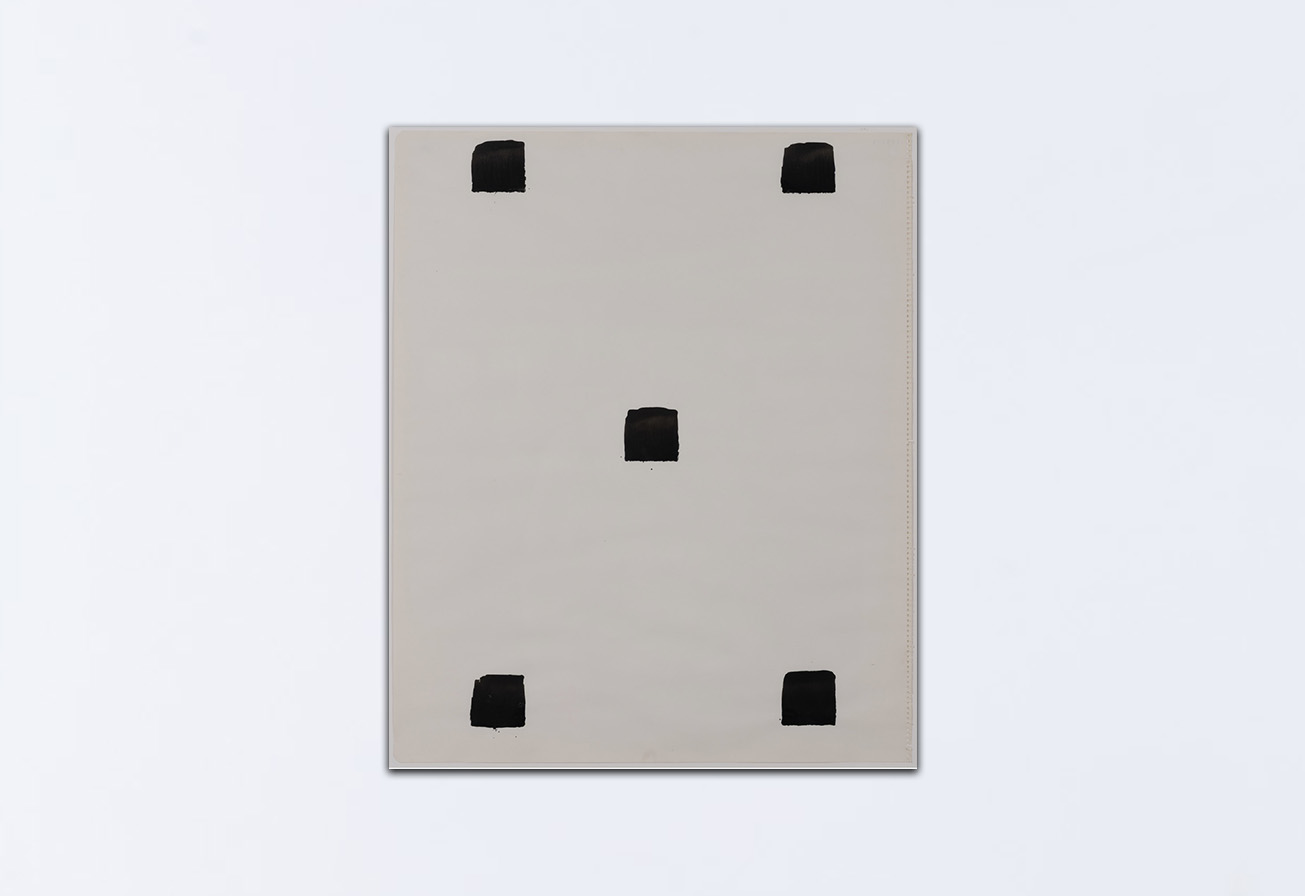
This logic of repetition finds meaningful echoes in On Kawara, four of whose works are included in the sale (lots 51 to 54, €2,000/3,000 and €10,000/15,000). From 1966 until his death in 2014, he pursued his Date Paintings according to a comparable protocol: same format, same gesture, same rigor, day after day. This conception of painting is even more pronounced in Niele Toroni (lots 62 and 63, €10,000/15,000), who since 1966 has applied the invariable imprint of a No. 50 brush at regular 30 cm intervals. Painting is thus reduced to the attestation of its own presence.
For these three artists, the series is neither a style nor a commercial signature: it is the form of a thought that refuses to be fixed and instead dissolves into the act of creation. Yet the similarities end there. On Kawara operates in the realm of pure conceptual art: the painted date affirms existence through the physical inscription of time. Niele Toroni, for his part, exposes his protocol, making it visible and unavoidable—this becomes the essential element of his vision. Yun Hyong-Keun, by contrast, seems to let his painting drift toward places and temporalities that do not belong to him. Time is absorbed into matter, deposited in the layers of oil slowly drunk by the linen. This is not the same relationship to the world.
For the Korean artist, this refusal of pictorial mastery takes the form of an ascetic discipline without equivalent in European painting of his time. The same gesture, the same pigments, the same linen canvas, repeated unfailingly for thirty years. This is neither a brand nor a style, but the expression of an ethic. Each painting is not a variation on a theme; it is the continuation of a practice, an attention, a relationship to time. The series does not produce different works—it poses the same question, without intention, again and again, to the point of exhaustion.
 LOT 62