


Born in 1940, the self taught Younousse Seye was an actress and a housewife before fully embracing her craft. First scouted by Senegalese filmmaker Sembene Ousmane, she went on to star in Mandabi (Le Mandat), one of the great masterpieces of African cinema, which won the International Critics’ Prize at the 1968 Venice Film Festival, but also Xala (1976) and Faat-Kiné (2000), pursuing in parallel an ever growing career as one of the first female painters of Senegal. A feminist, with strong beliefs about the role of women in society, she remained all through her career, very vocal about the issues she believed in, insisting that President Senghor hire women as ministers, denouncing Apartheid, chastising what she felt were fading notions of African solidarity:
“All of us, writers, poets, painters, etc., are committed to the African cause. There is no alternative."
“I believe in the evolution of women and their participation in the future of this continent. […] I would like us women to participate effectively in everything that is happening in our countries. […] It is not enough to proclaim it, we must put it into practice...”
The work presented in our sale dates from 1972 and perfectly embodies the various themes that one finds expressed throughout Younousse Seye’s career: The cowrie shell, used in ancient times as a currency for trading in the sub saharan region, a signature of her work, is present here as a powerful testament to the artist’s African heritage and a symbol of the richness and power of the divine feminine archetype, which is also found in the streaks of white paint, which evoke the maternal milk.
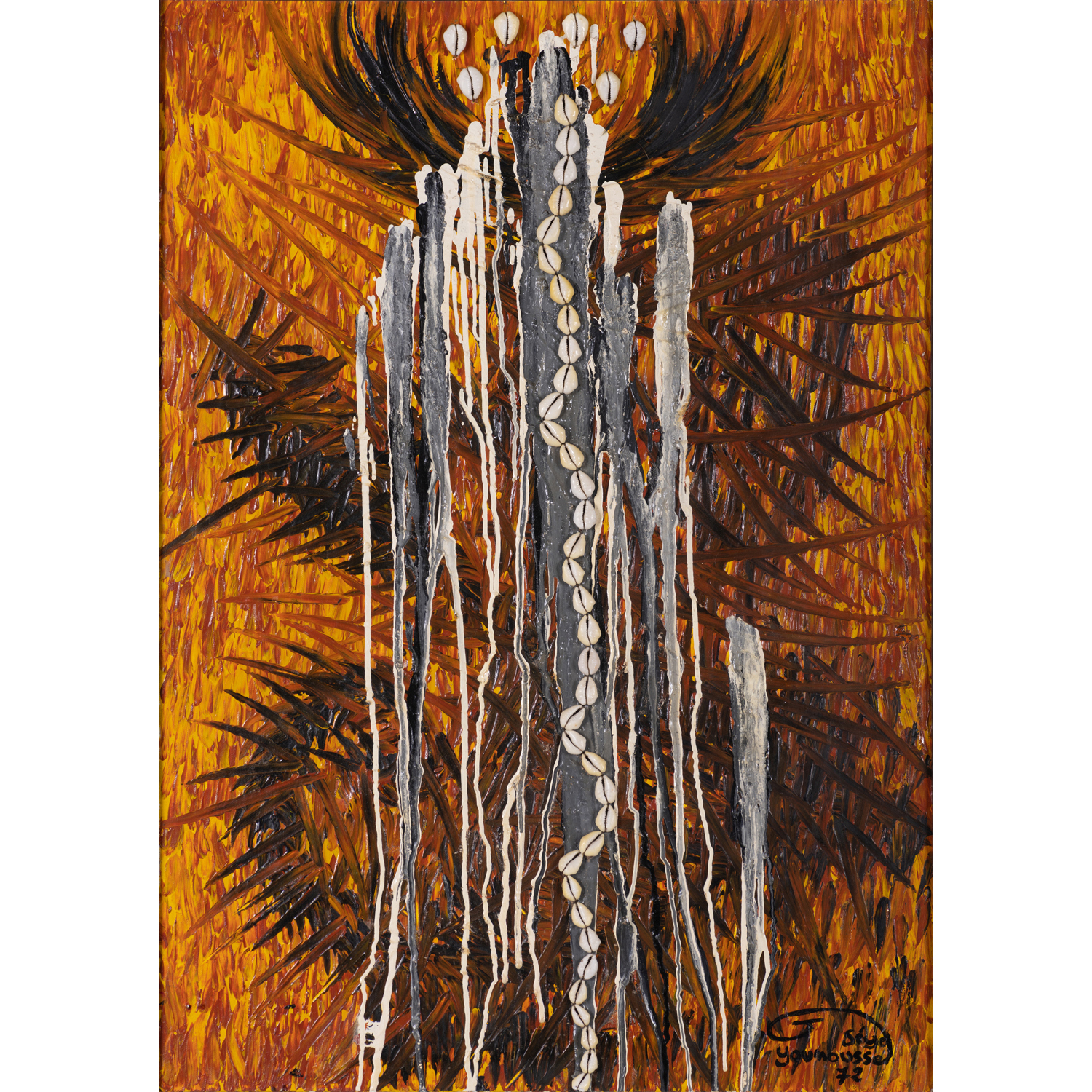
Younousse Seye (b. 1940, Senegal)
Untitled, 1972
Estimate : 8000 / 12000 €
The artist refers to a painting similar to ours in her 1972 interview with Annette d'Erneville for AWA: The Black Woman's Magazine, in these words:
"I like all colors, but if you saw my show last November, you noticed that ochre dominates. Ochre, the color of Africa [...] Ochre attracts me. [...]
E. A. Among the paintings you exhibited last year, is there one that is the most dear to you [...] that you sold, or gave away with great reluctance, with a hint of sadness?
Y. S. Yes, there is one and I donated it to the Senegalese state, to all my fellow Senegalese. I could not sell this painting because for me it was priceless. It is called "L'Afrique nourricière". [...] I am still very attached to it. I track it to find out where it is shown, where it is being kept.
E. A. What exactly does it represent?
Y. S. Three women have their breasts pierced, and milk flows from them. Milk, the first nourishment of the being, a symbol. Why the woman? Because the woman means motherhood, she is the mother of humanity. It is she who has the role of the continuity of mankind, and in this subject, I wanted to symbolize the role of the woman in traditional society. We know perfectly well that women play so many roles. They are the guardians of our traditions, mothers, wives, educators. The woman is a whole and everything revolves around her. I have titled this painting "L’Afrique nourricière" because Africa has given "its milk" to humanity, in various and too often painful forms..."
- Extract from the interview between Annette d'Erneville and Younousse Seye, AWA Magazine, 1972. Reproduced in the catalogue of the exhibition Senghor and the Arts: Reinventing the Universal, Musée du Quai Branly, Paris, from February 7 to November 19, 2023.
Two years after the creation of the present work, in 1974, Younousse Seye would embody this power as the sole female artist exhibited in the landmark exhibition Art Sénégalais d’Aujourd’hui, organized by President Leopold Sedar Senghor in Paris’ Grand Palais. In 1977, she is celebrated in her home country, becoming the first woman to receive a solo show at the Grand Théâtre Sorano.
“For me, painting is a means of expressing myself, a means of engaging in a dialogue with society, a means of communication and communion, because the role of the artist is very important in society.”
- Younousse Seye
