


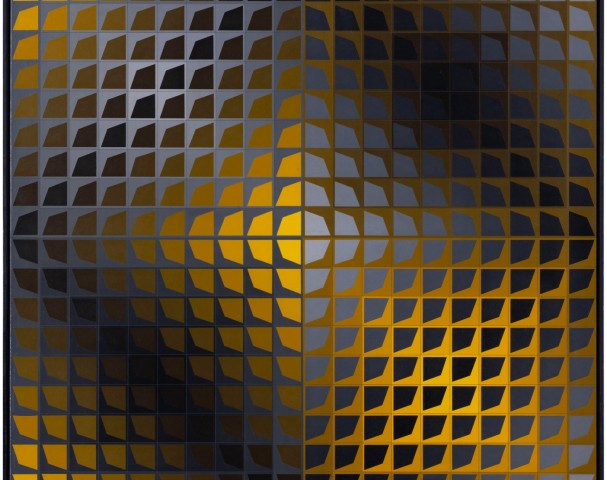
In the late 1920s, Victor Vasarely was interested in the Bauhaus movement, whose influence at that time was felt far beyond Germany's borders. He received his first artistic education at the Műhely of Sándor Bortnyik in Budapest before succumbing to the attraction of the cultural dynamism of which Paris was the theatre.
Victor Vasarely then moved to Arcueil with his wife Claire Spinner (1908-1990) and attended the Plas studio. In collaboration with several advertising agencies, he developed a production of posters and illustrations that anticipated what historiography has retained as the first attempts at optical art (or Op Art). On the surface of a 1938 "Mitín" advertising poster, the inflated checkerboard makes its first entry into the artist's plastic repertoire.
The chromatic contrasts in the canvases he produced in the early 1950s produced optical phenomena that misled the eye. The work seems capable of setting itself in motion. The time of observation is, in fact, taken into account in the viewer's appreciation. Despite the geometry of the forms represented by the artist, the link that his painting maintains with reality has never been broken. It can be seen as an exploration of the microstructures of matter or the phantasmagorical landscapes of the cosmos. If the two infinites, small and large, prevented Pascal from sleeping, they influenced this painter for whom science was an inexhaustible source of reflections, conducive to the conception of mental representations.
A free electron navigating the landscape of abstract art in the 1960s, Vasarely set up a sort of plastic alphabet made up of simple shapes in different colours. As a witness to globalization, he intends to create a new global folklore.
Nearly sixty years after the first presentation of his work at the Musée des Arts Décoratifs in 1963, the 300 or so pieces brought together for the retrospective organized by the Musée National d'Art Moderne in 2019 have highlighted the importance of his trajectory in the 20th century he has lived through.
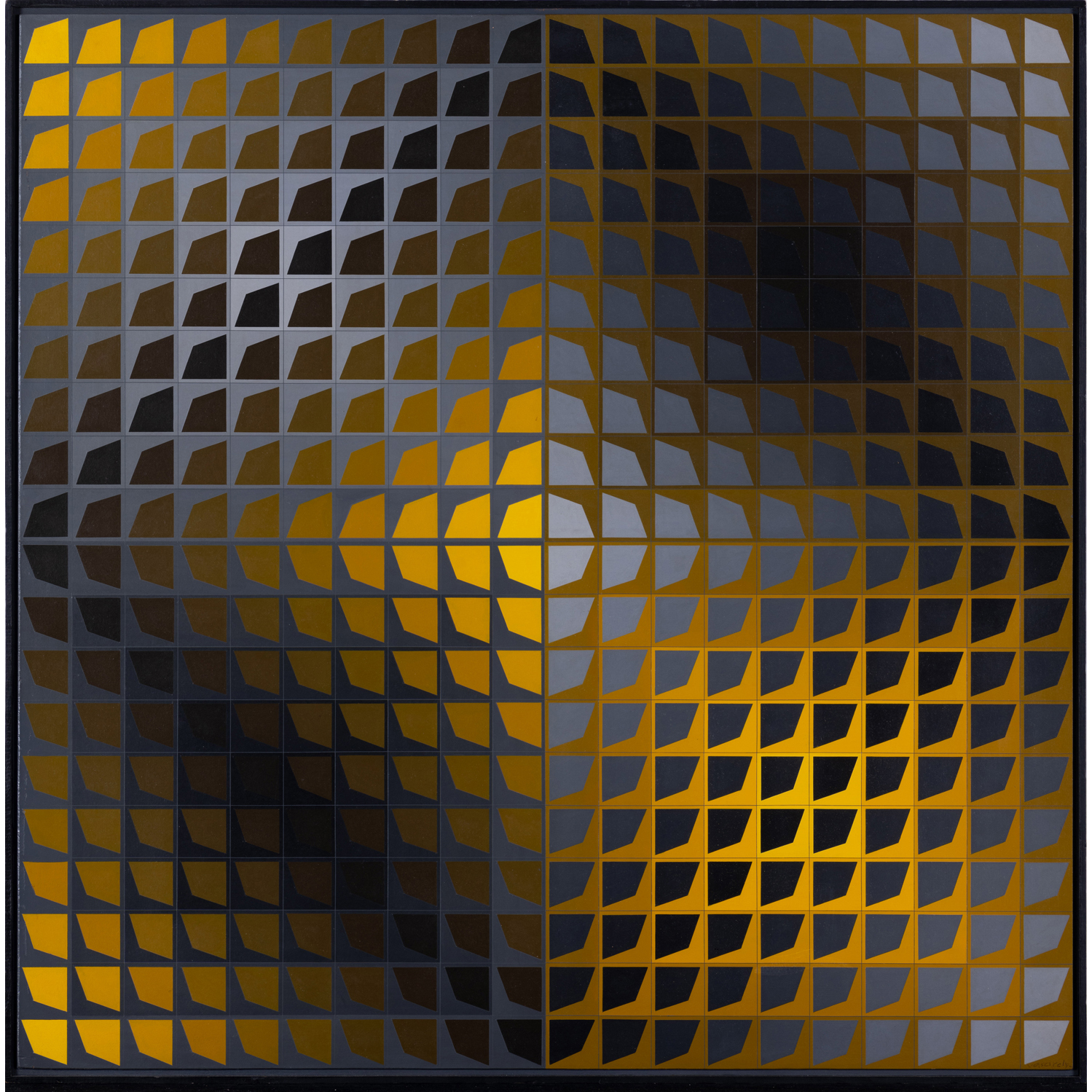
Victor Vasarely (1906-1997)
VA-22 BARSON, 1966-1969
Acrylique sur panneau
Signé en bas à droite
Contresigné, daté et titré au dos
80 x 80 cm
Résultat: 47 810 euros
Beyond the boundaries between disciplines and artistic practices, the artist, like a Mondrian or a Warhol, is the author of a protean work. Testifying to the keen interest that the artist arouses among both French and foreign collectors, Va-22 Barson, an acrylic work created between 1966-1969, was sold by PIASA in May 2019. Translated with www.DeepL.com/Translator (free version)
