


Furniture, glass, textiles, but also paintings, drawings and illustrations: the great diversity of Stig Lindberg's artistic practices testifies to the appeal that materials and different creative techniques have had on this designer, one of the most emblematic of the Scandinavian scene.
Born in Umeå, Sweden in 1916, he studied History of Painting at the University College of Arts, Crafts and Design in Stockholm. From 1937, the young man went to work in the Gustavsberg porcelain factory alongside the ceramist Algot Wilhelm Kåge (1889-1960).
Initially, he was in charge of painting on earthenware. Located in the town of the same name, this Swedish company, founded in 1826, was one of the major centres of ceramic production in Scandinavia. A museum open to the public since 1956 illustrates this glorious past.
Stig Lindberg took over the artistic direction of the factory some ten years later. For more than thirty years, he was the author of a very large number of ceramic pieces and kitchen utensils. A great freedom in the forms and their proportions ensure that the works he designs are astonishingly original.
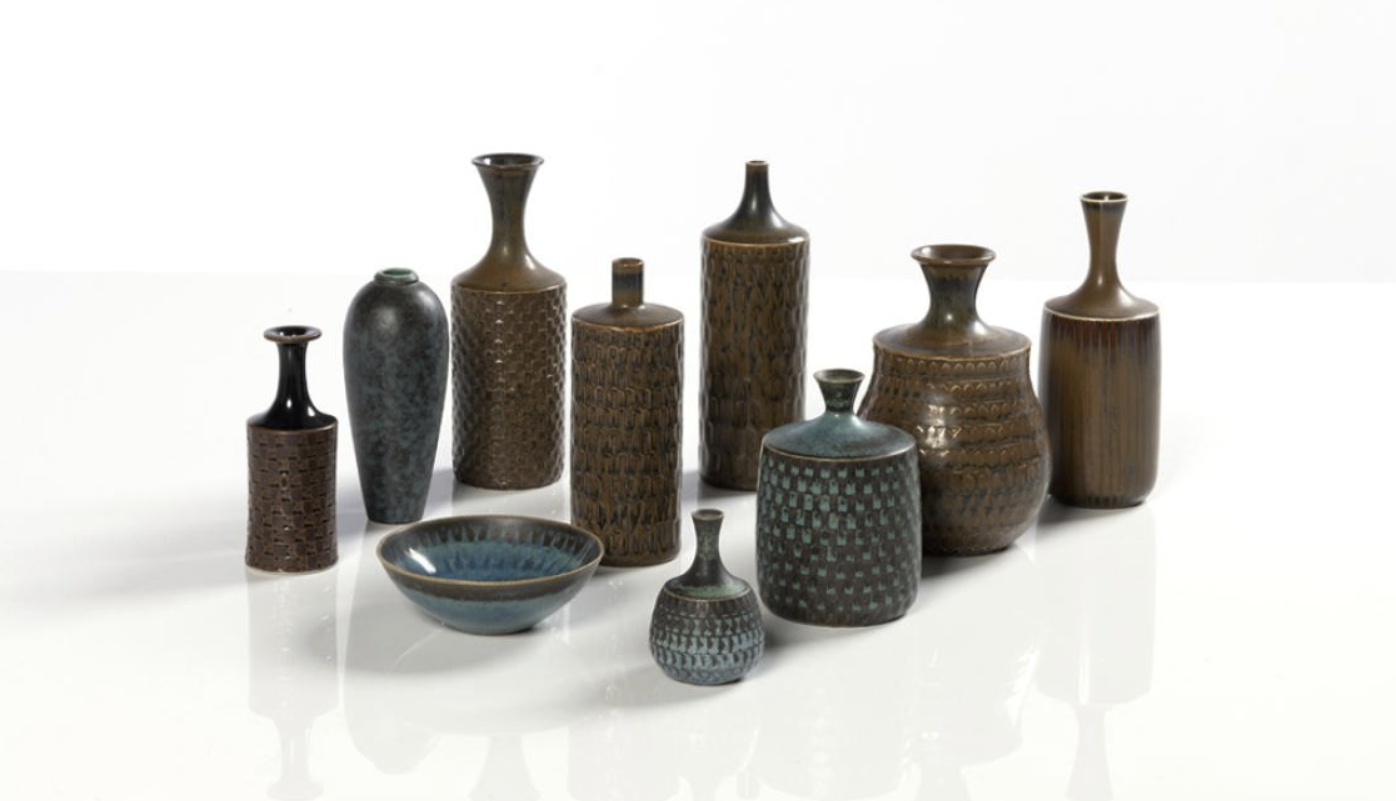
Stig Lindberg (1916-1982)
Suite de dix miniatures
Céramique émaillée
Monogrammées et gravées 'Stig L'
Date de création : vers 1940
Estimation : 3 000 - 4 000 euros
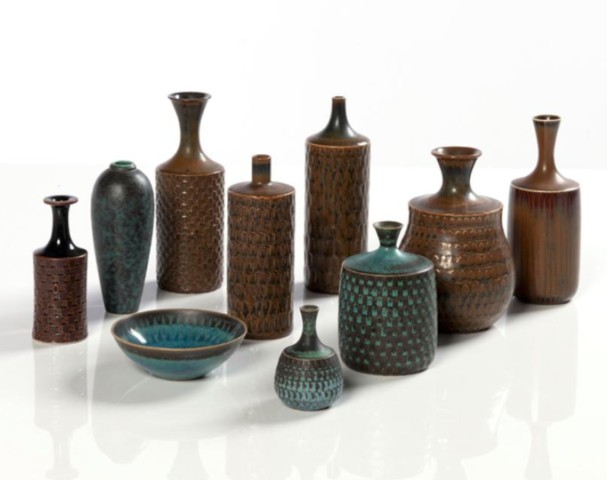
The suite of ten enamelled ceramic miniatures also illustrates the solidity of the links between his creations and sculpture. The ornamental motifs in shades of blue and brown obey an elegant sobriety. Made around 1940, it is offered with an estimate of between 3,000 and 4,000 euros. In the early 1980s, the designer opened a new chapter in his career and opened his own studio in Italy.
His work was rewarded on numerous occasions, such as in 1948 and 1957 with the gold medal at the Milan Triennial and in 1951 and 1954 when Stig Lindberg won the Grand Prix. In 2006, his work was the subject of an ambitious exhibition at the Nationalmuseum in Stockholm.