


Under the patronage of Léon Blum, the International Exhibition of Arts and Technology in Modern Life opened in May 1937 in a particularly tense political and social climate. The Popular Front decides to support artists weakened by the crisis by launching a major programme of wall decorations. Those of the Pavillon des Chemins de fer et de l'air are entrusted to the "Art et Lumière" group, a collective of artists from different trades led by Félix Aublet, Robert and Sonia Delaunay.
For the Railway Pavilion, Sonia Delaunay created two wall panels, Portugal and Faraway, dedicated to "Regional Visions" and intended to occupy the wall space overlooking the central staircase of the hall. The Portugal fresco, which won a gold medal from the international jury of the Exhibition and was acquired by the French state, has since been kept at the Musée d'art moderne de la Ville de Paris. However, not all the panels made by SoniaDelaunay were preserved and today, a collection of photographs, sketches and gouaches testify to the work accomplished.
*Sonia Delaunay (1885-1979)
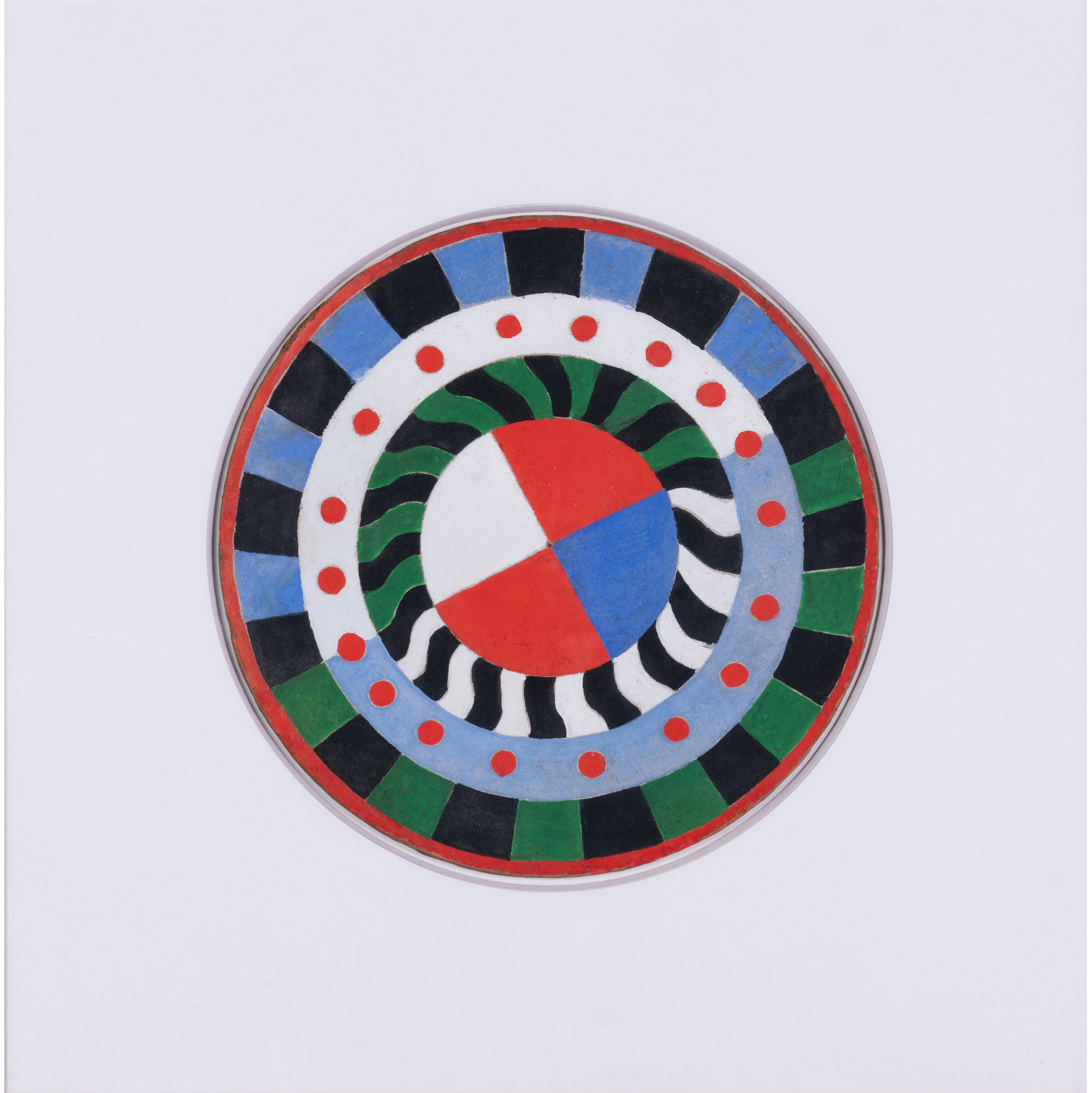
La cible
Projet pour le palais des chemins de fer de l'exposition internationale de Paris 1937, 1936-1937,
Gouache en tondo sur isorel
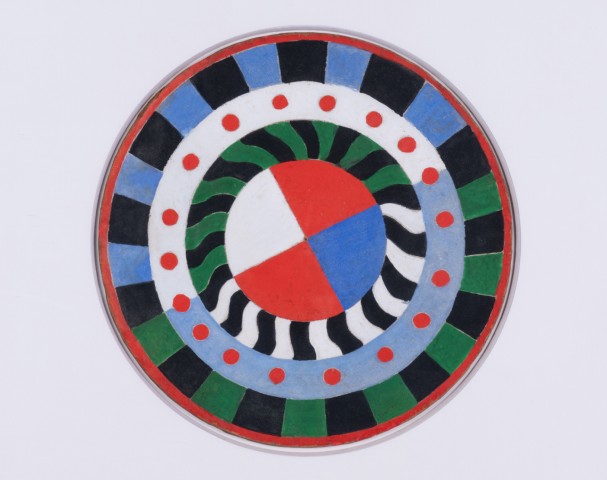
The work entitled Cible (1936-1937), which is related to this important body of work, is very representative of Sonia Delaunay's approach in its conception and realization. True shaped canvas before its time, Cible adopts the circular cut-out of the tondo, which is one of the artist's favourite plastic motifs. For reasons of formal homothety, this motif is in its nature highly effective visually as it draws the eye to the focal point of the canvas. In Cible, Sonia Delaunay explores the structural principle of concentric circles (inaugurated in 1913 by Robert Delaunay with his famous Disc) in a style that is unique to her: points, stripes, triangles are distributed in each of the concentric circles, without gradations or modelling, so as to create an impression of visual rhythm through the play of contrasts and repetitions. We see how Sonia Delaunay's resolutely modern plastic vocabulary is nourished by the work she did for textile prints in the 1920s and 1930s. It is through this absence of a border between decorative art and pictorial art that it has contributed to enriching and renewing the language of abstraction in a new way.
As such, Sonia Delaunay's participation in the 1937 Universal Exhibition marked a milestone in her career. Until then considered as "Ensemblière" or "Décoratrice", she has demonstrated here her ability to execute works of monumental format. She also affirmed her desire to synthesize the arts, which she will have the opportunity to develop in the years after the Second World War, particularly in the context of the Espace group.
