At the heart of the New York scene gradually dethroning that of Paris, Roy Lichtenstein (1923-1997) has established himself as a leading artist. After training at the Art Students League and after a brief stay in France, he taught at the State University of New York and at Rutgers University where he met the painter Allan Kaprow (1927-2006) and sculptor Claes Oldenburg (born in 1929) who help to raise awareness of popular culture and imagery.
From 1961, deeply influenced by the comic strip and the techniques used by advertisers, he made his first pop works. His work attracted the attention of the merchant Léo Castelli (1907-1999) who organized a first exhibition in his New York gallery.
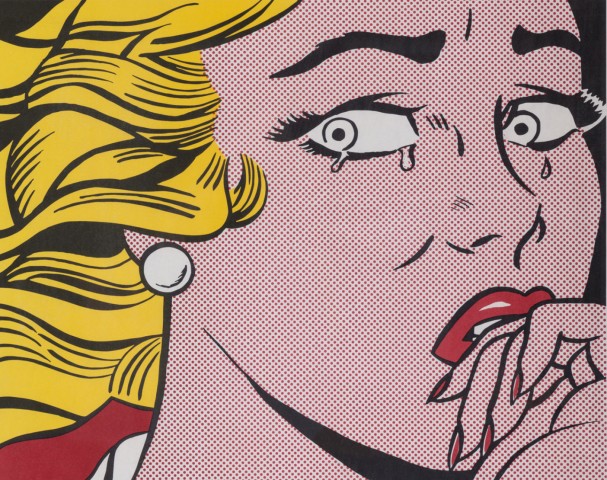
It was during this period, of rare intensity for the artist, that Roy Lichtenstein made Crying girl, a colour lithograph on wove paper estimated between 25,000 and 35,000 euros.
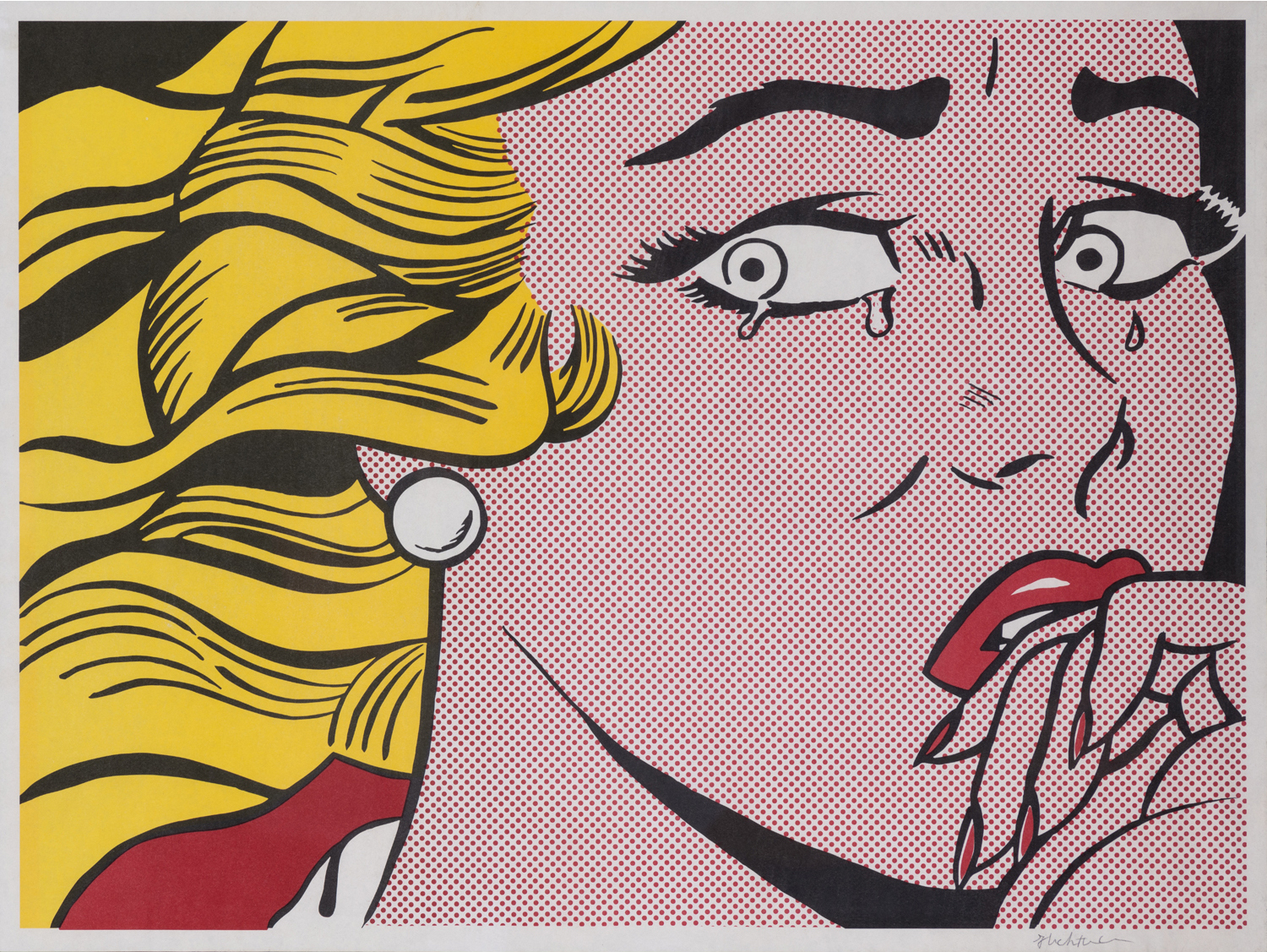
This work, like a fragment of mythology that American society is now building, is emblematic of the artist's aesthetic. Investing graphic codes of comics, antipodes the logic of an abstract expressionism then triumphant, it removes from the surface the slightest gesture, sign of the work of the painter. Thus, the immaculate yellow of the hair or the whites of the eyes correspond with the points of impression, giving the skin of the young woman its pinkish tint.
In the picture we can see the astonishing contrast between the sensuality of the red of her luscious lips and the dread of a gaze soaked in tears, setting a danger that the ambitious framing pushes out of the field and that the spectator, helpless, cannot imagine. Here, the Hollywood cinema is also summoned and with it the status of icon of the most publicized actresses.
Produced in the early 1960s, this image exemplifies Walter Benjamin's prophetic writings on the technical reproduction of piece of art, published posthumously in 1955.
Since then, there has been a growing interest in Roy Lichtenstein's work. With the general public as evidenced by the success of the retrospective that the National Museum of Modern Art dedicated to him in 2013 but also to the art market. For example, in 2017, collector Steven A. Cohen spent nearly $ 165 million to acquire Masterpiece, setting a record for the artist who died twenty years earlier.