


On the occasion of its next sale dedicated to modern and contemporary art on 6 December, PIASA will auction a selection of works by leading 20th and 21st century artists from major European private collections.
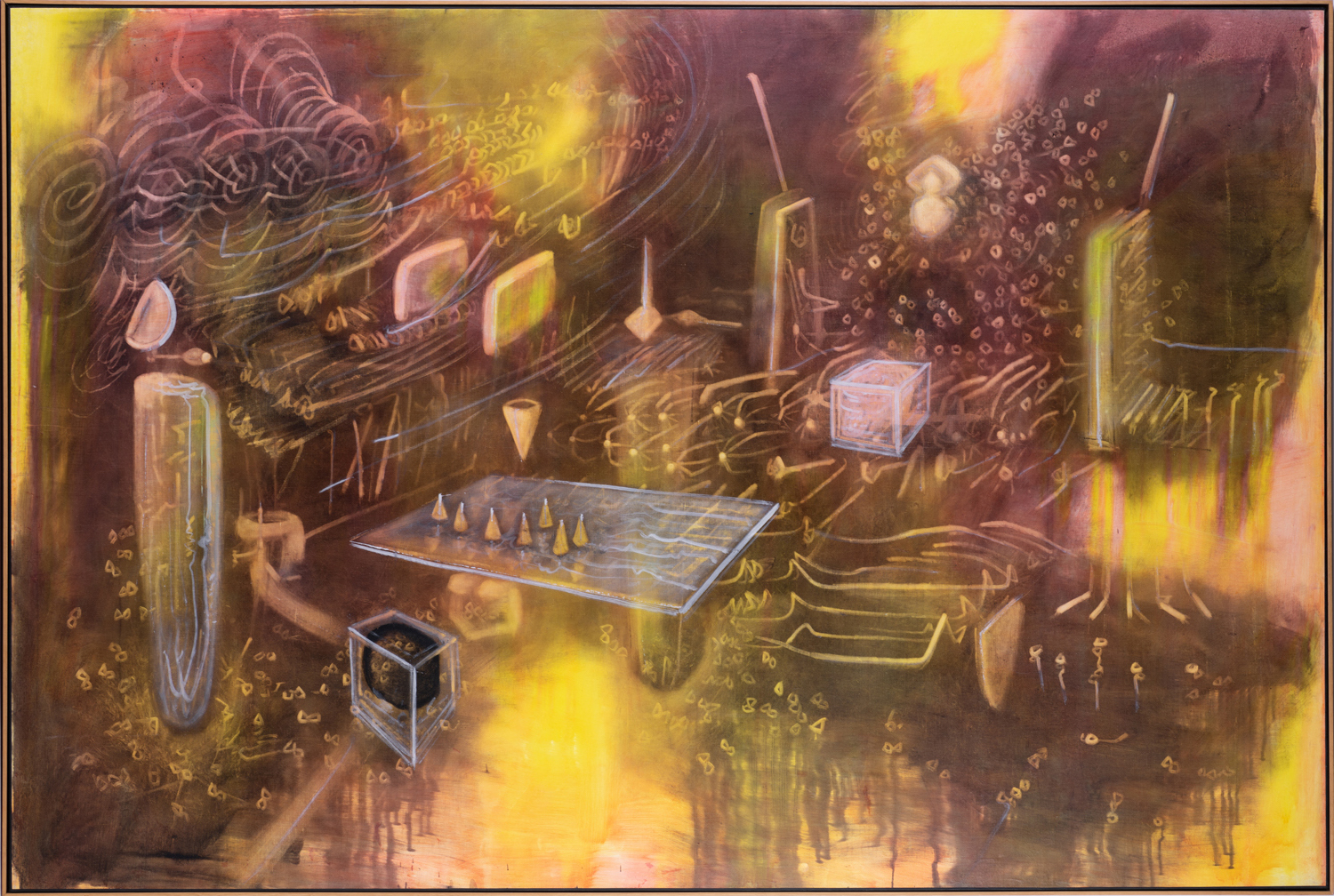
lot 17 - Roberto Matta (1911-2002) Rooming life, 1977
Oil on canvas
Provenance :- Alexander Iolas Gallery, New York- Galerie Thomas R. Monahan, Chicago- Collection particulière, Paris
Expositions :- Boston, Mc. Mullen Museum of Art-BostonCollege, "Matta, Making the Invisible Visible",février-mai 2004, reproduit en couleur sous len°48, p. 134- El Paso, UTEP, "Matta from the Thomas MonahanCollection", 7 avril-10 juin 2006- San Diego, San Diego Museum of Art,"Transmission-The Art of Matta and GordonMatta Clark", 19 août-12 novembre 2006, reproduiten couleur p. 77
Cette œuvre est enregistrée dans les Archives del'œuvre de Matta sous le n°77/3Un certificat de Madame Germana Matta Ferrarisera remis à l'acquéreurUn certificat de la Galerie Thomas R. Monahansera remis à l'acquéreur
After studying architecture in Chile, Roberto Matta arrived in Paris at the age of 22 and very quickly met the great figures of the avant-garde. He drew in Le Corbusier's studio, then trained in London with Walter Gropius. Back in Paris in 1937, Matta took part in the vast construction site of the Pavilion of the Spanish Republic, alongside Picasso and Miró. The following year, he joined the surrealist movement, after having met André Breton through Federico García Lorca and Salvador Dalí. He then had the honour of participating in the 1938 International Exhibition of Surrealism, where he made the decisive acquaintance of Marcel Duchamp. Throughout his career, Matta has been very impressed by his masterpiece, the Great Glass, which makes him realize that "you can paint change". In 1939, he created his first "Psychological Morphologists", a term that refers to the new plastic language he developed, composed of organic and vital motifs, whose shaping in the pictorial field destabilizes our usual visual references. In New York, where Matta found refuge during the war, he met Arshile Gorky, Robert Motherwell, and JacksonPollock, showing them the way to gestural automatism.
Back in Europe, Matta moved to Italy, while continuing to work between Rome, Paris and London. For a while, he left André Breton, who reproached him in particular for having openly reintroduced the human figure into his painting. However, in these post-war years, it seems essential for Matta to affirm the place of Man in his work: "We are not on the balcony to look at the world. Now you have to say to yourself: "I am in the world, I am a dimension of the world..." The painting must therefore contain four elements: a stone, vegetation, a man and an object made by man. From the 1950s to the 1960s, Matta, who had come closer to the Italian Communist Party, devoted vast compositions to the political questions of his time, which would engage him in all revolutionary struggles (he denounced, among other horrors, Maccarthyism in the United States, the practice of torture during the Algerian war, the atrocities of the Vietnam War, etc.).
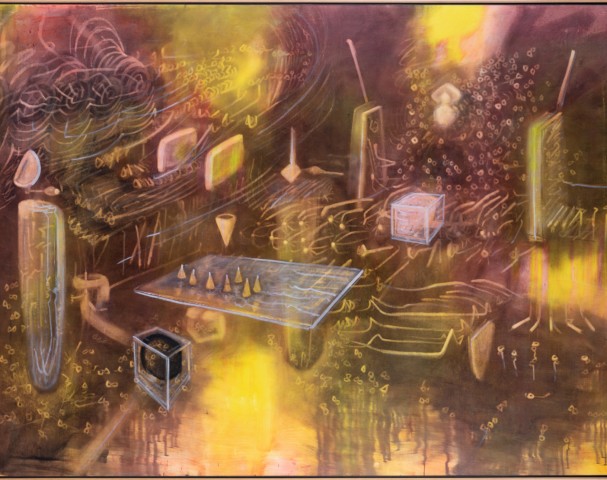
When her painting does not engage in the social and historical reality of her time, it is timeless and very convincing because of its strong metaphorical power. Thus, Rooming life (1977), whose imposing format is worthy of historical painting, presents a composition in movement, where objects that are vaguely anthropomorphic signs coexist with mechanical elements in a spirit close to Great Glass. They seem to be subjected to a rotating force in a unified and floating space, whose depth is given by their perspective, by the interplay of colour variations, the alternating areas of opacity and transparency. Networks of vibrating lines, some abstract inscriptions, reinforce the feeling of speed and give the impression of a world in perpetual turmoil. Through these enigmatic spaces, Matta offers the viewer other forms of knowledge of the world, inaccessible to our perceptual capacities, and which appear to be in constant mutation. As Édouard Glissant pointed out, they are, as "prefigurations of sidereal spaces, visions of this world to which humanity will conform its sensitivity when it has explored it in the imagination or reality, all possible dimensions" (Édouard Glissant, Le troisième œil, preface written for the exhibition catalogue "Matta", Centre culturel d' Issoire, 1987).
