


The current of narrative figuration appeared through two exhibitions organized by the art critic Gérald Gassiot-Talabot: "Mythologies quotidiennes", in 1964 at the Musée d'Art moderne de la Ville de Paris, and "La Figuration narrative dans l'art contemporain", in 1965, at the Creuze gallery.
Marking a renewal of figuration, the emergence of this movement is to be considered as a reaction to the lyrical abstraction and formalist coldness of American Pop art, to which they contrast "the need to reflect an increasingly complex and rich daily reality. " (Gérald Gassiot-Talabot). Coming from quite distinct backgrounds, the main protagonists of the movement are Valerio Adami, Gilles Aillaud, Eduardo Arroyo, Leonardo Cremonini, Erró, Gérard Fromanger, Peter Klasen, Jacques Monory, Bernard Rancillac, Antonio Recalcati, Peter Stämpfli and Hervé Télémaque. Beyond the diversity of their plastic language, they have in common the photographic transfer, the smooth and flat processing, the simplified drawings with sharp and precise outlines inspired by illustration, advertising and cinema techniques.
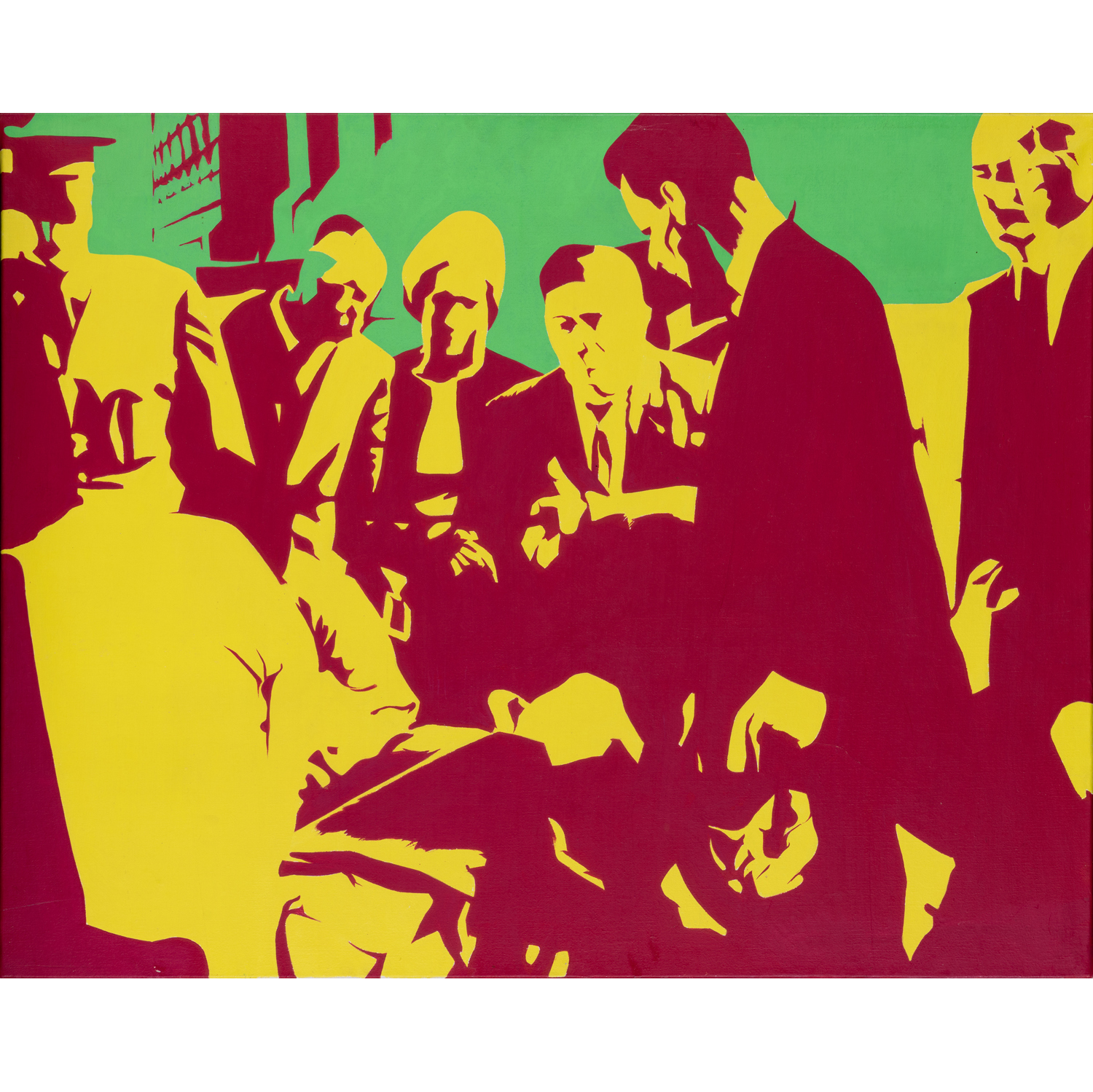
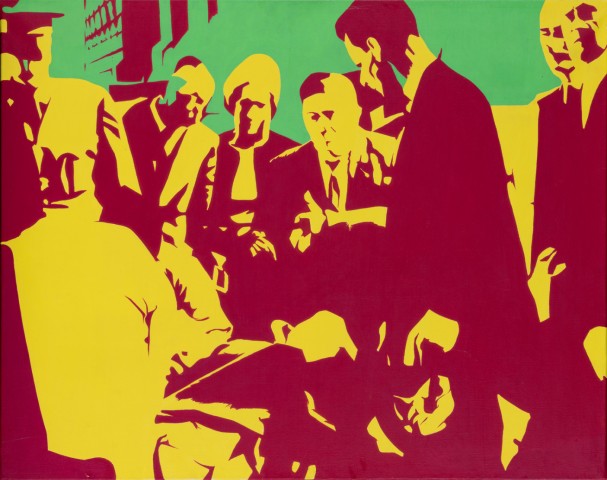
Bernard Rancillac (born in 1931)
Fin tragique d'un apôtre de l'Apartheid, 1966
Acrylique sur toile
Signée datée et titrée au dos
73 x 92 cm
If by all these characteristics, the artists of narrative figuration are not a priori at the opposite of those of American Pop art, they are nevertheless distinguished by the refusal of any ideological neutrality and by the introduction of the anecdote and time into painting. Thus, in 1967, Gérald Gassiot-Talabot defined, on the occasion of the exhibition "Comic Strip and Narrative Figuration" presented at the Decorative Arts: "Any plastic work that refers to a representation represented over time, through its writing and composition, without there always being strictly speaking a "narrative". Indeed, their works often integrate a temporal dimension into the composition games, montages and juxtapositions of scenes inspired by comic strips in Monory du cinéma or in Erró and Rancillac. As Telemachus says, there is a certain "urgency of expression" that manifests itself through the search for a strong visual impact in the treatment of forms.
The desire to produce a militant and provocative art in the world of art has been expressed in the execution of collective works including Une passion dans le désert (1965), a series of thirteen paintings illustrating a short story by Balzac painted by Aillaud, Arroyo and Recalcati and to be considered as an ironic attack against an abstraction considered too wise and a too poetic figuration. Let us also mention the same artists: the famous polyptych Laissez mourir or Marcel Duchamp's Fin tragique (1965), through which we witness the murder of the father of modernity, precisely praised by the artists of Pop art and those of New Realism. To the one who embodied the artist's omnipotence through the concept of "Ready-Made", Aillaud, Arroyo and Recalcati retort: "If we want art to cease to be individual, it is better to work without signing than to sign without working. »
The political commitment of the artists of narrative figuration culminated in the events of May 68, with the collaboration of many of them (Aillaud, Arroyo, Cueco, Fromanger, Rancillac...) at the popular workshop organized by students of the Ecole nationale supérieure des Beaux-arts de Paris: by printing posters in silkscreen printing without signature, collective art takes here its most radical form. The collective art experiences were later expressed in Equipo Cronica's parodic paintings and the subversive and allegorical frescoes of the Coopérative des Malassis, founded in 1970 by Henri Cueco, Lucien Fleury, Jean-Claude Latil, Michel Parré and Gérard Tisserand.
