Technique is a fundamental experimental subject for Peder Moos. He hardly draws, for a project three lines are enough, he adds a few notes of intent. While Kaare Klint takes the body as a reference, Peder Moos takes wood and its qualities as a starting point, he analyses its strength and character. "The best material is solid wood, the quality of which can be determined by hand, the second type of wood must be different in colour from the first, but have the same density. The inlays, ankles, tenons emphasize form and technique. These different elements give life to the furniture. "Before any project is carried out, he designs a prototype with ordinary wood to ensure the accuracy of the project. The finished version is made of precious wood and often fully in accordance with its model. The time required for this double realization, explains the price of P's pieces. From conception to manufacture, he masters the entire project. Only once did he execute a piece of furniture that someone else had drawn.
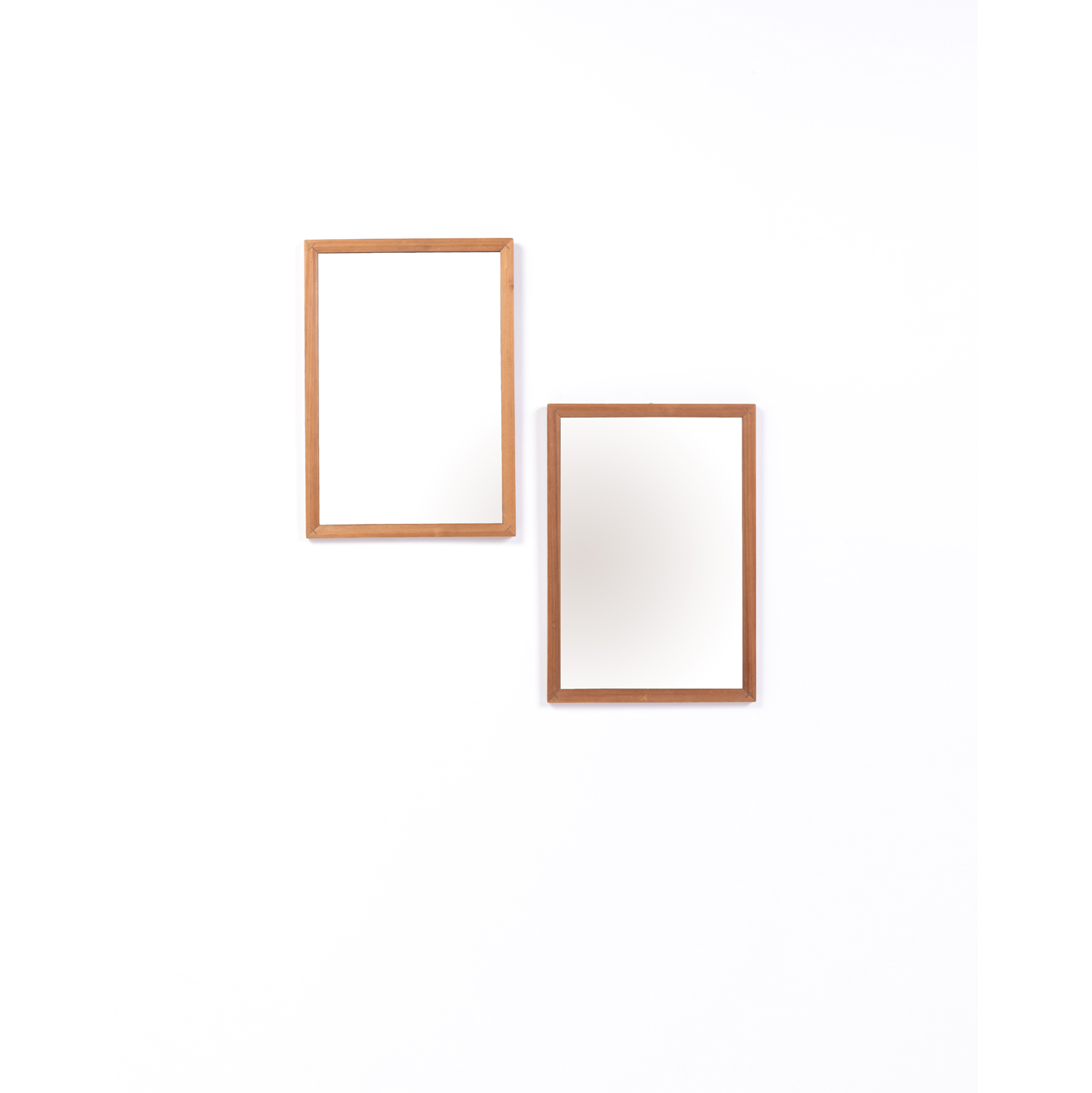
Lot 56 - Peder Moos (1906-1991)
Pair of Mirrors
Oregon pine and mirror
Signed Moos A35-1945/2
Date of creation: 1945
H 50.5 × W 35 cm
Origin: Østrupgård House Faaborg, Denmark
Result : 2 340€
He differs from his colleagues, who work on plans. He has observed in the French decorative arts that masterpieces are designed for an elitist, refined and demanding clientele. In a 1947 article, he explains his source of inspiration. "My inspiration is linked to nature and technology in all its richness and beauty. "As a child born in the heart of nature, he admires its simplicity and perfection. "Look at an animal in the wild, no matter how you look at it, it's perfect. Whatever the point of view, it forms with its skeleton a coherent whole, the legs are both thin and solid. "This metaphor provides an understanding of his creative approach. The construction of his furniture is in adequacy with the structure, the frame, he delivers the essential, avoiding any superfluous material. A reference to art nouveau is required in the organic expression of some of these models, "An aesthetic that obeys only its own rules - an end in itself. »
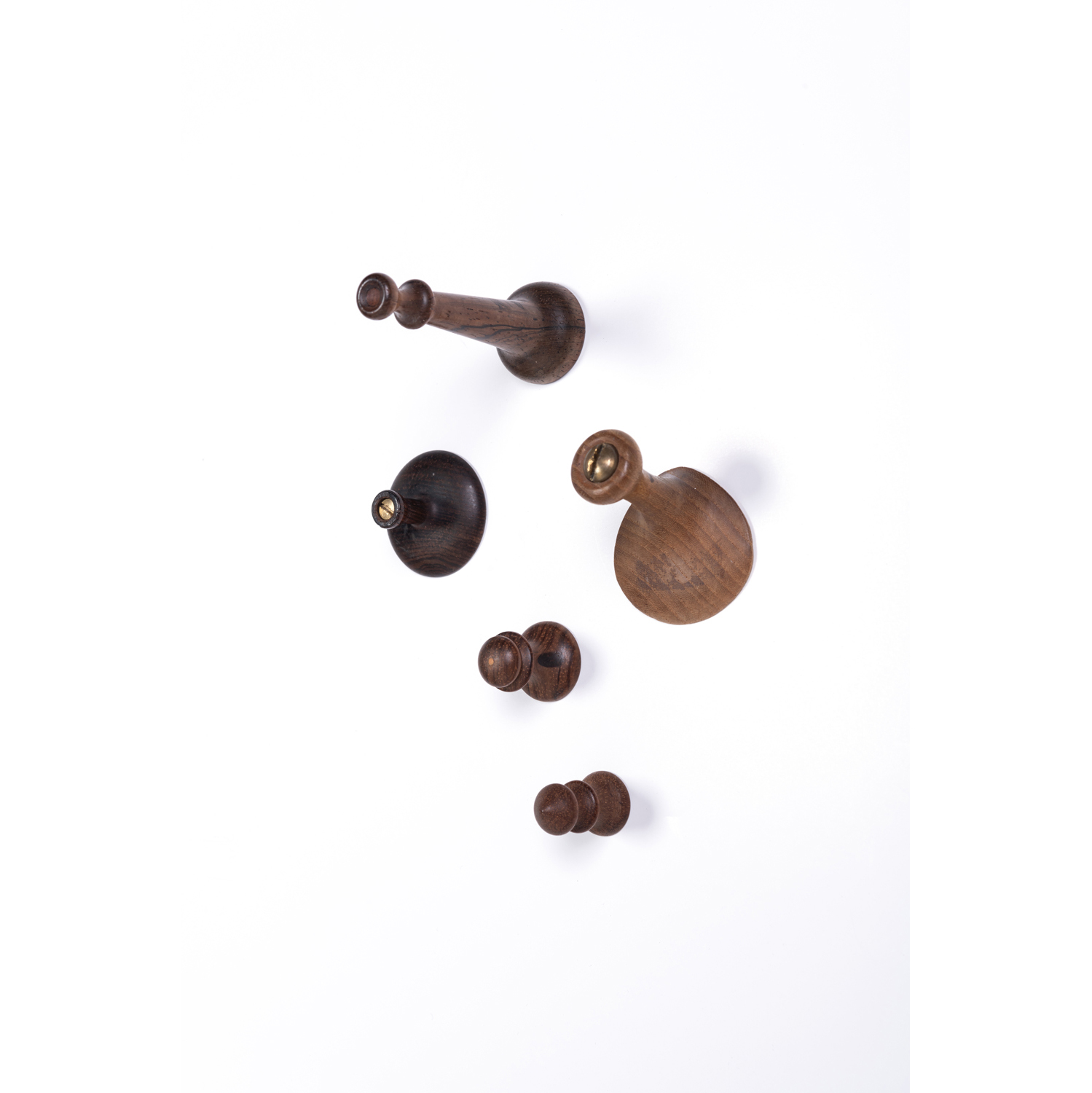 Lot 57 - Peder Moos (1906-1991)
Five coat hooks
Teak, rosewood and brass screws
Date of creation: 1944
H 7.5 cm, 5 cm, 5 cm, 5 cm, 2.5 cm, 2.5 cm, 2.5 cm, 2.5 cm, 2.7 cm
Result : 2 600€
Just as in the nature, he designs furniture with extremely fine lines, these are amazing reactions of audacity. To achieve the ideal shape, he proceeds by subtracting material and pushing his search to the limits, his attitude surprises, he summarizes his approach by talking about "an economy of shapes. When all that is superfluous is eliminated, the goal is achieved. ». To reinforce certain points, when absolutely necessary, it adds volume as in the ball-shaped foot termination or it chooses to use denser woods. The backrest of chairs is fragile because it receives a significant impact, it reinforces it. The calculation of the furniture structure is precise and intelligible. He uses solid wood for the tops and glued laminated wood to mark the joints or hide technical details, to hide lamp wires for example. A distinctive feature of his work is the inlay of motifs consisting of wedges, pegs that highlight the assembly. As a pretext to produce a decorative effect, he uses woods with contrasting, visible colours. Even if he said, "There are no useless things in my furniture, everything has a constructive function. "There are several examples that prove that he was sensitive to aesthetics, as his son Bjarne confirms. "He embellished the construction while respecting the technique, if he hadn't taken different woods, the joints would have been invisible. "He defended himself against it to differentiate himself from the members of the Guild who produced stylish furniture with unnecessary ornaments.
The character is particularly singular and free, he produces very few pieces of furniture, he creates each element like a painter or a sculptor, he evaluates its colour, contrasts and volume. A monogram that evokes the two legs of the M de Moos, or according to certain interpretations such as the XX of the 20th century, seals the project. Sometimes he signs and dates his furniture or objects on the back with a red signature. Finishing, the last step of the realization, is an essential phase. He polishes the surface with finer and finer steel wool, between each polishing he wets the surface. For the last pass, he rubs the surface with fir wood chips, a rare technique that gives the surface an inimitable velvety and silky shine. The hand can caress the skin of the furniture, which is free of grain and defects. "The finest chips, wood against wood, the light is broken because the defects are visible, there is still a long way to go. »
Extrait de Peder Moos dit P., par Anne Bony, aux éditions PIASA, septembre 2014