


Born in Greece, Pavlos grew up in Filiatra in the Peloponnese, then in 1949 he entered the Athens School of Fine Arts from which he graduated in 1953. Most of his career took place in Paris, which he visited for the first time in 1954, thanks to a scholarship.
When he moved there definitively four years later, he felt the need to escape painting and to distance himself from lyrical abstraction, which he considered to be the last academism. Two decisive events definitively confirmed him in his choices: the discovery of Rauschenberg's Combine-Paintings at Daniel Cordier's and the discovery of Jasper Johns' work at the Rive Droite gallery.
Pavlos then turns to paper, which he says "beckons" to him in the garbage cans of Paris and starts making collages out of magazines. Little satisfied with the result, he became interested in subway posters: impressed by their monumental and colorful aspect, the artist had the idea of extracting long strips of paper, an original approach that brought him closer to the poster artists of the New Realism, in particular the "decolors" Hains and Villeglé. But Pavlos asserted his specificity by never considering the image of the printed poster, his reliefs from the early 1960s being posters cut lengthwise with a guillotine and assembled vertically. As the critic Pierre Restany, who supported Pavlos throughout his career, remarked, "Pavlos' gaze was not on the front or back of the poster, but on the edge. Beyond the skin, he discovered the flesh, no longer the image but the structure. »
Pavlos will never abandon paper, a medium that has given him the opportunity to live a harmonious relationship between the world and himself, to find a balance between hands and mind. This aspiration comes from his childhood when, in contact with nature, he would spend hours making little toys without even thinking about it: "Another very important thing was the school vacations (...). We used to go to a small hut we had by the sea. In this small village far from the cities, there were no toys or the few that there were were not within our means. As there were, on the other hand, prickly pears, being careful to remove the thorns, I cut the leaves with a knife and made mobile toys - tanks, cars, planes. This developed my creative imagination in an extraordinary way, because with the same material I made something different every time. »
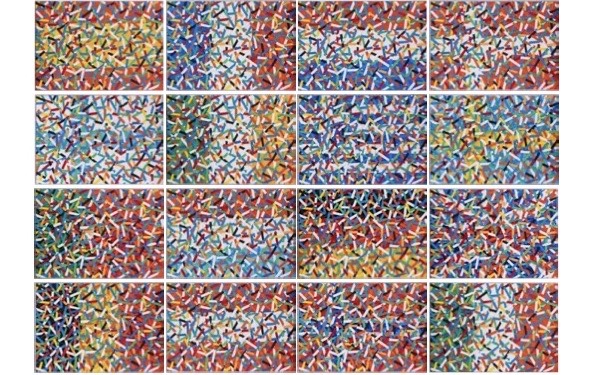
With Pierre Restany's enthusiasm for his work, Pavlos exhibited his first "Cut Posters" in 1964 alongside the Nouveaux Réalistes. These were made up of tight strips of paper, giving rise to the deployment of vibrant colored fields. Following a principle of presentation to which he will always remain faithful, Pavlos decides to enclose his works in Plexiglas boxes to protect them but also to make them function as a "showcase that separates the real and imaginary worlds. »
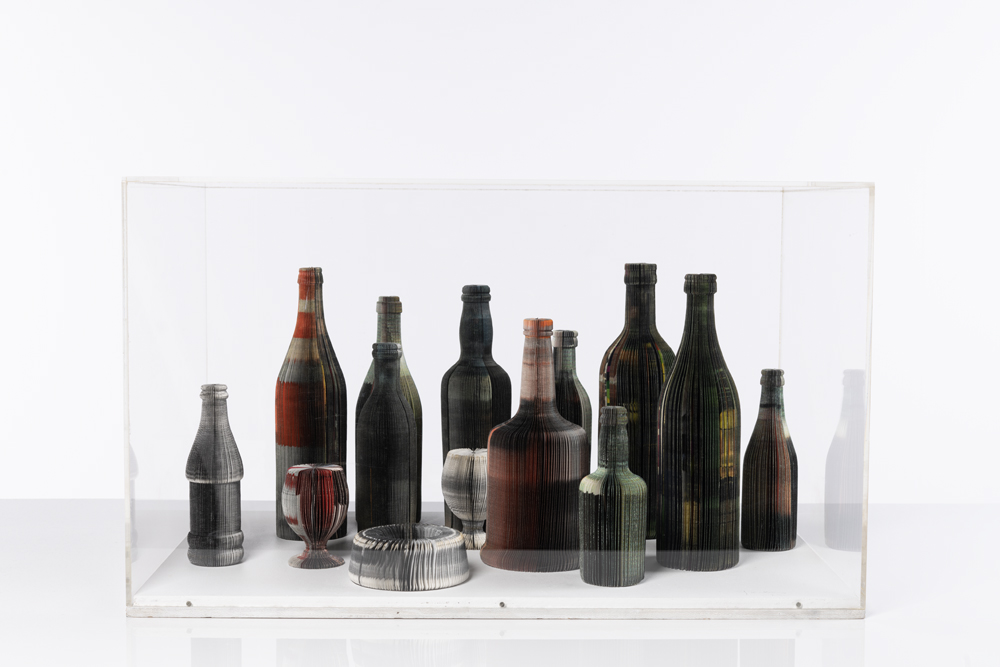
With the "Baroque" series initiated in 1965, Pavlos explores the rhythmic modulations and moiré effects that arise from the flexible articulation of paper. Once he masters this technique, the artist, seeking to "describe forms in relation to things around us", manipulates these strips of paper so that they take the shape of everyday objects, such as flowerpots, a glass of wine, a camera, an ashtray, a sandwich... Pavlos does not look for verisimilitude in representation, as Daniel Abadie has pointed out: "the only reality of these works, that of the poster paper, is diverted to replace its presentation by a representation and give rise to the creation of simulacra, metaphysical images in the strict sense of the word. »
Pavlos then indulged in a limitless inventory of daily life, gradually taking over everything that constitutes the framework of our existence, going so far as to reconstruct on a real scale "Tuxedo Changing Room", circa 1967, (lot 6), a "Shower" shower cubicle, 1967, (lot 3), chairs with jackets on their backs "Le Congrès", 1967, (lot 8) or a "Gas Station" petrol pump, 1967, (lot 11). In this poetization of the ordinary, man is curiously absent and his presence is only suggested through the object. As Pavlos explained, it is easier to apprehend a person by his clothes, a sort of "second skin," than by trying to make a portrait. Pierre Restany saw in "this presence of absence" a critique of the consumer society of which "man is both the producer and the victim of the object".
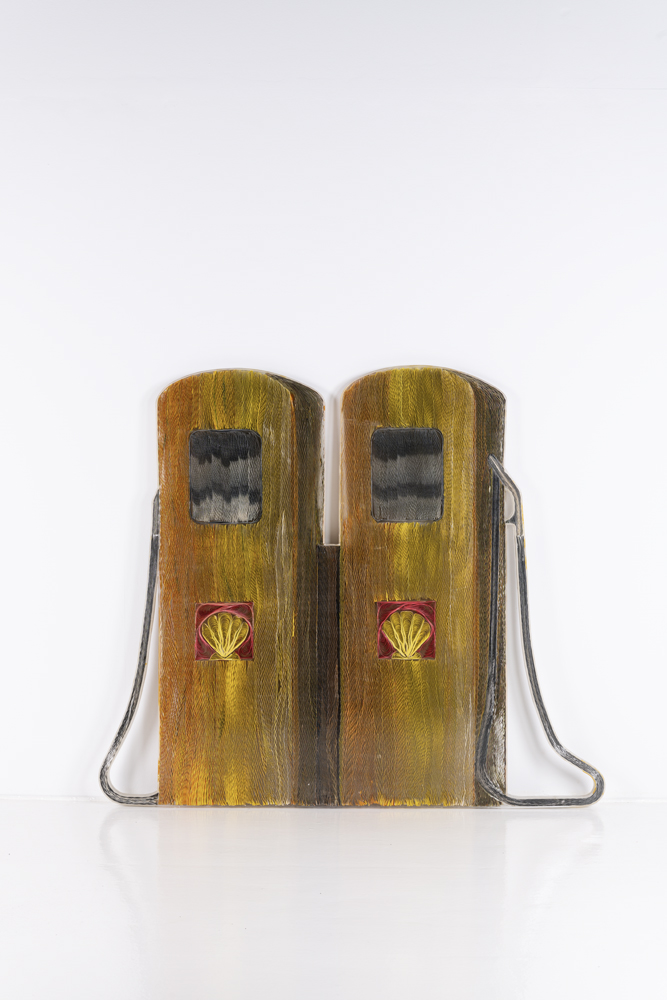
Pavlos (Pavlos Dionyssopoulos) (1930-2019)
Gas Station, 1967
Estimate: 40 000 / 60 000 €
Through his taste and his sublimation of ordinary objects, Pavlos is close to American Pop Art without, however, being fully related to it, as he himself explained: "I am also close to the boundaries of Pop Art because I sought movement with those strips of paper that were initially parallel, which led me to baroque forms that, without recalling nature, posed the question. Thus, I went from New Realism to a banal, advertising image that brought me close to Pop Art. This proximity to Pop Art ensured Pavlos' success on the other side of the Atlantic through the two exhibitions devoted to him in 1967, at the Fischbach Gallery in New York and then at Dayton's Gallery in Minneapolis.
In the same year, 1967, Pavlos creates a work that announces a new direction in his work "Curtains on frames", 1967, (lot 1). By presenting a frame on which curtains fall, this work once again raises the question of painting in his work. He convokes it indirectly as if to better affirm the possibility of painting without a brush. In this sense, the work has the value of a manifesto, just like the exhibition that took place in 1968 at the Sonnabend Gallery where he presented an environment consisting of "Four columns" of cut-out posters, going from floor to ceiling, and "Curtains" structuring the space "Curtains", circa 1967, (lot 2). Less than a tribute to ancient architecture, the column symbolizes for Pavlos "the essence of sculpture". Thus transforming the exhibition room into a unique work, it breaks the distance between the work and the spectator (not without creating the dismay of some uninitiated visitors).
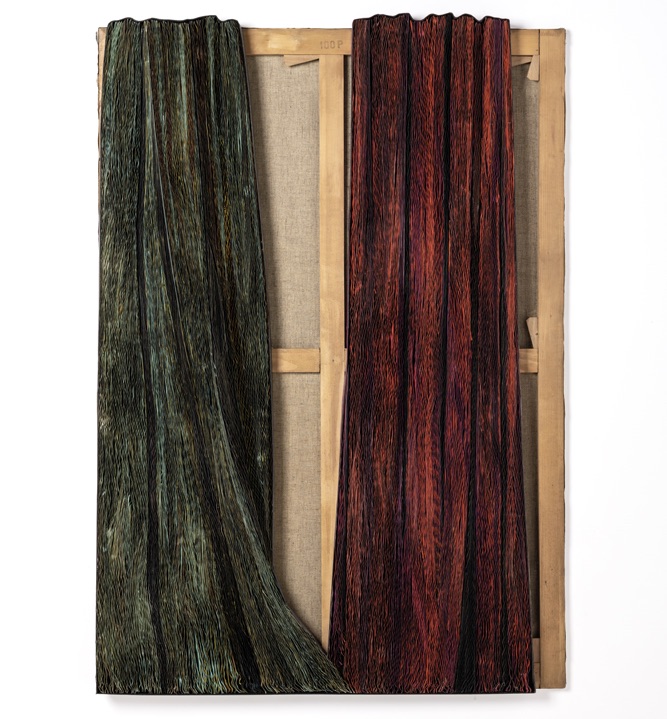
Pavlos (Pavlos Dionyssopoulos) (1930-2019)
'Rideaux sur châssis'
Estimate: 30 000 / 50 000 €
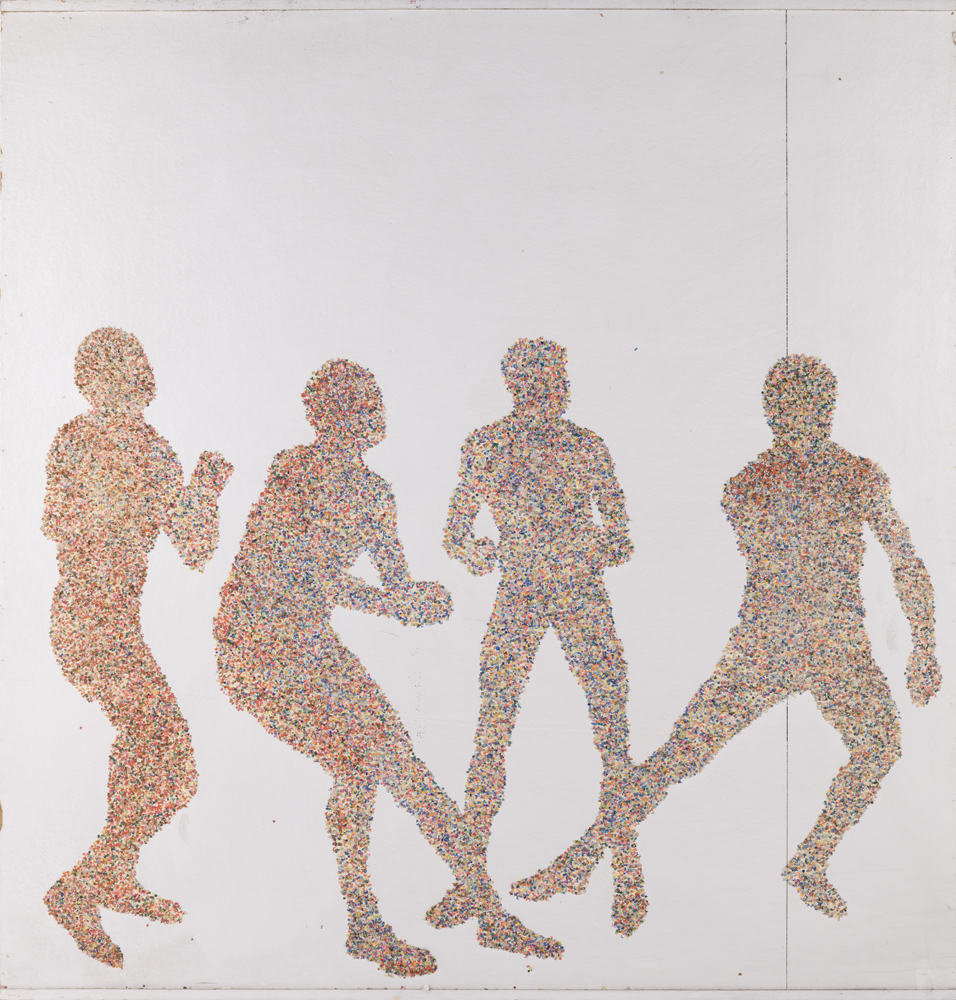
Following this desire to bring art and life together, a desire that is particularly dear to him, Pavlos creates happenings. The first took place at the port of Hydra in 1970, where he improvised as a shoe shiner, and the second was held in 1973 at the Folkwang Museum in Essen, where he conceived the giant happening "Basketball", of which all the works presented by Piasa, "The Appening Game of Basketball", circa 1974 (lots 23 and 24), are a souvenir today. The public was invited to throw confetti against the walls of the museum's exhibition rooms, which were left blank but where Pavlos had previously applied glue to define the outlines of the silhouettes. As they threw the confetti, the participants saw silhouettes of sportsmen and women appear, giving birth to a kind of large fresco animated by moving bodies. The final aspect of the work is not unrelated to Yves Klein's "Anthropometries", which Pavlos was familiar with. But while the two artists affirm through their performances the same desire to stand back, the speakers they have designated, the public of classic museum visitors for Pavlos, "brush women" for Klein, refer to very distinct participatory strategies. Pavlos will later produce other sporting happenings around soccer, on the occasion of the Football World Cup organized in France in 1998.
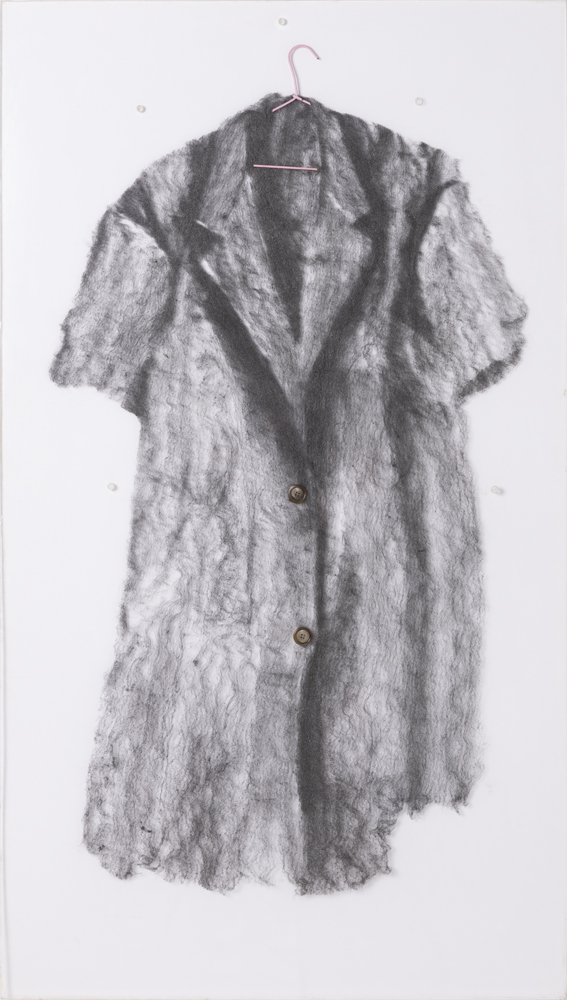
At beginning of the 1970s, Pavlos, tired of color, felt the need to change his technique, substituting the colorful paper of the posters with the shades of gray of the metal wadding (or steel wool) of which " Robe sur cintre avec boutons ", circa 1970, (lot 9) offers an example here. He exhibited the first works made from this surprising material at the Sonnabend Gallery in 1971, which included an advertisement by José Pierre: "Scrub your eyes out! / Put a JEX BUFFER / in your brain / in your PAVLOS, / you will have the / cleanest / artistic concepts in the world / ART that shines again / with all its brilliance / Leave the dirt to / those who feed on it. "The works made from steel wool, seeming to be executed in charcoal, have a ghostly aspect, very well described by the critic Gilbert Gatellier in Opus International: "The metal wadding (jex stamp) (is) transmuted into an alignment of suspended coats (rendered just a little ghostly by diaphanous parts) and into human shadows projected on a wall - or rather into a drawing shaded by these shadows, the second degree of artifice. Of a much less insistent physical presence, the new material authorizes this reverie on materiality, shadow, representation.
The still lifes to which Pavlos has been dedicated since 1972 inaugurate a new way of working with paper that will hold it in place for a long time. It is a technique based on the use of pleated paper, inspired by an ancient Chinese practice but also by the closer example of certain Christmas decorations. Pavlos starts from a folded sheet of paper that he then unfolds on a shelf around a central axis to create three-dimensional objects such as apples, apples, grapes, bottles, glasses, and ashtrays, "Still Life with Bottles and Glasses," 1972, (lot 16). Exhibited at Iolas in 1973, these works, Daniel Abadie analyses, "are the perpetual questioning of these relationships between reality and its image. Indeed, these paper sculptures, devoid of weight and of an evanescent materiality, while they get closer to the object, have a presence that seems totally virtual.
1980, Pavlos surprised once again by seizing an equally new material, the bolduc. He executed a series of large monochrome bolducs (greens, pinks, whites, blues, greys, browns, violets...), whose bright and shimmering colors radiate through the transparency of Plexiglas "Bolduc fuschia", 1980, (lot 18), "Bolduc marron", circa 1980, (lot 19). Like an alchemist, Pavlos gives this ordinary material "the fascinating splendor of the most sumptuous fabrics of the Orient" (Restany). That same year, in the Greek Pavilion of the Biennale, which was entirely dedicated to him, Pavlos presented these monochromes of bolduc alongside large columns resulting from the superimposition of multicolored bolducs.
Another highlight of this decade, in 1985, on the occasion of the creation of the European flag, Pavlos made Community Flags which he showed at the Pierides Museum in Athens (lot 27). The exhibition consists of a monumental hanging, where the exhibition hall is entirely paved with all the flags of the European countries.
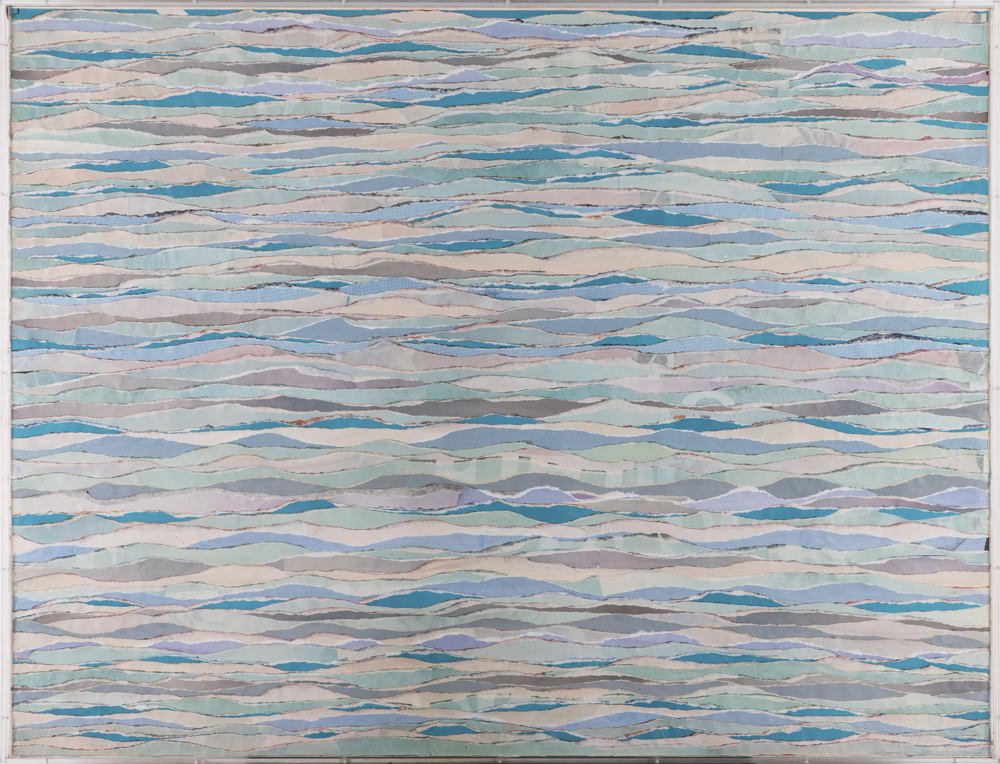
At the end of the 1980s, Pavlos became interested in the genre of landscape, making seascapes and fields. For these works, the artist uses the technique that seems most appropriate to him: paper cut into strips for the grass of the fields, and paper torn into a curved shape so that it visually evokes the lapping of the waves "Marine", 1987, (lot 20), "Marine", 1988, (lot 21). But here again, he thwarts any attempt at hasty classification through: "Myself, I am a movement in movement. I don't create, I have fun. I am only a naive thinker. The semblance is at the base of all my work, but beware, I only give here the idea of landscapes, only the idea of seascapes. I refuse figuration. "This statement gives a good account of the conceptual approach of the artist whose work, of great inventiveness and poetic force, has been able to question reality with magic and humor, by situating itself beyond the traditionally established artistic categories.
Pavlos (Pavlos Dionyssopoulos, dit) (1930-2019)
'Marine'
Estimate: 30 000 / 50 000€
-
1Written testimony of Pavlos in Pavlos, Chirossophos, Jannink Editions, Paris, 2006, p. 13.
2Pierre Restany, " Pavlos, l'espace temps de la couleur ", in Pavlos, Hellas, Biennale de Venise '80, Athens, 1980, p. 57.
3The artist states: "Things were simple: I had a head, I had hands, and I was trying to maintain a balance between the two. Let this relationship get out of balance, let something get jammed up and it doesn't work anymore. The activity of the hand is the condition of this balance. Testimony from Pavlos in Pavlos, Chirossophos, op. cit. p. 17
4Daniel Abadie, "Eléments biographiques et chronologie synoptique", in Pavlos : Papiers en fête, 1962-2003, cat. exp., Ville de Cannes, Images en manœuvres éditions, 2004, p. 55-56.
5Written testimony of Pavlos in Pavlos, Chirossophos, Jannink Editions, Paris, 2006, p. 37.
6Written testimony of Pavlos in Pavlos, Chirossophos, Jannink Editions, Paris, 2006
7Daniel Abadie, "Les pièges de l'apparence" in Pavlos, 30 ans de papier, cat. exp., Chapelle de la Sorbonne, 17 September-18 October 1992, éditions Lanoo, Gent, p. 11.
8Ibidem. p. 41
9Text by Pierre Restany, "Pavlos, l'espace temps de la couleur" written in April 1980 and published in the catalog of the exhibition of Pavlos at the Fiac, Guy Pieters Gallery, Paris, 1991, n.p.
10Testimony of Pavlos, in Pavlos, 30 years of paper, cat. exp. Chapelle de la Sorbonne, 17 September-18 October 1992, éditions Lanoo, Gent, p.p. 65
11Quoted by Daniel Abadie, "Eléments biographiques et chronologie synoptique", in Pavlos : Papiers en fête, 1962-2003, cat. exp., Ville de Cannes, Images en manœuvres éditions, 2004, p. 129.
12Daniel Abadie, "Les pièges de l'apparence" in Pavlos, 30 ans de papier, cat. exp., Chapelle de la Sorbonne, 17 September-18 October 1992, éditions Lanoo, Gent, p. 12.
13Pierre Restany, "Pavlos, l'espace temps de la couleur", in Pavlos, Hellas, Venice Biennale '80, Athens, 1980, p. 71.
14Témoignage de Pavlos in Pavlos, Editions Linda et Guy Pieters, Knokke, 2008, p. 13.
