As part of its next Modern and Contemporary Art Auction, on November 25th, 2020, PIASA is highlighting the the work of the Greek painter and sculptor Dionyssopoulos Pavlos through two of his works.
Bringing out the beauty of everyday objects that habit has gradually made invisible. This seems to be the ambition of Dionyssopoulos Pavlos. Born in 1930 in Filiatra, a small Greek fishing port stuck between the fields and the Adriatic Sea, Pavlos turned his back on architecture and, in the immediate post-war period, joined the Athens School of Fine Arts.
He frequented the capital's bookshops and discovered the works of Paul Klee and André Masson as well as the power of Pollockian expressivity. A scholarship from the French Embassy enables him to continue his studies in Paris. Between classes at the Académie de la Grande Chaumière, the young man visits galleries and museums with great assiduity.
The Paris in which he settled permanently in 1958 was in turmoil. It was the scene of Yves Klein's Vide, Arman's Plein, Jean Tinguely's consecration and the emergence of the New Realists. He met the sculptors Giacometti, César and Calder at the counters of Germanopratine cafés.
In a departure from his classical training, he moved away from painting and cut thin strips of newspaper and assembled them into an abstract composition. Guided by the plastic potential of paper, Pavlos developed a unique formal vocabulary.
"The first cut-out posters I saw in 1962 were part of the Parisian context of the time, that of the new realism of the objective investigation of reality, of the expressive adventure of the object."
Participating in the Salon des Réalités Nouvelles in 1963, Pavlos was spotted by the critic Pierre Restany, who offered him the opportunity to exhibit the following year on the fringes of the Venice Biennale. This meeting, the most important of his career according to the artist, opened new horizons for him.
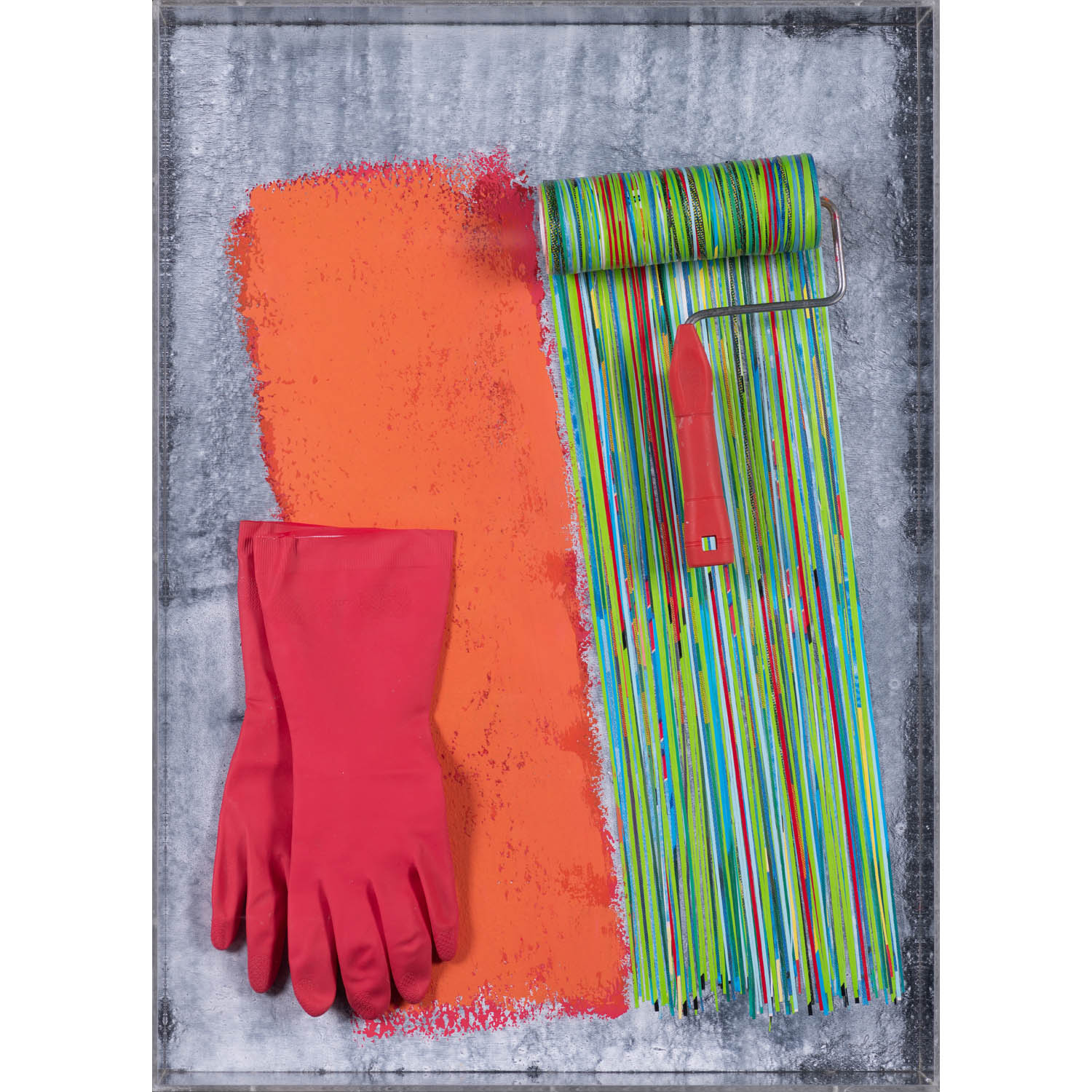
Pavlos (Pavlos Dionyssopoulos) (1930-2019)
Rouleaux, 1994
Estimate : 8000 / 12000 €
The feathers of a few critics gave a positive assessment of his work. His notoriety grew. His tapes, hitherto vertical, are animated by a baroque spirit and are modelled on the arabesques of Henri Matisse, one of his most solid references. Abstract compositions gradually gave way to an iconography composed of everyday objects, clothes and accessories.
The work "Tyres" sold by PIASA bears witness to Pavlos' plastic research. The artist disposes of forgotten everyday objects made only with thin slices of paper of different colours. The quasi-organic forms of this type of work attract the viewer's attention to inflect the relationship he has with a real, at the very least, strange rendering.
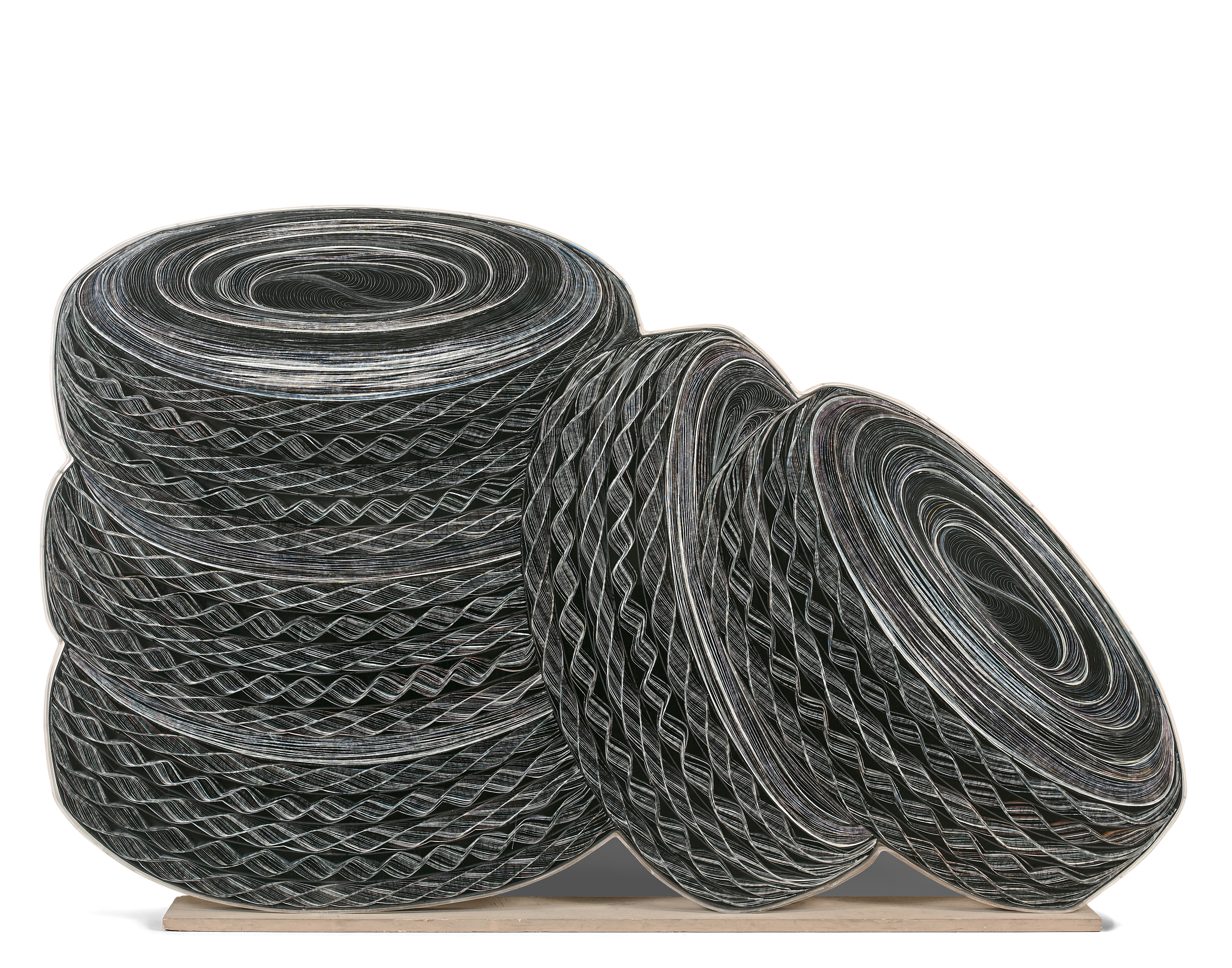
Pavlos (Pavlos Dionyssopoulos) (1930-2019)
Pneus, 2004
Estimate : 20000 / 30000 €
This play with everyday objects can be likened to the influence of American Pop Art on his career, and Pavlos' work met with some success when it was first shown in the United States at the Fischbach Gallery in New York in 1967. The early 1970s were marked by a series of paper installations, including a set of 26 trees (The Forest), presented as part of the artist's first retrospective in Hanover.
As a free electron, Pavlos was a master at bringing together art and life, the work and its audience. Contemporary of a culture that mummifies art, his ambition was to influence the viewer's gaze so that a new world could emerge from his consciousness.