As the world before it according to the theogony of the Greek poet Hesiod, it is in the most absolute chaos that the career of the German artist Otto Dix (1891-1969) began. It consists of the shapeless mud of the trenches, the shot of a gleaming artillery and, for the first time, sneaky clouds of chlorine and phosgene.
As a volunteer, the painter made his entry into a first world conflict which, like the invasion of Spain by the Napoleonic troops for Francisco Goya (1746-1826), constituted for him a repertory of images.
After resuming his pre-war training in Düsseldorf, started at the School of Applied Arts in Dresden, he joined the Neue Sachlichkeit (New Objectivity) where he met painters such as George Grosz (1893-1959) or Max Beckmann (1884-1950).
But painful memories of the battlefield continue to obsess his imagination until the early 30’s when, strongly influenced by the painting of the Renaissance, he directed Der Krieg (The War), a triptych now Exhibited in Dresden.
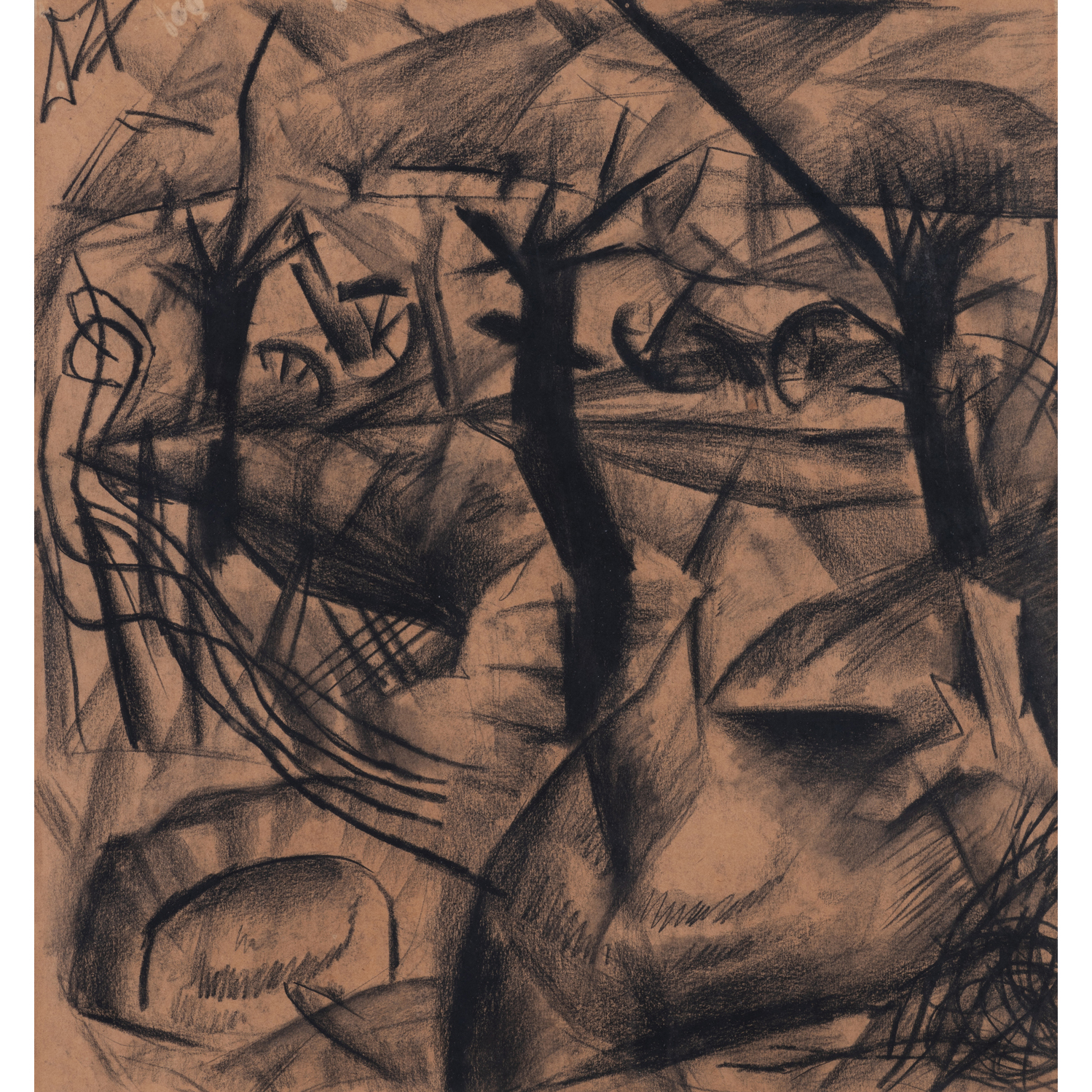 Otto Dix (1891-1969) Tümfel, 1916
Estimate : 20000 / 30000 €
The work proposed for sale was made by Otto Dix in 1916 while steel was still pouring rain on Europe. Like deep wounds, large blows of charcoal on the brown paper dramatize this landscape jagged by the violence of the fighting. Everything is upside down. Here, barbed wire, there, the wheels of a barrel put out of state of harm, elsewhere of sinister trunks recalling that the nature, like the humanity of the men, had withdrawn from this world of horror.
"To paint not to prevent it, but to ward off war", wrote Otto Dix in 1946, a year after the end of the Second, which had been in preparation since the Treaty of Versailles in 1919. Cursed, his generation will still germinate, from Munich to Berlin, from Dresden to Hamburg, one of the most dynamic artistic scenes in Europe.
Resigned from his post of professor of art at the university in 1933, savagely stamped "degenerate" in 1937, he continued, despite everything, to paint in Germany where he died in 1969.