On Tuesday, December 20, PIASA is organizing a sale titled Editions, featuring prints, illustrated books, and more.
In the history of art, Niki de Saint Phalle (1930-2002) is an exception. Few women artists enjoy such a level of recognition as she does. She made a name for herself and a destiny of her own thanks to her freedom of expression, the iconoclasm of her gestures, and the excessiveness of her projects. However, she has long been misunderstood, confined to her iconic Nanas, her fiery statements, and her ardent sense of finery. Her work is finally being reconsidered today in all its richness and complexity and its undeniable and unique contribution to a history of forms and gestures, measured against her commitment and attention to the troubles and struggles of her time.
Niki de Saint-Phalle was born in 1930 in Neuilly-sur-Seine. She is the second of five children born to Jeanne Jacqueline Harper and André Marie Fal de Saint Phalle, from a French banking family. As a result of the Wall Street crash, the family business struggled and the de Saint Phalles moved to the United States. From then on, Niki was educated in American schools while regularly spending her summers in France.
Her artistic vocation was revealed during a stay in a psychiatric hospital at the age of just 22 ; it was during this hospitalization that she discovered her vocation as a painter, and she decided to devote her life to it. From that moment on, Niki de Saint Phalle embarked on a frantic pictorial adventure. "Painting calmed the chaos that agitated my soul. It was a way of domesticating these dragons that have always arisen in my work. She had no choice, she says. "It was my destiny. [...] I embraced art as my deliverance and as a necessity." She has been creating ever since.
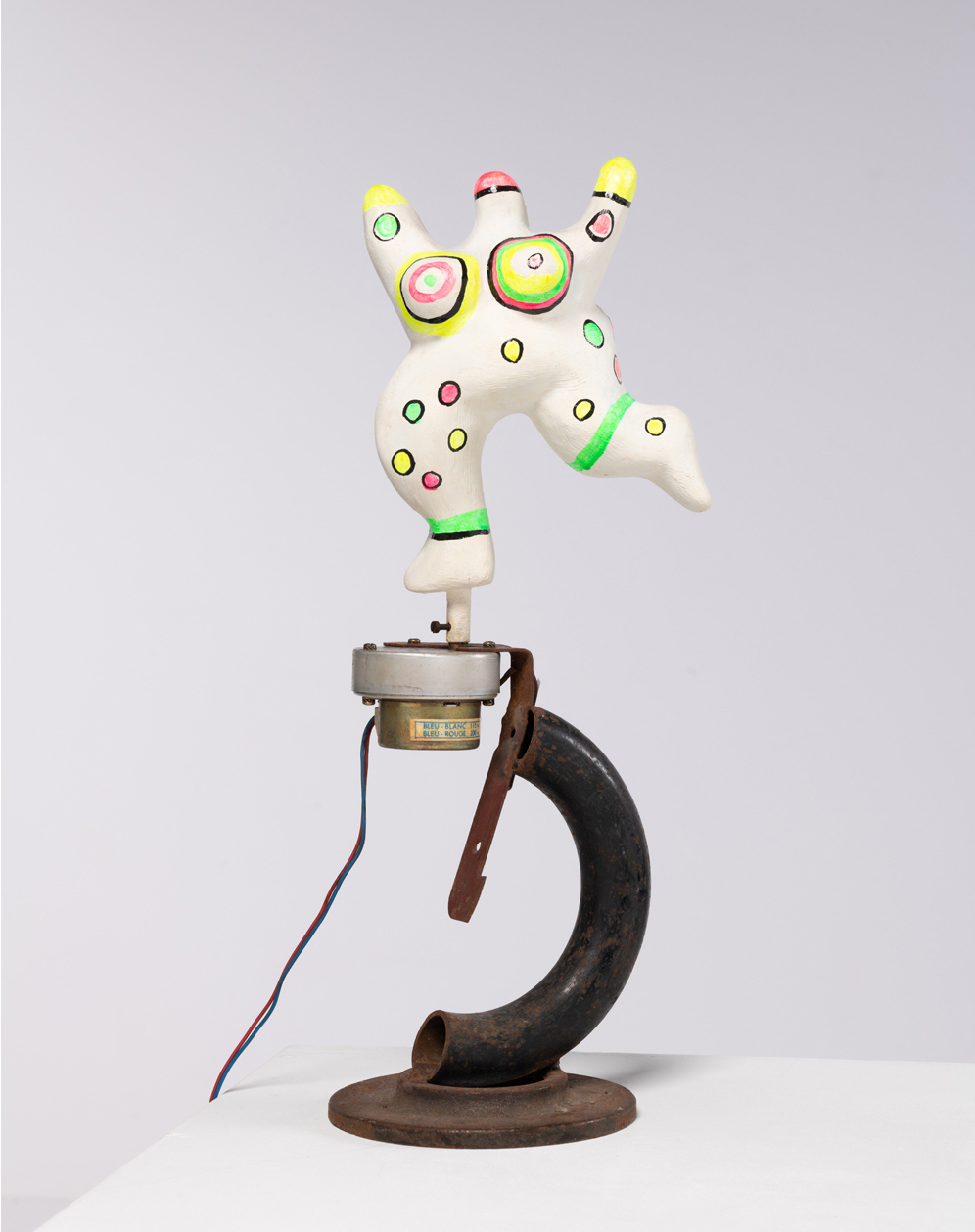
Niki de Saint Phalle and Jean Tinguely met in 1956 when she moved into the studio of the American artist Jim Metcalf, where Tinguely was sharing a studio with Eva Aeppli. Here, a great friendship and professional partnership was born. At that time, Saint Phalle was still living with Harry Mathews, and it was not until 1960 that she decided to settle down on her own permanently, leaving her husband and children behind. The relationship between her and Tinguely quickly became more than friendly, according to their correspondence. Between 1960 and the end of 1963 she shared Tinguely's studio, and they produced their first joint works: a series of small assemblages of wire and everyday objects that were more like experiments than finished works. Their collaboration continued, and in 1967 Saint Phalle and Tinguely went to Stockholm and began working on Hon. This was their first monumental collaborative work. Less than a year later, they repeated the experience for Expo 67 in Montreal, where they exhibited their Paradis Fantastique - a set of nine colored polyester resin sculptures made by Niki and six metal machines by Tinguely that interacted with each other - on the roof of the French Pavilion.
In July 1971, Niki de Saint Phalle and Jean Tinguely got married. Paradoxically, this union occurred at the same time as the two artists decided to separate as a couple. The main reason for their marriage was to entrust each other with the posthumous responsibility for their works. Despite their separation, the two artists remained inexorably linked; their artistic collaboration did not seem to suffer from this rupture. Indeed, several projects were born, such as the films "Un rêve plus long que la nuit" and "Le Jardin des Tarots", or even "La Fontaine Stravinsky" which was inaugurated in March 1984 in Paris.
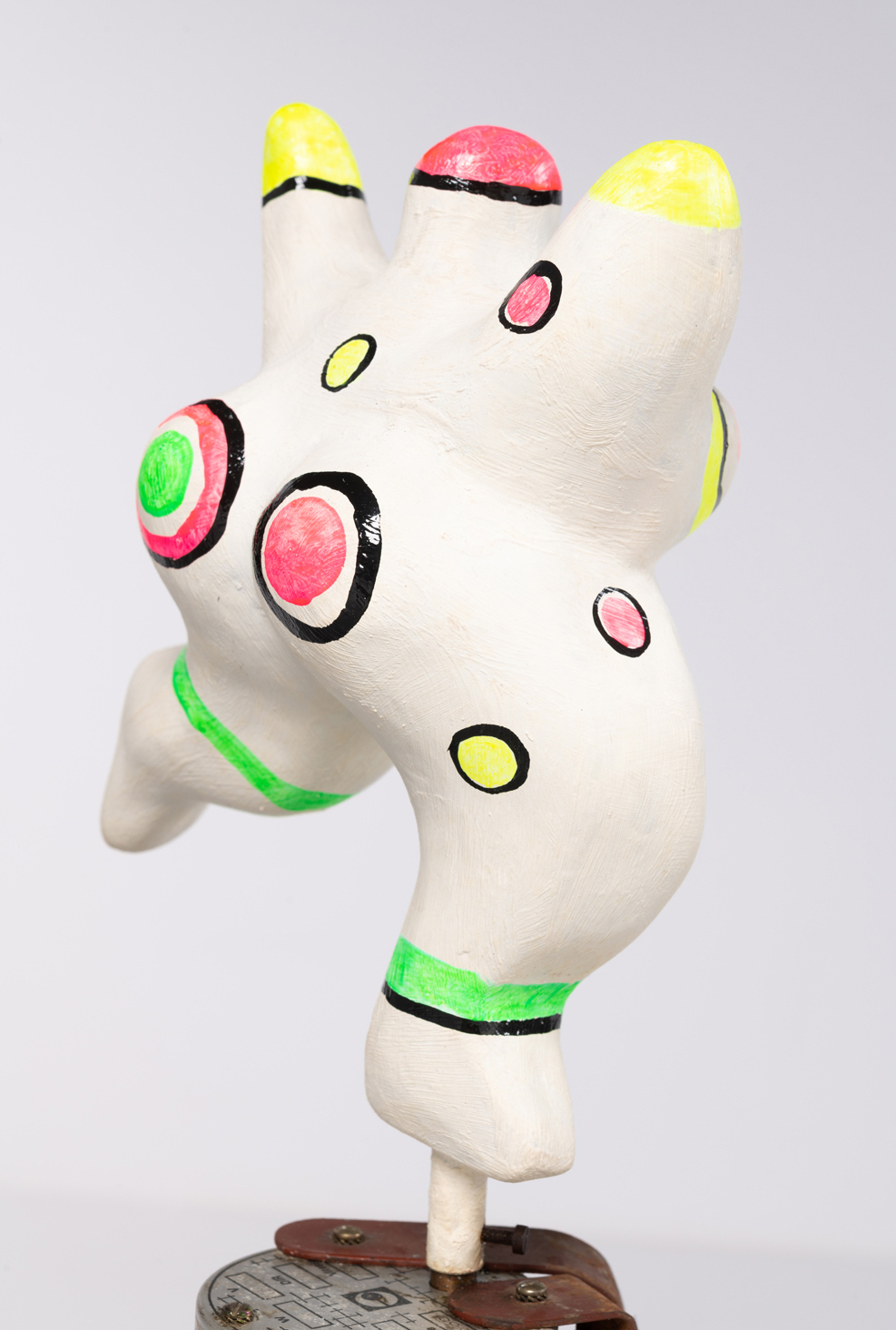
The death of Jean Tinguely in 1991 marked the end of Niki de Saint Phalle's collaboration with him. For many years, however, Saint Phalle worked to ensure that her partner's work would not be forgotten. In his honor, she created a series of mobile paintings entitled Méta-Tinguely (1991-1992) in which she mixed iconographic elements typical of Tinguely's art with her own. Shortly afterwards she created her Tableaux éclatés, which she regards as collaborative works, although they were created in Tinguely's absence. In a posthumous letter to him, she wrote: "Through my new works, Jean, we continue to collaborate. You are always present, even if these paintings do not look like you."
In 1996, the Museum Tinguely was opened in Basel, to which Niki donated 52 sculptures and numerous drawings, further perpetuating the bond between them.