The quality of the corpus constituted by the PIASA Editions department for its first session in 2020 highlights the diversity of the artistic scenes in Europe, Asia and the United States. If New York, after Rome and Paris, becomes the world capital of art, the artists who settled there in the post-war period inaugurated an extraordinary creative dynamism. Icon of this generation, Mark Rothko is represented in this sale of Thursday, March 12, 2020 by a carpet made in 1968, two years before its tragic end.
A visible excrescence of the mysticism that would influence the artist throughout his life, Mark Rothko's work is a remarkable alternative to the gestural painting that was very much in vogue in New York in the 1950s.
Long before he anglicized his real name "Marcus Rothkowitz" at the outbreak of the Second World War, the artist was born in 1903 on the western fringes of a Russian Empire on the verge of disappearing in the turmoil of history. He accompanies his sister and mother who join his father, who has been living in Portland, Oregon, for a few years, where he begins his studies at the prestigious Yale University. In New York, joined by Barnett Newman and Clyfford Still, Mark Rothko experiments with a painting technique that the critic Clement Greenberg will define as Colorfield Painting, literally "painting in fields of colour".
From the 50’s, thanks in particular to the purchases of the American collector Duncan Phillips, his career enjoyed its first successes. For Mark Rothko, as for Leonardo da Vinci several centuries before him, painting was resolutely a mental causa. While the strong attraction he felt for Henri Matisse's chromaticism led him to use flat tints on his canvases, his passion for the philosophy of Friedrich Nietzsche considerably refined his interest in Greco-Latin and Hebrew mythology. Free from mimetic concerns, the colour used by Rothko is destined to propagate itself in space by integrating, in fact, the spectator.
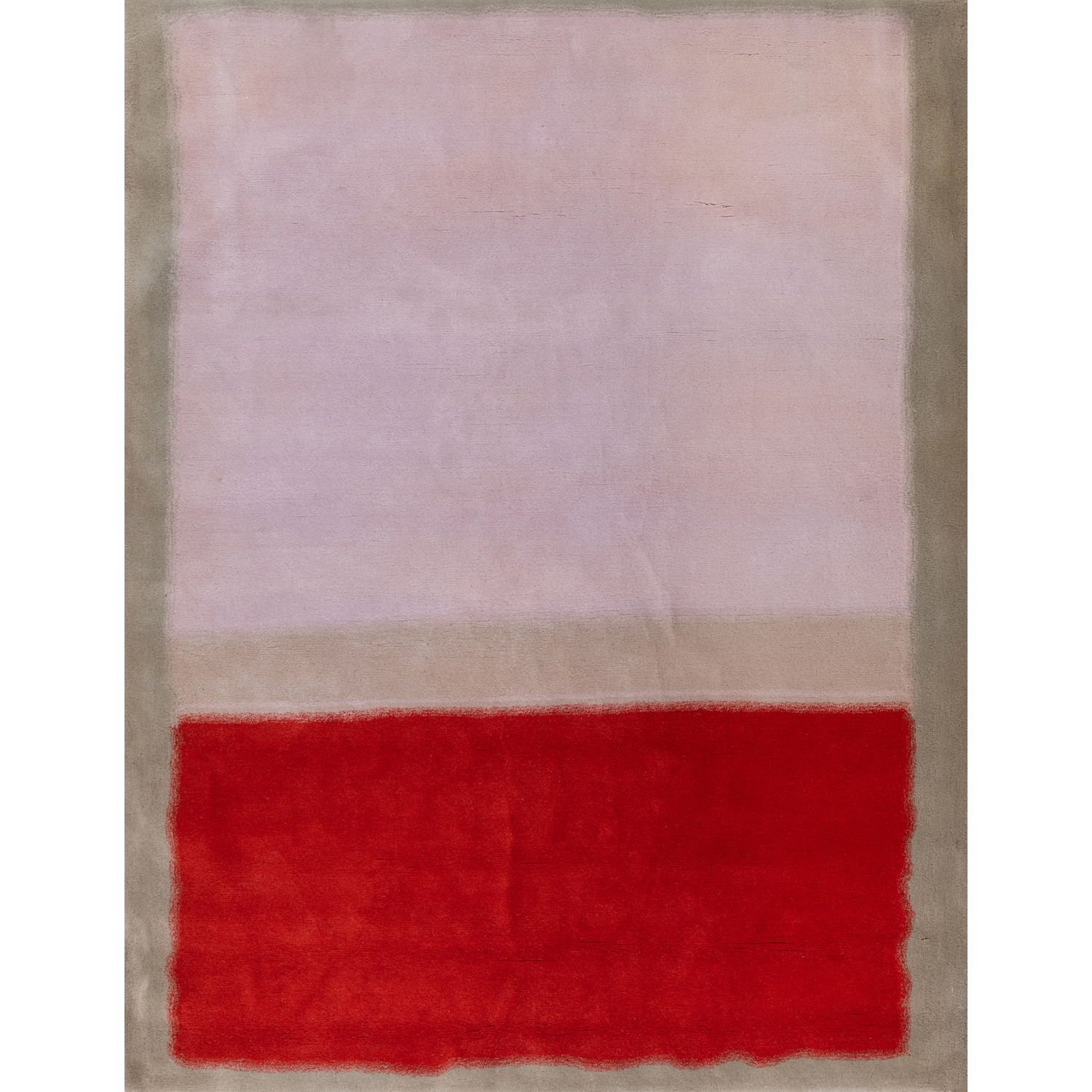
Mark Rothko (1903-1970)
Pink Over Red - circa 1968
Colored knotted wool carpet
One of 8 copies
Modern Tapestries Edition
(D): 249 x 198 cm
Estimation: 12 000 / 18 000 euros
Only eight copies of the woollen tapestry based on a work created by the artist in 1968 have been published. Its very imposing dimensions coincide with the artist's concern to offer visual experiences on a monumental scale.