


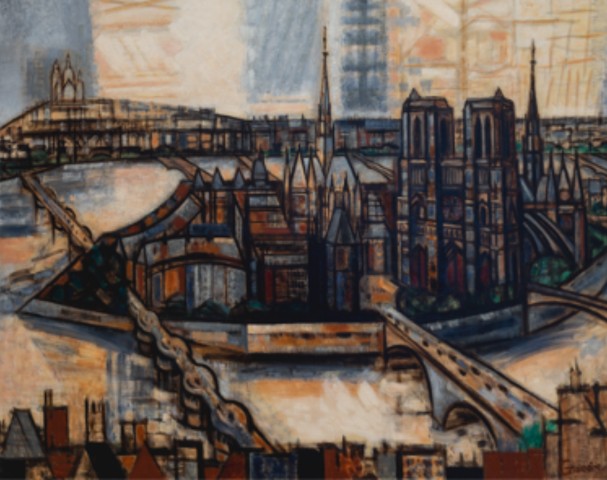
As part of the modern and contemporary art sale organised by PIASA on Thursday, July, 9, 2020, an important work by the painter Marcel Gromaire will be offered for sale.
Trained at the Free Academies of Montmartre, Marcel Gromaire very early on developed a figurative style to which he remained faithful throughout his career: forms reduced to the essential, sculptural and powerful, a chromatic range often limited to earthy colours, underlined by a powerful black ring. As early as the 1920s, Gromaire was successful, particularly with his paintings that refer to the painful episodes of the First World War for which he had fought.
Gromaire also benefits from the support of important collectors, such as Doctor Maurice Girardin, who will leave a legacy to the City of Paris (Municipal Museum of Art Modern) of a hundred of his works. Dating from the post-war years, Gromaire's series of Parisian canvases testify to a desire to return to the roots. Indeed, after spending some time in the United States (where he was named Carnegie Prize winner in 1952), the artist returned to Paris and painted many of the capital's high places, as shown in "Paris, la Cité". (1956) representing a view of Ile la Cité and more particularly the Cathedral Notre-Dame de la Cité.
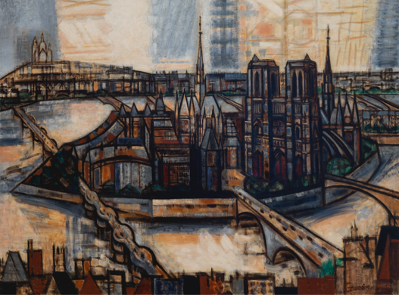
Marcel Gromaire (1892-1971)
Paris- la cité, 1956
Oil on canvas
Signed and dated on the bottom right
Countersigned, dated, titled and annotated on the reverse : "HDB"
Provenance :
- Galerie Louis Carré, Paris
- Private collection, Paris
Dame de Paris, while in the distance emerges the Sacred Heart. It is estimated at between 30 000 and 50 000 euros. The style of Gromaire perfectly marries the monumentality of Gothic art. Under his brush, the Cathedral is restored in all its grandeur: the artist has favoured a view of its façade, and in the background we can see the pointed arches and other elements of its architecture (spires, transept, rosettes...).
The whole gives rise to a powerful graphic game of lines, curves and counter-curves, to which the arches of the bridges that punctuate the whole composition with their powerful piers respond. The predominantly brown palette is enlivened, as is often the case in works of this period, by shades of blue and a few touches of green.
