For its first sale of the year in 2020, the PIASA Editions department is pleased to present a selection of pieces by some of the most emblematic artists of the 20th century, including Pablo Picasso, Marc Rothko and Marcel Duchamp.
No sooner had he obtained his baccalaureate than he left for Paris to meet his brother Gaston Émile Duchamp (better known under the pseudonym Jacques Villon). Marcel Duchamp, who was a selective student, attended classes at the Académie Julian for a year. In order to reduce the length of his military service, he passes his engraver's diploma and becomes an art worker. After a few publications and exhibitions of his drawings and caricatures, the young man presented his first paintings at the Salon d'automne in 1908, then at the Salon des indépendants the following year.
Marked by the spatial innovations proposed by the Cubists in France and the Futurists in Italy, but also by chronophotography, Marcel Duchamp creates the Nude descending a staircase. The work, a hinge, is nevertheless mocked during its presentation at the Armory Show in New York and at the Art Institute in Chicago. Research conducted at the Sainte-Geneviève library took him away from painting for a time. It is in this context that he invented the "Ready-mades" with Bicycle Wheel in 1913 and Bottle Holder the following year. Thanks to this staging of the banality of manufactured objects, Duchamp elevates them to the rank of works of art, even icons.
The break with artistic tradition is consummated. Shortly after the start of the First World War, the artist left to settle on the other side of the Atlantic. He then became friends with Man Ray, Arthur Cravan and Francis Picabia, with whom he founded an art magazine. The iconoclastic dimension of his work paved the way for the Dadaists, with whom he maintained relations, without ever fully adhering to them.
The Bride laid bare by his bachelors, even, a work created in New York between 1912 and 1923 is composed of two assembled glass panels, partly painted in oil, and including, among other things, lead inserts and dust. Exhibited at the Brooklyn Museum in 1926, the work is packed in a wooden crate for delivery to the person who bought it. When it was opened ten years later, the glass panels broke. The artist decided to keep the broken pieces and assemble the fragments into thicker glass plates.
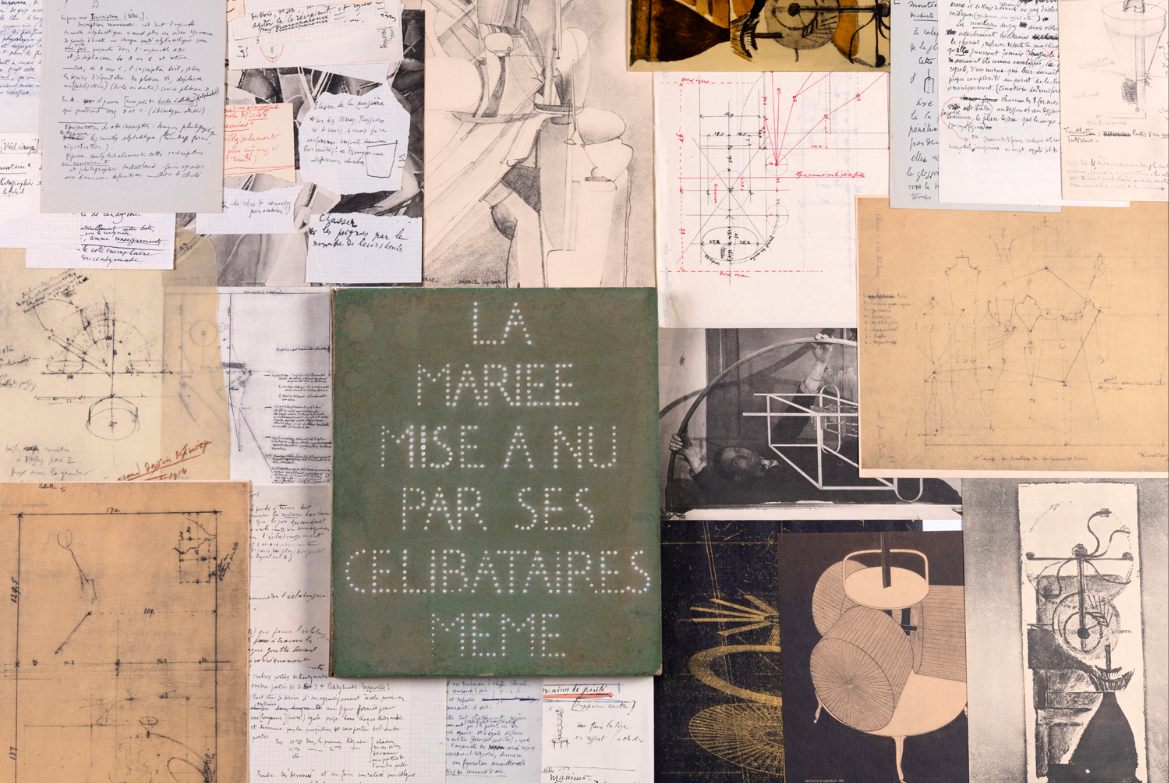
Marcel Duchamp (1887-1968)
La mariée mise à nu par ses célibataires même - Boite verte
Paris, Editions Rrose Selavy, 1934
Boite-coffret In4., recouvert de suédine verte, le premier plat titré en pointillés blancs au pochoir
Exemplaire complet de ses 94 reproductions en fac-similé et phototypie sur différents papiers, des années 1911 à 1915
Trois reproductions supplémentaires "Sculpture musicale", "Dans le pendu, famille et épanouissement", "Régime de la pesanteur" sont jointes.
Signé, daté et situé "Marcel Duchamp Paris 1934" par l'artiste au crayon rouge à l'intérieur de l'emboitage sur la tranche.
D'une édition à 320 exemplaires, 300 exemplaires numérotés + 20 Deluxe, celui-ci numéroté "257/300" au stylo rouge
(D) : 33,3 x 28,5 cm
Un certificat de l'Association Marcel Duchamp sera remis à l'acquéreur.
Estimation: 20 000 / 30 000 euros
Although the work is now kept at the Philadelphia Museum of Art, the 93 explanatory documents (notes, diagrams, drawings) were published in 1934 under the title Green Box. They form an integral part of the work. Published in 300 copies, the work is a complete reproduction of his notes written on scraps of paper, respecting the format, the coloured inks, the erasures and corrections. The man whom André Breton described as "the most intelligent man of the century" thus laid the foundations of conceptual art by elevating ideas to the level of their plastic manifestation.