On the occasion of its next Modern and Contemporary Art auction on Wednesday 25 November 2020, the PIASA auction house is offering collectors a collection of works of art by emblematic artists of the second half of the 20th century, including Kurt Schwitters.
Kurt Schwitters was born on June 20th, 1887 in Hanover into a family of merchants. In 1908, he began studying at the city's School of Applied Arts and later attended the Dresden Academy (1909-1914). Incorporated in 1914 and declared unfit for active service in 1917 after feigning imbecility, he was assigned as an industrial draughtsman in a metal factory near Hanover.
Kurt Schwitters, the Dadaist painter and poet from Hanover, famous for his collages, has himself recounted how, in the aftermath of the First World War, in a Germany in ruins but aspiring to social harmony, he sublimated scarcity and chaos: "I felt free and felt the need to shout my joy to the world. To do so, and for reasons of economy, I took what I could find. For the country was very impoverished. You can create with rubbish, and that's what I did by gluing them together, nailing them. I gave these objects the name of Merz, and it was my prayer to myself to celebrate the victorious end of the war, since victory, once again, was returning to peace. In any case, everything was destroyed and it was a matter of building something new out of rubble. That was Merz, for me it reflected the revolution. Not as it was, but as it should have been. "
All these waste materials were transformed under the hand of this artist into admirable compositions where colours and volumes mysteriously combined.
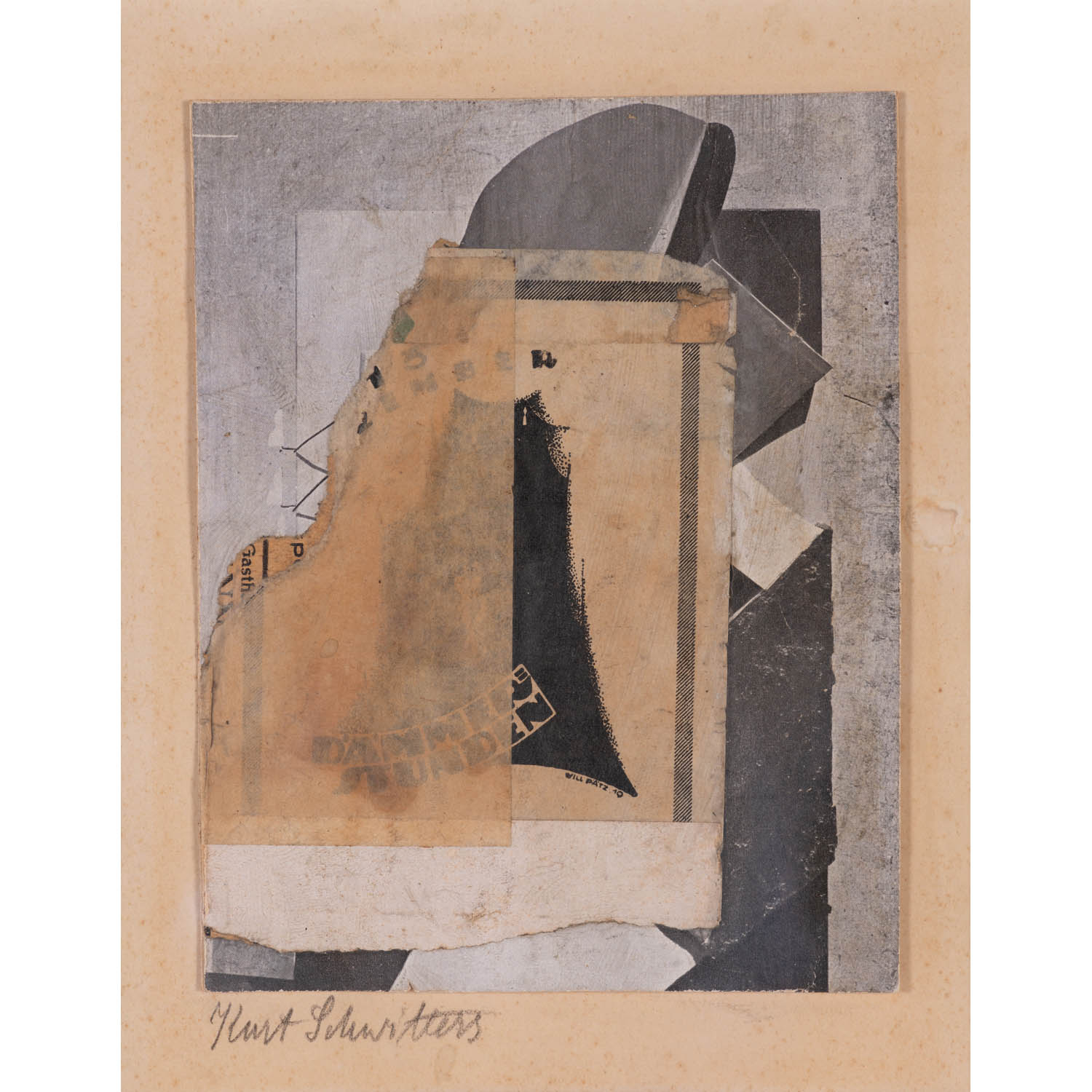
Our Schwitters collage, "Untitled" (Twilight Hours, circa 1925) is made up of many geometric paper fragments, arranged along vertical and slightly oblique axes. The materials chosen by Schwitters are pieces of raw paper and printed pages, whose triviality he transcends through his art of assemblage, favouring beige and grey harmonies and the play of tactile superposition and transparency.