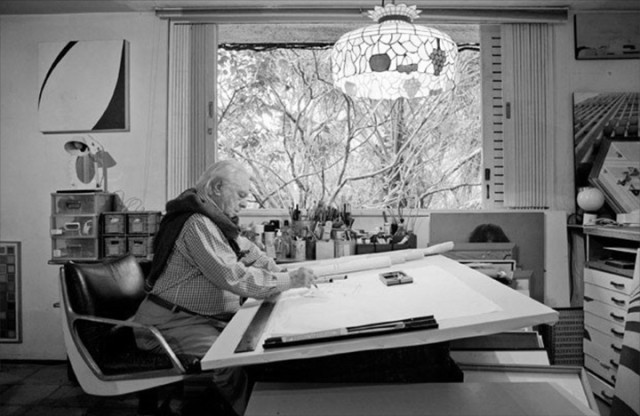
The Modulados Componíveis series created by Jorge Zalszupin occupies a special place today in the landscape of Brazilian design. Produced by L’Atelier Móveis, founded in 1959 in São Paulo by the Polish-born designer, the series aimed to meet a growing demand for functional furniture in a country rapidly modernizing, where administrative buildings, banks, and residential complexes were multiplying everywhere across the territory. For his creations, Jorge Zalszupin was inspired in particular by the Scandinavian “Cabinet Makers” — Hans Wegner, Børge Mogensen, Arne Vodder, and especially Poul Cadovius — who carried on a traditional artisanal approach while adapting it to the constraints of modernity.
The Modulados Componíveis were designed as a series of standardized modules — sideboards, bookcases, storage units, and room dividers — that could be freely combined. This modularity made it possible to create large-scale, custom-made arrangements while preserving the impeccable quality and finishes that characterized L’Atelier Móveis. The furniture was made using veneers of tropical woods such as imbuia or rosewood, which quickly became hallmarks of Brazilian furniture design.
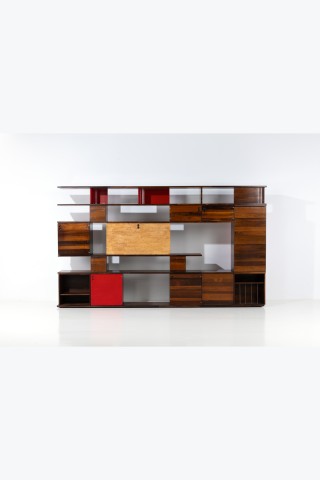
These pieces stand out for their simple lines, balanced proportions, and absence of ornamentation. This aesthetic neutrality had a clear purpose: to provide elegant, adaptable, and discreet furniture suitable for both offices and private homes. The double-sided bookcases (Important double-sided bookcase, laminated wood, cork, imbuia veneer, lacquered wood and metal, published by L’Atelier Móveis, around 1960, est. €25,000/35,000), as well as the sideboards (Sideboard, imbuia, published by L’Atelier Móveis, around 1960, est. €8,000/12,000) could, like Charlotte Perriand’s Bibliothèque Mexique, become lightweight partitions that structure space.
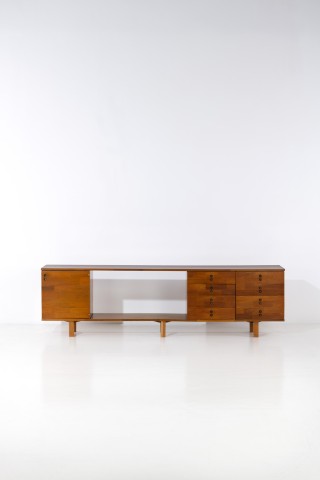
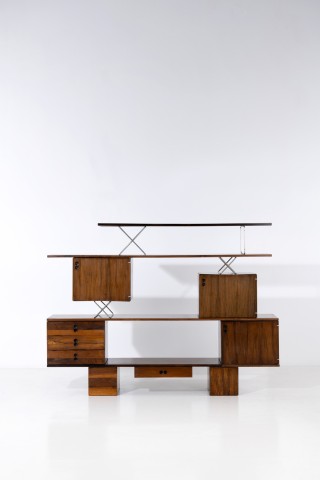
Today, the series appears as a successful attempt to democratize high-quality modernist design, reconciling streamlined production with meticulous attention to detail. Its influence has spread far beyond Brazil’s borders, inspiring numerous contemporary designers — from Italian Luca Nichetto to Japanese Oki Sato (of studio Nendo), as well as the French designers Ronan and Erwan Bouroullec.