


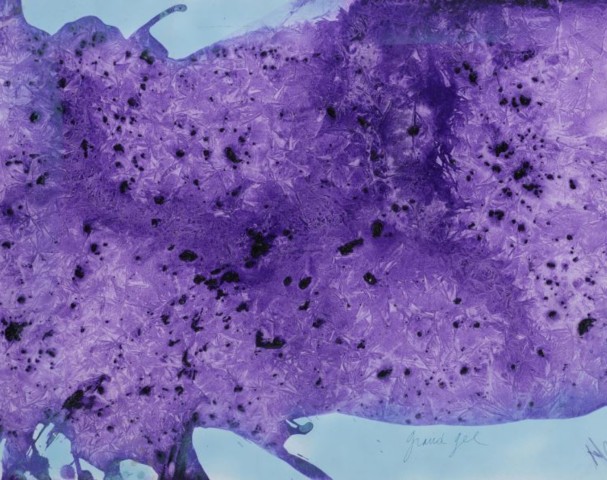
After attending the School of Decorative Arts, the French painter Jean Messagier travels to Italy and Algeria where he discovers the liberating power of light. His style asserted itself in the 1950s, when he abandoned the conventions of representation (perspective, proportions) to create large formats, traversed by broad colourful rhythms and whose main object became light. Messagier, who now belonged to the New School of Paris, regularly exhibited alongside other lyrical abstracts such as Raoul Ubac, Arnal, Degottex, Bram Van Velde, Fautrier and James Guitet.

Jean Messagier (1920-1999)
Grand gel, circa 1980
3000 / 5000 €
In the works of the 1960s and 1970s, Messagier traverses the canvas with broad brush strokes, creating effects of whirlpools and transparent interlacing that express the artist's desire for communion with nature. From the mid-1960s onwards, both the title and the signature appear in the lower part of the canvas: their large writing echoes the gesturality of the paintings, bringing a touch of humour or poetry that opens up a new imaginary.
Seeking to capture the world in all its richness, Messagier, during the 1970s, will multiply his pictorial experiences, making art and life interpenetrate with ardour and exuberance. One such example is the series of absurd paintings including radishes and fried eggs. Messagier also conducts experiments that bring him closer to land art when he tramples on his canvases or prints traces of frost on them (lot 30). As Michel Faucher wrote in 1985, Messagier "poet of everything that moves, explorer of the futile (...), reinvents life, nature. A wizard of the world, he mixes the forces of life, not painting. »