


As part of the Modern and Contemporary Art auction organized by PIASA on Thursday, June 3, 2021, the auction house is offering collectors a beautiful piece by French painter Hervé Télémaque.
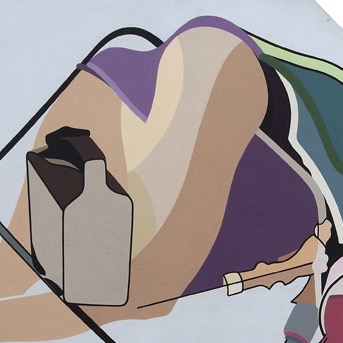
Born in 1937 in Haiti, Hervé Télémaque, after studying at the Art Student League in New York, moved to Paris in 1961. He frequented the Surrealists and then developed a plastic language close to Pop art and Figuration Narrative, of which he became a major representative. In the works of this period, Telemaque assembles characters from the world of comics and Walt Disney's cartoon, various consumer objects (women's underwear, household utensils), through an icy layout with bright colors. The climate of these works, mixing scathing humor and poetry, is quite personal to him. In 1968, Télémaque's taste for assembly and relief encouraged him to incorporate objects directly onto the canvas, giving rise to compositions that he would later use in his paintings. Made nearly ten years later, our painting, Corde à objet; pour un clavecin (1979), is made under the plastic and iconographic sign of the horse saddle. This functional object, which had held Télémaque's attention for a short year, inspired him to create works with surprising visual and semantic associations. In our painting, the saddle, occupying the right part of the composition, is put in relation with a series of elements, without apparent link, and some of which resist any attempt of identification: one detects here an ear pierced with a safety pin, there a fragment of female body to the allusive pose, but also a weight, a reversed seal from which spills a liquid, a diagram of uterus and other fragments of objects more difficult to decipher.
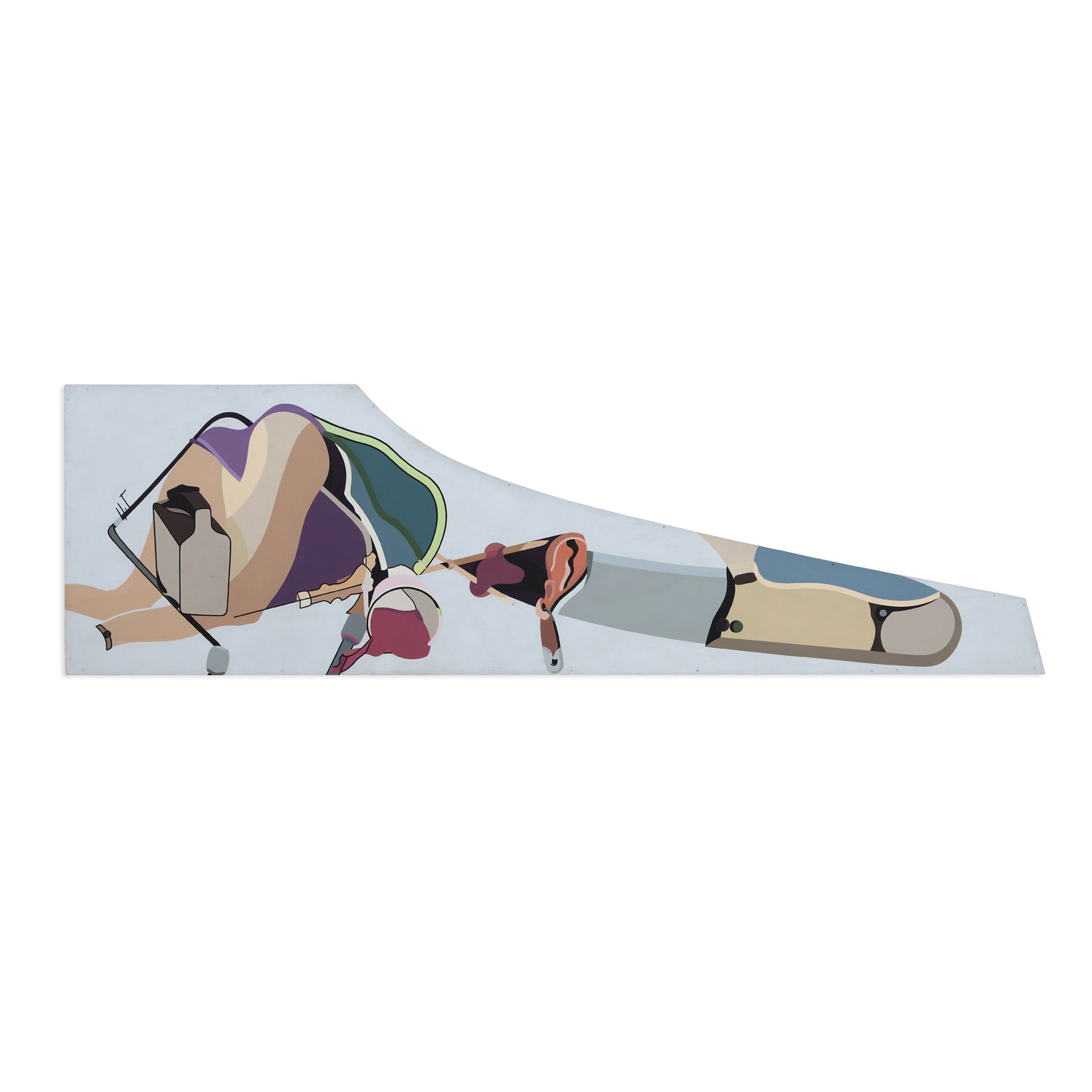
Herve Telemaque (born in 1937)
Corde a objands; pour un clavecin, 1979
Estimate : 40 000 - 60 000 €
The overall composition, taken in a general abstract form that resumes the cut of a harpsichord lid, echoes the elliptical shape of the saddle in the fluid and flexible distribution of its components. It is organized in such a way as to create a feeling of strong plastic tension between two antagonistic poles, the saddle on the one hand, and the female body on the other, opposed in their distribution in the plane which leaves an important part to the void. Corde à objet; pour un clavecin (1979), by these connections of incongruous objects, referring to the idea of possession, evoke encounters of a particular kind about which the artist, while cultivating a certain taste for ambiguity, provided some tracks of interpretations: "the saddles interest me because at the bottom it is the same thing as the briefs, the sheaths that I painted for a long time, it is a condensation of the sex. It is an envelope that is inverted, the saddle envelops the horse. In voodoo, the word horse is very important because the voodoo gods ride the possessed; it came to me from this Creole term: it is said that the Loâ rides the practitioner. "Telemaque fetishizes the saddle by giving it an emotional, sexual and religious charge. Corde à objet; pour un clavecin (1979) illustrates perfectly the way in which Télémaque's thought is articulated, by mixing plastic imperatives, mental speculations, unconscious and poetic imaginary.
Télémaque's work is now internationally recognized. In 2015, the Centre Pompidou (Paris) paid tribute to him through a remarkable retrospective. In 2018, the Museum of Modern Art in New York acquired a historic painting by the artist: Untitled (The Ugly American) from 1964. Finally, Télémaque will soon benefit from two monographic exhibitions, one in the fall of 2021 at the Serpentine Gallery in London curated by Hans-Ulrich Obrist (entitled Free, September 2021) and the other in Miami at the ICA (Institute of Contemporary Art), at the end of 2022.
