


Painter, draftsman but also sculptor and photographer, Hans Bellmer was a leading figure of Surrealism. Born in 1902 in Germany, Hans Bellmer began working in a steelworks, then in a coal mine.
In 1923, he entered the Technical University of Berlin. It was at this time that he developed a keen interest in political and intellectual life, in Marxist ideas and in the Dada movement, whose members he frequented. He then met the painters Rudolf Schlichter and George Grosz. Following the advice of the latter, he abandoned his engineering studies to train as a typographer at the Malik-Verlag publishing house.
There he produced a large number of book covers and illustrations. In 1925, he travelled to Paris for the first time before opening an advertising studio in Berlin. In a turbulent political environment, he left in 1933. One year after the Nazi regime came to power, the artist started to make his Dolls. From 1937, his work is qualified as "degenerate art". A fetish object, placed at the heart of a transgressive work, the life-size Hans Bellmer Doll is a symbol of bodily integrity and sexual identity. Beyond categories, neither object nor sculptor, she is an icon of hybridity.
This omnipresent figure in Hans Bellmer's work reflects the importance of automatons and robots in a society devastated after the armistice of 1918. In addition to the genuine prism of political commitment, the work is "disturbingly strange, mixing the impulse of desire and the death drive, marvellous and cruel, everyday life and implausibility", as Brigitte Leal points out in the Centre Pompidou catalogue.
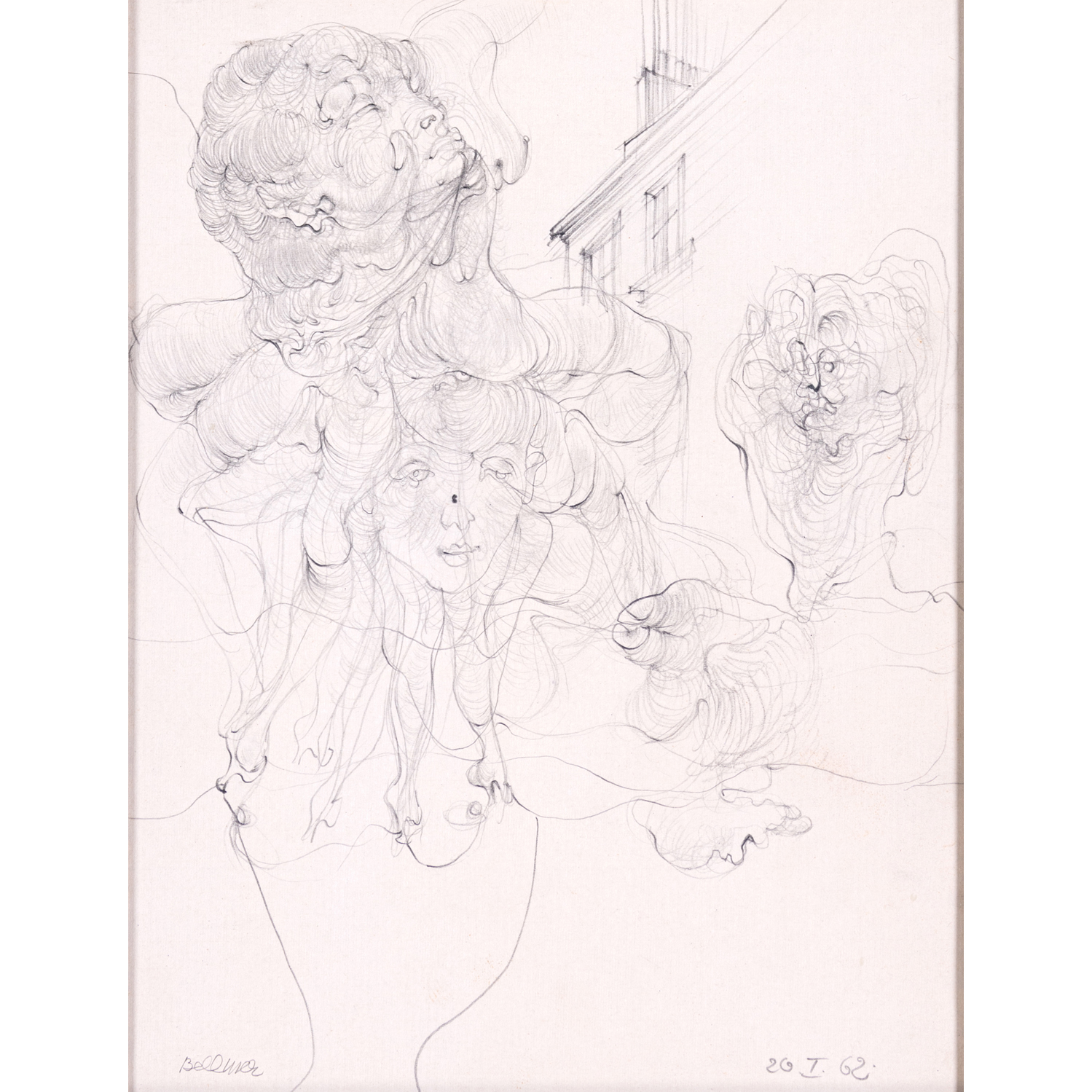
Hans Bellmer (1902-1975)
Têtes, 20. I 62
Crayon sur papier
The photos taken by Hans Bellmer are reproduced in the Minotaur magazine in 1935 with the title Poupée (Doll). Variations on the montage of an articulated minor, then the following year in Cahiers d'art. He settles in Paris in 1938 and participates in the Parisian surrealist exhibitions. But at the beginning of the Second World War, as a German citizen, is arrested.
He is imprisoned at the Milles en Provence camp with Max Ernst, Ferdinand Springer and Wols. He will later go underground. Attracted by literature and the humanities, he will become an assiduous reader of the Marquis de Sade to the point of creating illustrations with Cécile Reims in 1967.