As part of the sale devoted to Modern and Contemporary African Art on Wednesday, June,24, 2020, PIASA, in partnership with the South African auction house Aspire Auction, is proposing to collectors a rare work by the painter Gerard Sekoto.
Born in 1913 at the Lutheran Mission of Botshabelo in South Africa, Gerard Sekoto, son of a missionary, graduated as a teacher in Pietersburg. He taught for almost four years. After winning a prize in an art competition organized by Fort Hare University, the young man, then 29 years old, decided to devote himself exclusively to his career as an artist and moved to Johannesburg in 1938.
The following year his work was the subject of a first exhibition and the Johannesburg Art Gallery bought one of his works. He then became the first black artist to enter a museum collection in South Africa. Gerard Sekoto's early works rarely appear on the market. Created before he left for Paris in 1947, they are much sought after by collectors who appreciate their importance.
Barbara Lindop, a friend of the artist and author of numerous publications on his work, spoke of her amazement at "the humanity of his pre-exile paintings, free of sentimentality, faithful to the truth and with a poignant realism to reveal the heroism of ordinary human life". In 1938, Sekoto moved to Sophiatown, Johannesburg's legendary black cultural centre, celebrated by Miriam Makeba as "the songbird of Africa".
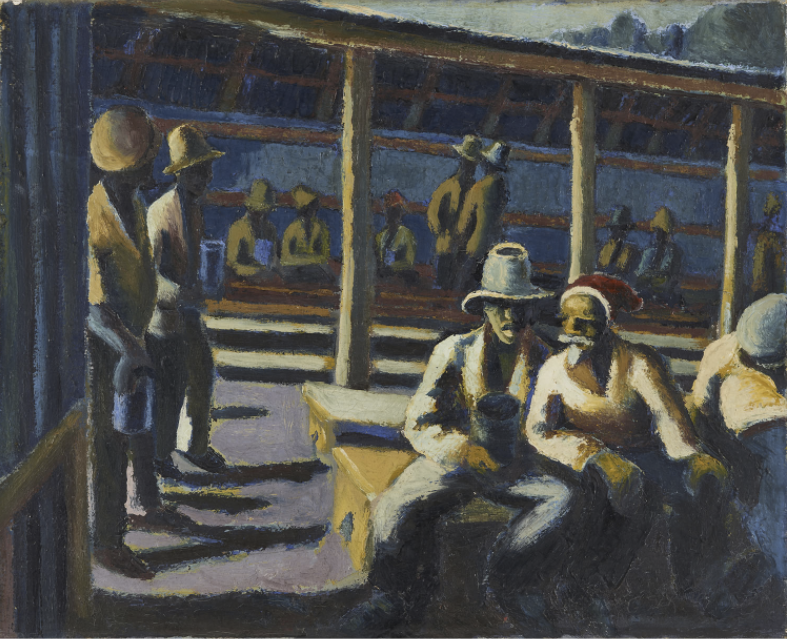
ƒ Gerard Sekoto (1913-1993, Afrique du Sud)
In the beer hall, 1939/40
Oil on canvas
Signed bottom right
41 x 51 cm
Provenance : Acquired from the Gainsborough Gallery in 1939/40, and thence by descent.
Exhibition : Gainsborough Gallery, Johannesburg.
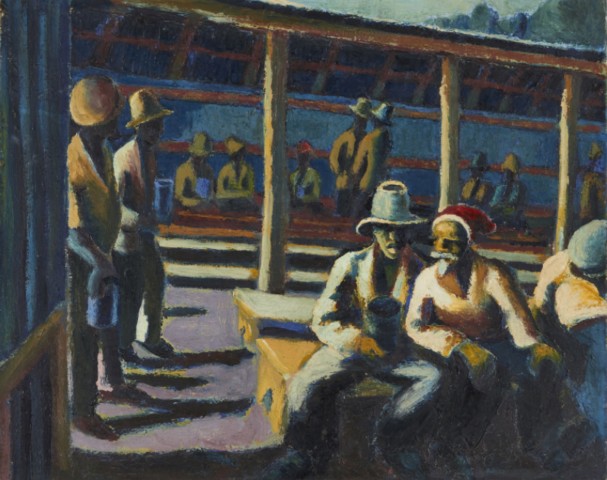
In the painting "In the beer hall" presented during this session on Wednesday 24 June 2020, we find men gathered at the end of the day to drink a beer while the slowly setting sun casts its long shadows. Sekoto's painting is one of the first representations of black people painted with empathy by a black artist.
Sekoto depicts his fellow men with sensitivity and warmth. The tonal variations of the primary colours create a syncopated rhythm while the warm and bright light emphasizes the camaraderie between men.