The Lasi pogrom, perpetrated in 1941 by Romania, shatters the artist's father and pushes his family on the roads of exile. Through the Balkan mountains they took them to Switzerland. It was in Zurich that Daniel Isaak Feinstein, as he was called before the war, was taken in by his maternal uncle, the literature professor Theophil Spoerri (1980-1974).
At the dance school of the Zurich Opera House, then with the dancer Olga Preobrajenska (1871-1962), it is at the confluence of dance, mime and theatre that the young Daniel Spoerri spend his first years.
Shortly after his installation in Paris in 1959, he created the "MAT" editions (Multiplication of Transformable Art) and organized his first exhibition at the Edouard Gallery. The idea was to produce originals editions of kinetic objects that encouraged the spectator's intervention. Multiplied up to a hundred copies, they were numbered and signed by the artist.
Among the artists who contributed to it were Marcel Duchamp, Jean Tinguely, whom Daniel Spoerri met in Basel in 1949, but also Victor Vasarely, Hans Arp and Christo.
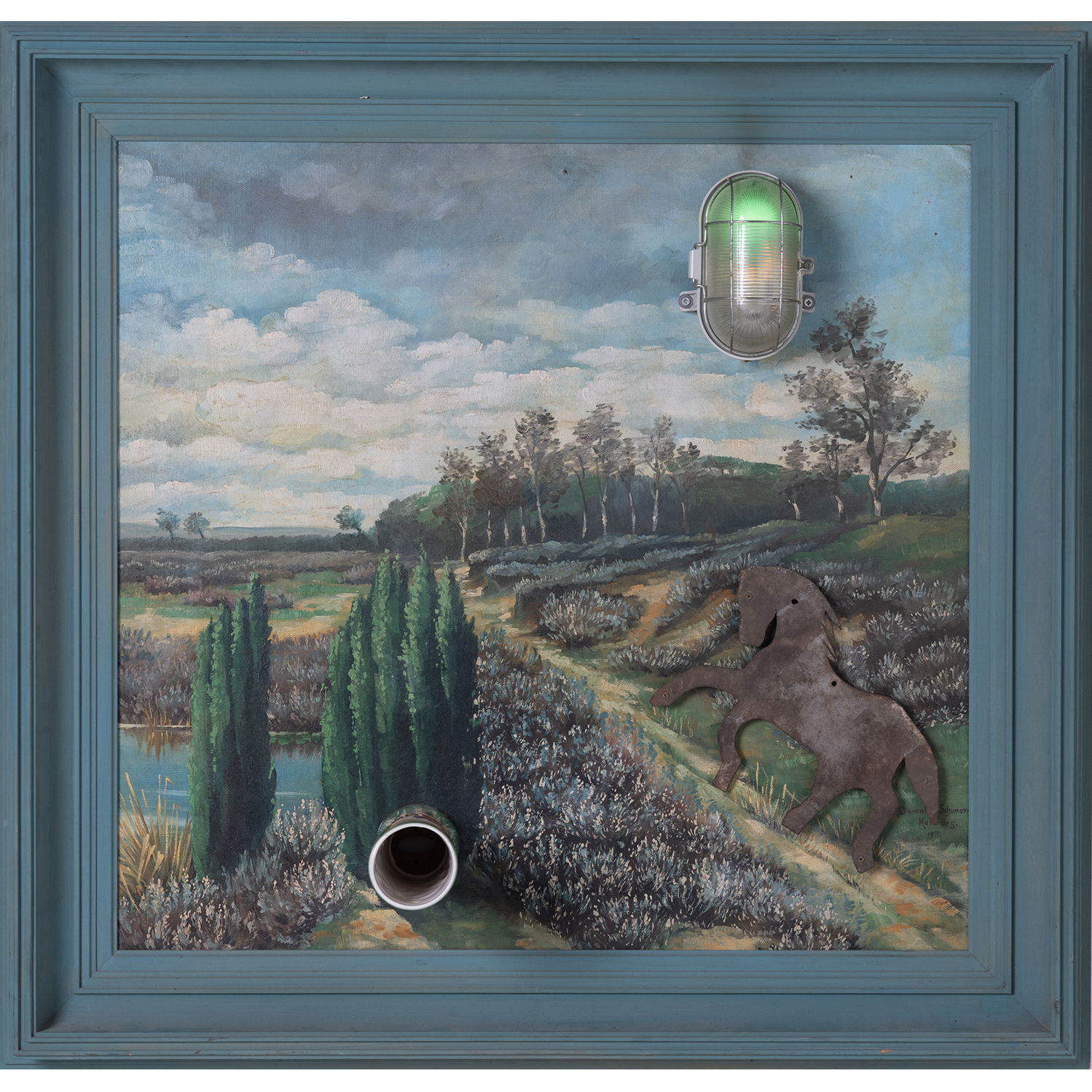
Daniel Spoerri (né en 1930) Détrompe l'œil, le cheval évadé, 1986
Estimate : 25000 / 35000 €
In 1960, he invented his first " trap-painting " where the passage between horizontality and verticality gave objects of everyday an unusual presence. This work led him to join the group of New Realists at its founding in 1960.
From 1963, in an attempt to transfigure the banality of a reality that the viewer no longer manages to look at as he should, he creates what he calls "the wrinkle-eye". In these heterogeneous assemblies, the artist integrates everyday objects.
From the Greek Island of Symi in 1967 to Montcel Park in Jouy-en-Josas in 1987 with artists such as César, Arman, Pierre Soulages and Jean-Pierre Raynaud, Daniel Spoerri multiplied the artistic performances.
Dated 1986, "Détrompe l'œil, le cheval évadé " is emblematic of the work of the artist. On a painted canvas mounted on a wooden panel depicting a country landscape a lamp and the silhouette of a horse were glued. The juxtaposition between the feigned depth of the painting and the exacerbation of the surface creates a disturbance in the viewer's eye and questions the
limits of the notion of creativity.