As part of the "Daniel Varenne II Collection" session on Wednesday 28th October 2020, PIASA is presenting a collection of works of art by artists from the second half of the 20th century, including two pieces by the most emblematic couple in French Contemporary Art.
Christo is the artistic name claimed by Christo Vladimiroff Javacheff, born on 13 June 1935 in Gabrovoen Bulgaria, and Jeanne-Claude is that of Jeanne-Claude Denat de Guillebon, born the same day in Casablanca, Morocco. He is the embodiment of a desire for artistic collaboration that refuses to put the ego forward and goes beyond the traditionally accepted categories, since their works include sculpture, drawing, photography and architecture, and the artists work in fields that are as much a matter of urban planning, ecology and politics.
Christo made a name for himself on the artistic scene when he arrived in Paris in 1958 and produced his first "Empaquages et Objets embalqués" (Packaging and Packaged Objects), which led to his inclusion in the group of the Nouveaux Réalistes by Pierre Restany. Christo's first monumental projects date back to 1961, when he made a stacking of barrels and packagings in the docks of the port of Cologne. In 1962, he erected a wall of petrol barrels in Rue Visconti in Paris, entitled Iron Curtain, as a protest against the building of the Berlin Wall the previous year.

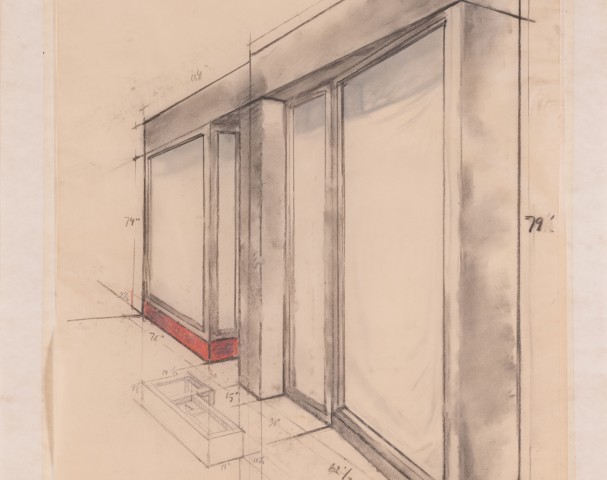
When Christo and Jeanne-Claude moved permanently to New York in 1964, they developed the "Store Fronts" series, initiated in 1961. The starting point for these works was a first set of store fronts made in 1963 from real glass cases to which electric light had been added and whose inner sides had been covered with paper, paint or fabric in order to conceal the interior.
The "Store Fronts" series consists of life-size storefronts directly inspired by the architecture of New York and for which diagrams, photomontages or models have been made beforehand. The series will retain Christo for four years, ending with the exhibition of his largest piece of the genre, a "Corridor Front", at the 4th Documenta in Kassel in 1968. Christo's choice of showcases evolves from an old style to a more contemporary one, with a desire for deliberately neutral fronts, with stiff and strict lines and limited colours, the particularity of which is to have none at all.
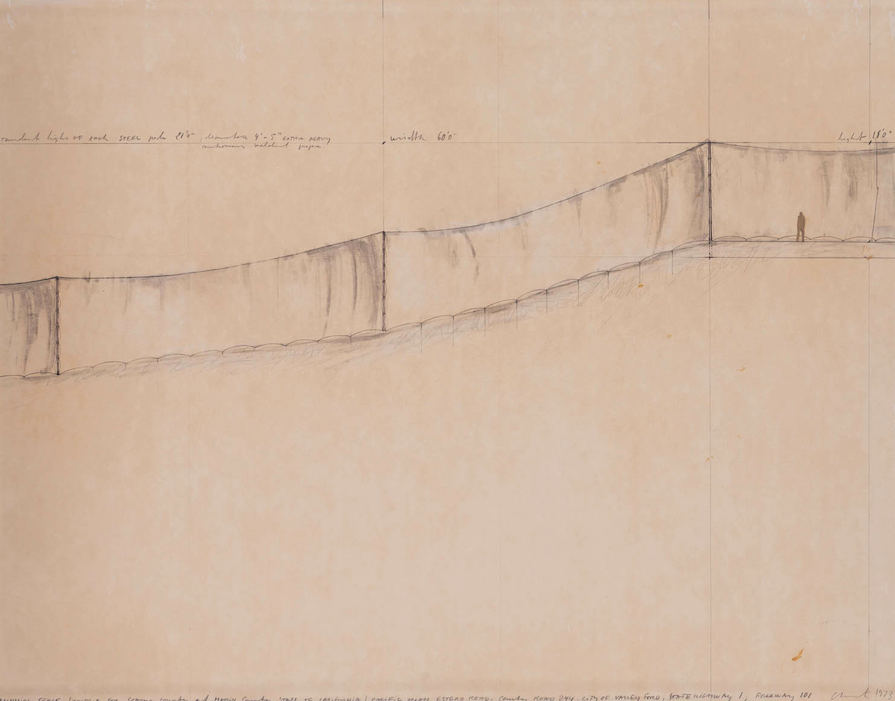
These fronts, made of wood and Plexiglas but also galvanised metal and aluminium, mark a decisive turning point in the evolution of Christo's work. They prefigure the work to come by the use of industrial materials and also by the use of the veiling process aimed at arousing the viewer's curiosity and desire to see. As in his later architectural works, the particularity of the "Store Front" lies in the paradox of their masking, their underlying and mysterious presence.