


PIASA auction House has the privilege of organising the auction of the furniture and art collection of the property of Aïda Aznavour and Georges Garvarentz on December 4th, 2020. This sale (246 lots) takes a new look at a family history through significant testimonials of Charles Aznavour's career, such as his Steinway piano, or his collaborations with his brother-in-law Georges Garvarentz, as evidenced by the scores and musical manuscripts put up for sale.
World-famous singer, composer and actor Charles Aznavour has worked with some of the greatest artists of the 20th century over the course of his very long career. These encounters contributed to his cultural and artistic training.
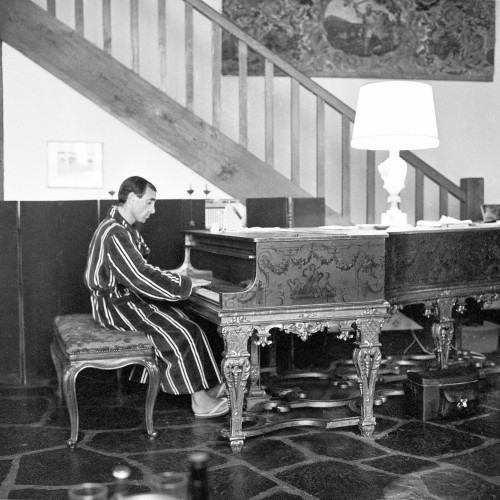
"The most important variety singer of the 20th century" according to the Times magazine, and also a great art lover, one can imagine the special place occupied by this piano in his property in Montfort l'Amaury, as shown in the photo by Roger Kasparian.

In an article published in Paris Match on February 3, 1962, Charles Aznavour wrote about this piano: "...for him, its luxury is the Steinway of its beginnings". Both a working instrument and a work of art, this piano accompanied Charles Aznavour during his creative process.
The history of Steinway began in 1797 with Heinrich Engelhard Steinweg in Wolfshagen in the Harz. Initially a violin maker, Steinweg made his first piano in 1835, but after the revolution of 1848, business became more difficult and he decided to cross the Atlantic with his sons. The American family then changed its name to Steinway and founded the firm Steinway & Sons in Manhattan in 1853. In 1880, a European factory was opened in Hamburg. The exceptional tunings made possible by the invention of the one-piece cast iron frame and the novelty of the string crossing ensured the firm's popularity with artists and amateurs all over the world.
As early as 1857, Steinway opens an art case department which allows the decoration of pianos to be entrusted to renowned artists who are inspired by the decorations of old pianos. These creations became the symbol of a fashionable society in Europe and the United States and were presented at international exhibitions.
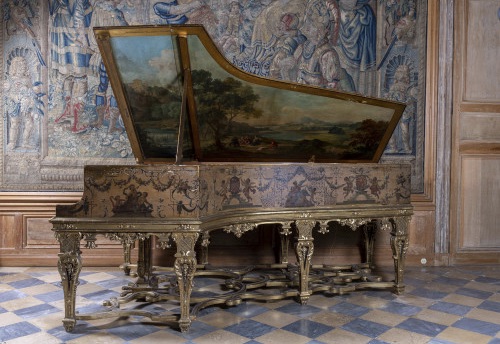
The piano presented here takes up this tradition with its exceptional decoration, received as a copy of the harpsichord by Ioannes Rückers (1578-1642), now preserved in Versailles. A similarly decorated Steinway & Sons piano can be found in the American Cathedral in Paris. It is named after the American composer Cole Porter, who lived in Paris between 1917 and 1920.
