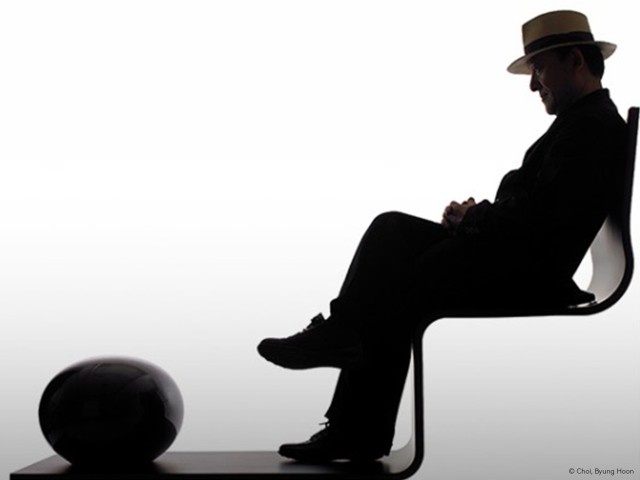
Through the breadth of his work, Byung Hoon Choi positions his practice at the crossroads of design, art, and spirituality. In March 2025, during the Voice of Silence exhibition at the New York–based Friedman Benda gallery, the Korean artist reflects on his relationship with silence and contemplation—essential foundations of his aesthetic.
“The materials I use […] each have their own history and their own energy. My process consists in finding harmony within their contrasts and celebrating the quiet beauty that emerges from these natural forms.”
The Afterimage 01-111 coffee table (€18,000 / €25,000) embodies this balance between the hardness of basalt, the luminosity of maple, and the softness of the adze-carved tabletop.
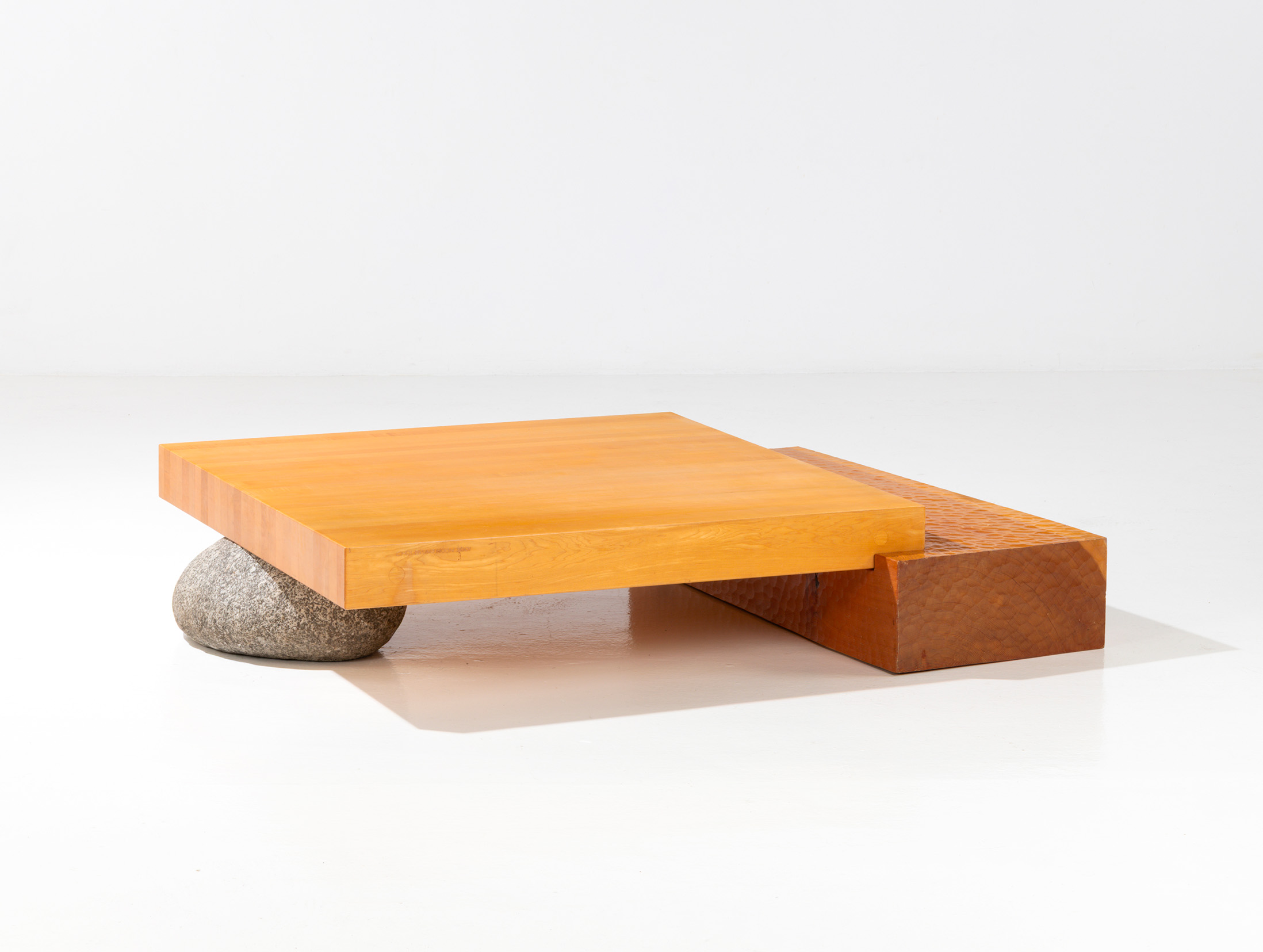 Side view of lot 15 © Piasa, 2026
Byung Hoon Choi’s work is not limited to the creation of objects. The designer describes his pieces as “meditative objects of introspection,” emphasizing the intention that guides each creation. This commitment to a form of meditation is evident in the chosen materials and the tensions they generate: “glacier blue” basalt and the warmth of wood, natural roughness and polished surfaces. This dialectic is not a mere aesthetic exercise, but a dialogue between opposing forces in which harmony is born from tension.
Contrasts lie at the heart of his research: the raw and the refined, untouched matter and the hand of man, silence and memory—pairings that structure a deeply contemplative aesthetic. Basalt, perceived as “a persistent afterimage of origins,” refers to a conception of time and matter that transcends the object’s purely functional use. The stone carries within it an indelible trace of the world’s beginnings. Here, the coffee table invites contemplation by offering a space of calm within a world saturated with noise and speed.
Finally, forms and cultural references are chosen with great care. Elements placed on stone plinths evoke the ethics of the scholar-gentlemen of the Joseon dynasty (1392–1910), and the Korean tradition of simplicity, humility, and connection to nature. These pieces of furniture are neither purely functional objects nor sculptures: they become sensitive spaces offering a singular experience, where objects act as interfaces between matter, memory, and our inner world.
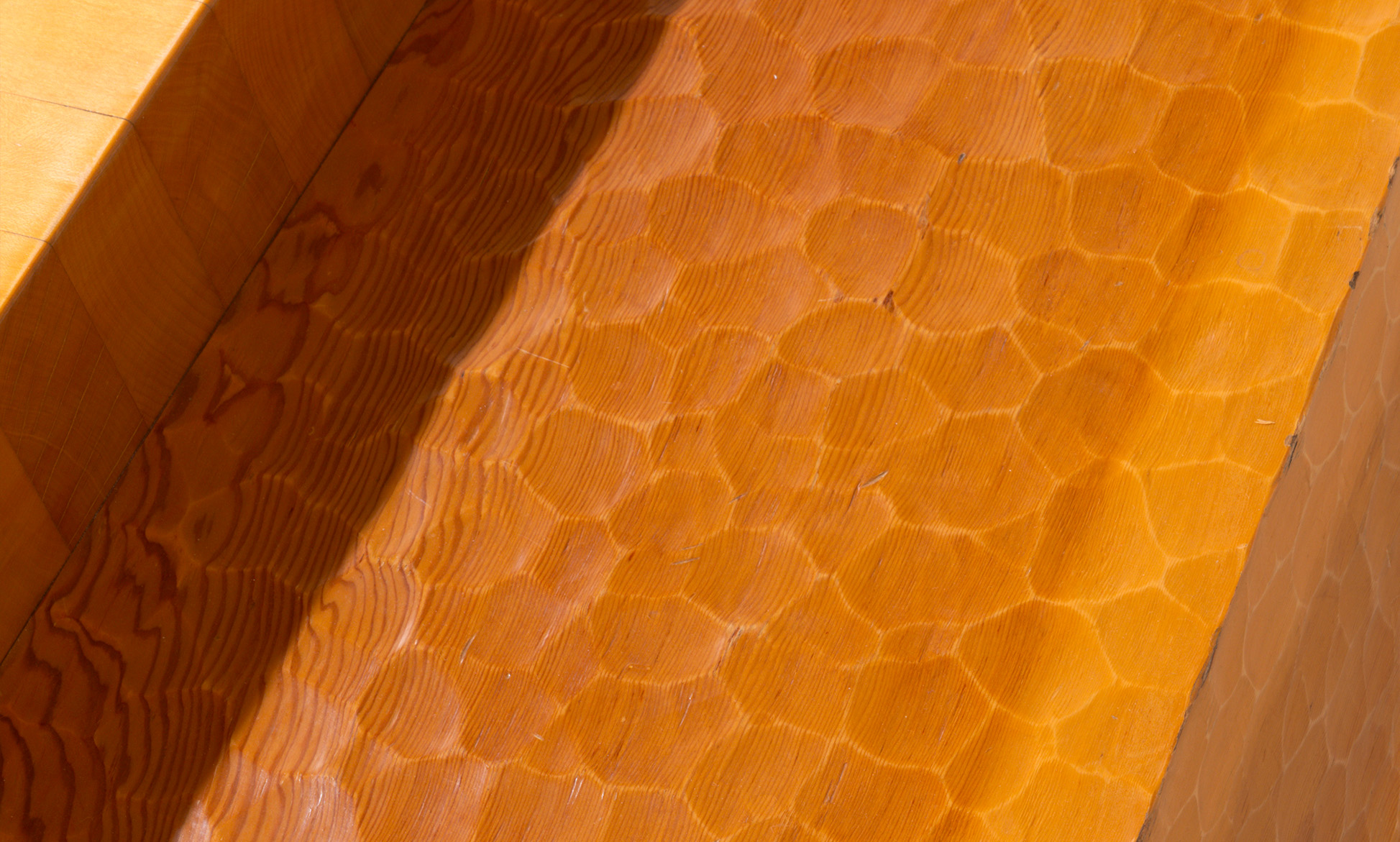 Lot details 15 © Piasa, 2026