The three Cartier brothers laid the foundation of Cartier’s jewelry and watchmaking prestige, winning the lasting favors of royals and tycoons; their eldest, Louis Cartier (1875-1942), was an ambitious businessman and an astute designer. The family motto, ‘Never copy, only create’, resonated in the famous Rue de la Paix workshops, and spurred Louis’ audacity in drafting new projects and spearheading the creative team himself. From the first wristwatch, designed for his French-Brazilian pilot friend, Alberto Santos-Dumont (1904), to the design of the iconic Tank watch (1917), Louis Cartier offered innovative watch cases in the early 20th century. Wristwatches were, indeed, far from being commonplace for fashionable men of the time. Following in the steps of his father, Alfred Cartier, and grandfather, Louis-François Cartier, Louis strayed from convention and created unprecedented shapes that, to this day, participate in the Maison’s reputation.
Maison Cartier does not solely produce jewelry and watches, but also offers superb accessories and everyday items, sublimated by its workshop. Among these, clocks particularly stand out. While a watch is subject to size and volume requirements, the creation of clocks allowed Louis’ genius to combine the newest watchmaking technology with the decorative and elegant object he held dear. Jean-Eugène Robert-Houdin’s (1805-1871) creations provided the technical inspiration for the first Cartier mystery clocks in 1912. Robert-Houdin, a watchmaker’s son, a mechanics enthusiast, and a magician, became an illusionist through happenstance. Indeed, having ordered Ferdinand Berthoud’s treatise on watchmaking from a bookseller, Robert-Houdin received two volumes on magic and sleight-of-hand. This mistake supposedly brought about his passion for automatons and grand illusions, and the creation of his own theater where he would perform his famous tricks, such as the well-known ‘Marvelous Orange Tree’. However, the magician’s original calling had been watchmaking, and he revealed his first ‘mystery’ clock at the French Industry’s World Fair in 1839. The Restauration-style clock presented a circular glass face, supported by a crystal column standing on a plinth decorated with griffins. Its hands were not driven by any apparent cog or mechanism, either on the face or in the clock’s case. The indication of time seemed to originate in the hands themselves, pivoting around their axis as if by magic, without visible movement or transmission. There is, of course, a mechanical explanation to this mysterious dial, from which Louis Cartier drew his inspiration.

CARTIER
Exceptional "Mystery" Clock
1930s
Estimate: 400 000 / 600 000 €
Louis Cartier, showing a gift for unearthing young talents, entrusted Maurice Couët, a young, independent watchmaker ten years his junior, with the development of the mystery clocks project. The young man had previously worked in the Prévost workshop, Cartier’s exclusive supplier until then. Couët and Cartier’s designers, Charles Jacqueau and Georges Rémy, combined their respective talents with the mechanical ingenuity of Robert-Houdin’s clocks. In 1912, the workshops produced the first mystery clock, whose frank and streamlined aesthetic foreshadowed Cartier’s signature Art Déco style. Louis Cartier christened this first clock ‘Model A’, a tongue-in-cheek reference to Ford’s 1908 first assembly-line produced Model-T automobile. The clock was entirely transparent, built of crystal, and stood on a hardstone plinth.
Cartier’s first mystery clocks were met with resounding success: all wondered at the precision of these hands, apparently suspended in air. Louis, a shrewd businessman, did not allow clockmakers to reveal the secret mechanism created by Robert-Houdin to the salesmen, in order to preserve mystery and accrue his clients’ curiosity. As new clocks were produced, without special orders, in order to supply stores, and despite high prices, mystery clocks (signs of elegance and distinction) attracted a prestigious clientele, including Count Greffulhe. These art pieces were remarkable in a refined interior. The mystery clock the Duke of Westminster received as a gift found its untimely end when, in a fit of jealousy, the duchess hurled it against a wall during a row with her husband she suspected of infidelity.
The destruction of such a mechanism is truly tragic when one is aware of its ingenuity. The inside of the clock’s face is made of a piece of rock crystal (or citrine in some cases), perfectly and precisely split in its center, in which turn two crystal discs upon which each hand is affixed. A clever clock mechanism hidden within the supporting elements of the face is directly in contact with the serrated edge of the crystal discs (one for the minutes hand, one for the hours), and impulses their rotation in a perfect illusion. The Cartier brothers’ limitless creativity explored the many possibilities afforded by this mechanism. As early as 1920, the Maison manufactured clocks with only one central transmission shaft, just like in Robert-Houdin’s first project. Three years later, the workshops produced ‘portico’ clocks, whose base-frame hid the mechanism activating the face’s invisible discs (through the use of a worm screw and a worm wheel). The greatest example of a portico clock is the 1923 model replicating a Shinto Torii gate, topped with a Billiken figure, and whose clock face appeared to hover like a gong, a model which now belongs to the Cartier Collection. Far- and Middle-East influences were more and more prominent in the Maison’s collections. Cartier created several series of ‘precious clocks’ in which Asian artworks were remarkably showcased, in the style of 18th and 19th century mantel clocks, and adapted to the Art Déco style of the moment, similar to miniature theater scenes created in the workshops by designers, watchmakers, lapidaries and jewelers.
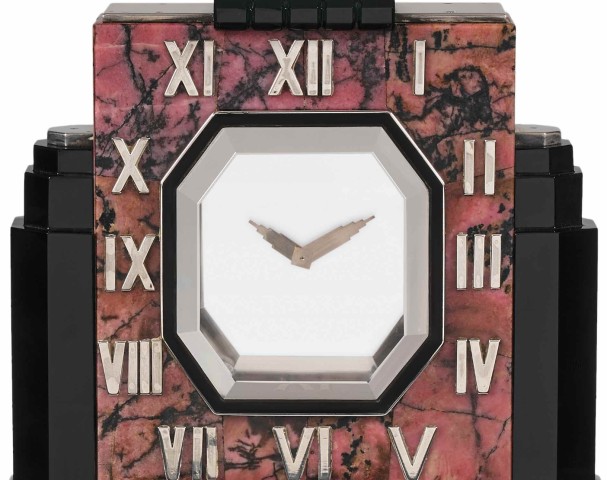
The mystery clock offered in this auction presents the main characteristics of the Art Déco style Cartier clocks. Indeed, the subtly balanced juxtaposition of materials enhances the harmony of this piece by blending the shimmering depth of the onyx with the silver’s metallic hues, the rhodonite’s contrasting veins, and the transparency of crystal. Moreover, its simple lines and carefully rhythmed volumes heighten the elegance and refinement of the materials. Even if, by definition, each Cartier mystery clock is unique, certain particularities place this atypical model in an exceptional range within the Maison’s collections. Its brute architectural aspect steers away from more habitual Asian influences and takes us West. The onyx shafts recall the rectilinear, conventional, and classic silhouettes of skyscrapers built across the Atlantic in the purest American Art Déco style – the first example being the Reynolds Building, built in Winston-Salem, North Carolina in 1929. This building prefigured the construction of several other skyscrapers, the most well-known being the Empire State Building, inaugurated in Manhattan on May 1st, 1931. A close look at the hands, which replicate the shape of this building (without the antenna, which would only be added in 1952), confirms the influence of this new architectural style and allows us to claim that the creation of this clock dates back to the early 1930s. Moreover, a graphite pencil, watercolor and India ink drawing of a clock project whose pillars, base, and hands are very similar to the one presented here supports this theory. Another atypical element of the model presented is the use of the roman number IV rather than the IIII index usually encountered on nearly all mystery clocks created by Maurice Couët and the Cartier workshops. A similar example of the use of the roman numeral is shown on a 1931 mystery clock with an aquamarine face, illustrated in ‘Jeweled splendors of the Art Deco Era: The Prince and Princess Sadruddin Aga Khan Collection’, by Stephen G. Harrison (p.206). Furthermore, the Roman numeral V on this clock is larger than the V used for the VII and VIII indexes, similarly to the 1930 clock having belonged to Alexander I of Yugoslavia (photograph by Clive Kandel, private Collection). These last elements are as many indicators of this mystery clock’s creation date. Finally, this clock perfectly echoes the stylistic canons of the time, according to which design serves purpose. Thus, despite its seemingly monumental aspect, it is the timekeeping aspect of the clock that is emphasized, in particular through the restraint of its lines and the transparency of the mysterious face, balanced by the open aspect of its half-portico construction.
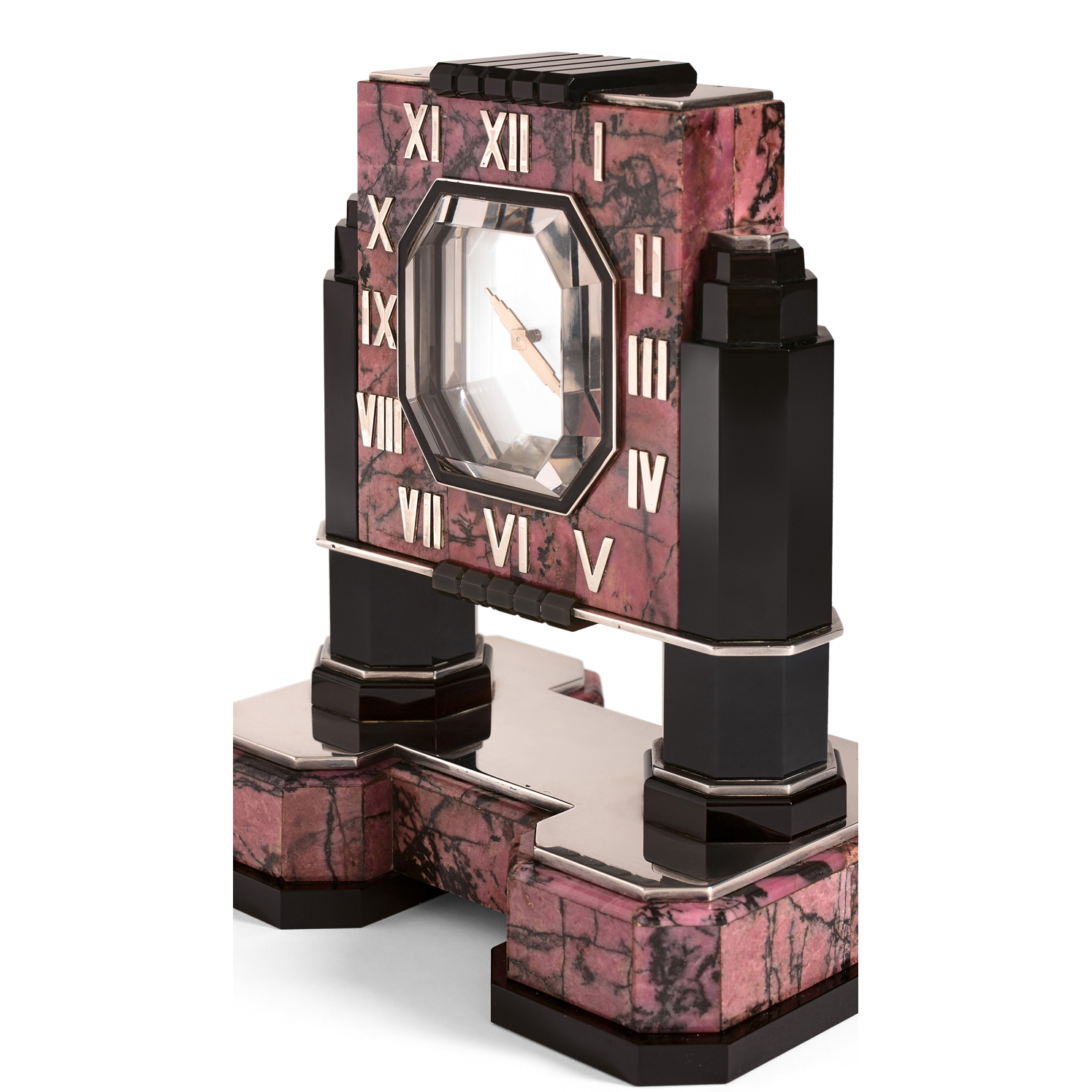
CARTIER
Exceptional "Mystery" Clock
1930s
Estimate: 400 000 / 600 000 €
While a mystery clock was produced every eight to twelve months by the Cartier manufacture – quite boldly as they were not created for special orders – it is probable that this model was produced with the clear aim of attracting an American public, clients of Pierre Cartier (1878-1964), Louis’ younger brother, having created the Maison’s New York City branch as early as 1909. The production of this clock was certainly a bold move, in the middle of Great Depression. Indeed, the Maison Cartier, fashion pioneer, adapted and evolved with its time. Only World War 2 interrupted the production of mystery clocks, as precious metals were used in the war effort and became scarce. Not until the early 1980s would the audacity and extravagance of mystery clocks reappear within the watchmaking creations of the Maison. The model presented here, kept in private hands for several generations, is a moving testimony to Maison Cartier’s exceptional and unique craftsmanship.
Antoine Géraud
Historian of watchmaking
@watchesandthegang