


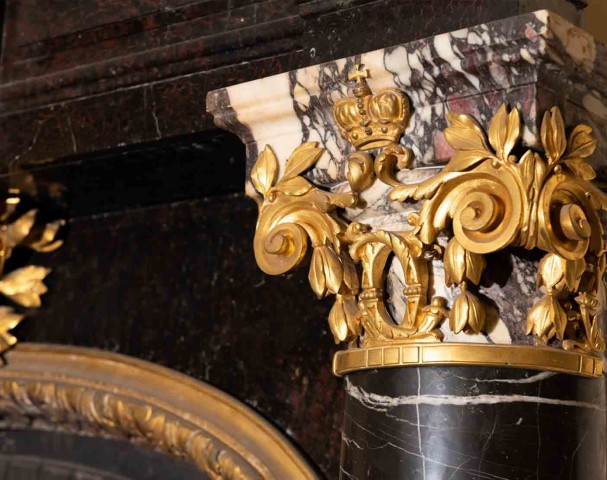
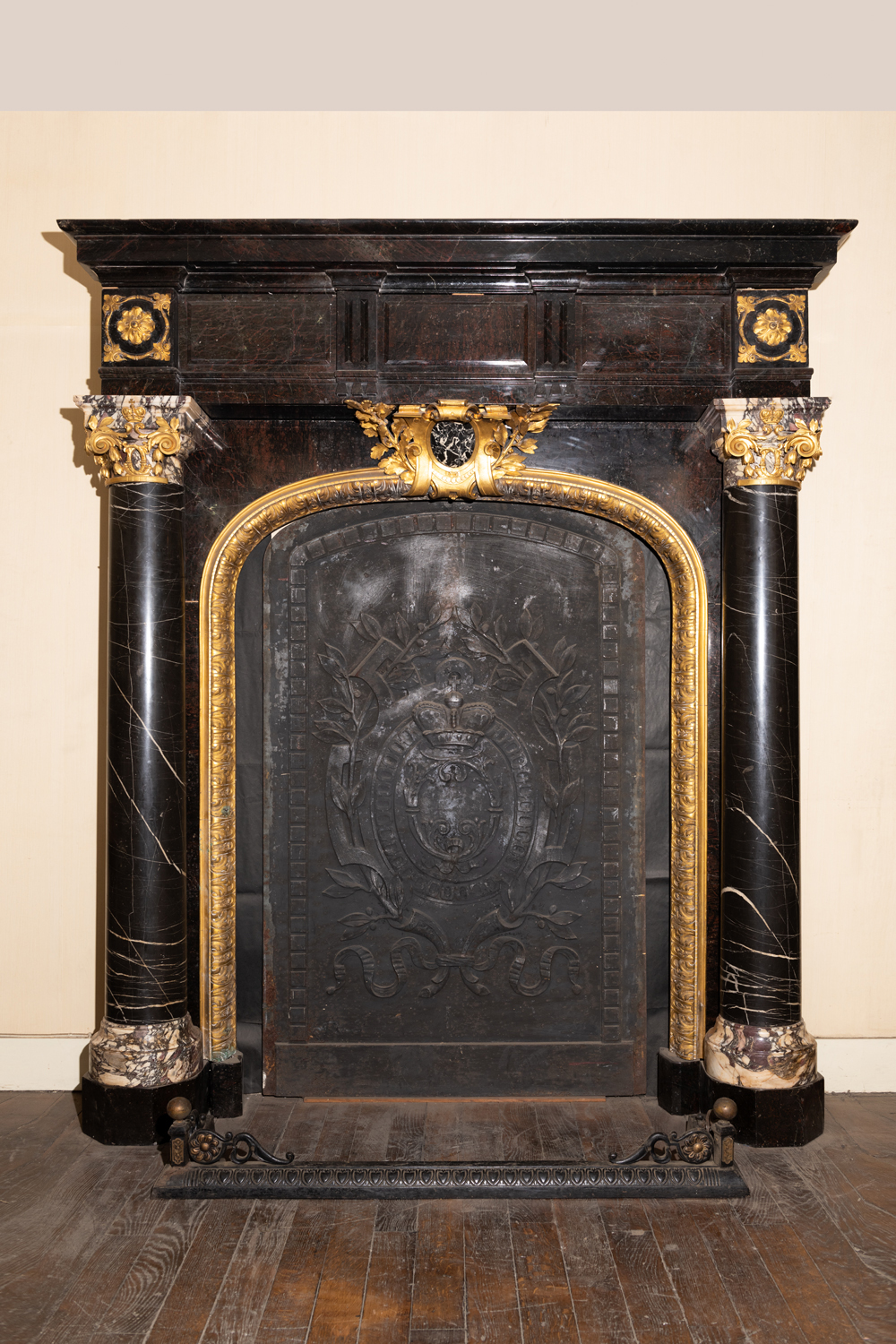
Piasa is holding an auction dedicated to drawings, old paintings, furniture and decorative arts. The sale will take place on September 21, 2022 and features an important XIXth century ormolu mounted and marbles chimney-piece, commissioned by the Prince Bibesco for his hôtel particulier.
Georges Bibesco, Charles Le Cœur and Auguste Renoir
Georges Bibesco (1834-1902) came from one of the most prominent families in Romania. His father, Prince George Demetere Bibesco, was elected Prince in 1843, before abdicating in 1848, following the Romanian insurrection. The young prince, sent to Paris at a very early age, had Victor Duruy (1811-1894) as his tutor. Duruy was Minister of Public Instruction under the Second Empire from 1863 to 1869, and a great friend of Charles le Coeur. The two men had met at the Château de Menars, home of Princess Valentine de Caraman-Chimay (1839-1914) who later became the wife of Prince Georges Bibesco.
Charles Le Cœur, who graduated from the Beaux-Arts de Paris in 1856, was appointed government architect thanks to his proximity to Victor Duruy. As such, he designed the main high schools in Paris, such as the Condorcet and Louis-le-Grand schools, as well as the architecture of the Vichy casino.
At the end of the 1860s, a close relationship was established between Charles Le Cœur and Renoir thanks to the friendship that the painter had with the Le Cœur family. Charles Le Cœur became one of Renoir's first patrons, as shown by the portrait of the architect in the Musée d'Orsay.
L’hôtel particulier du 22, Avenue de La Tour-Maubourg
In 1868, during a stay in Algeria, Prince Georges Bibesco commissioned Charles Le Coeur to build a hôtel particulier. The project was "a residence for a bachelor lord, including a large space for reception rooms". He placed this residence in the tradition of 18th century hôtels particuliers, influenced at the time by the "eclecticism" in vogue at the end of the 19th century.
In 1869, Prince Georges Bibesco bought a parcel of land at 22, boulevard de la Tour Maubourg and construction began in 1869. The hotel was delivered at the beginning of 1872.
Renoir was involved in the project from the beginning, delivering ceiling designs in 1868.
Renoir's only collaboration with Le Cœur was for the large fencing room, which Georges Bibesco had chosen to dedicate to the heraldic evocation of his family. The ceiling, as shown in a watercolour by Charles Le Coeur in the Musée d'Orsay, was painted with all the Bibesco family emblems.
The subject of our chimney piece, painted by Renoir, was the emblem created at the end of the 17th century by Constantin Bassaraba Brancovan, who was beheaded by the Turks with his four sons in 1714 and which was: "d’azur, au chevalier romain au naturel monté sur un cheval d’argent et tenant une épée d’argent qui supporte de sa pointe une tête de Maure, le tour terrassé de sinople". This subject, in one of the most important rooms of the house, exalted chivalrous virtues and was also a portrait of an ancestor and a heraldic support. The chimneypiece is decorated with the Bibesco emblem and the prince's cipher, which are two intertwined Gs. However, Renoir softens the subject with two female nudes in the foreground, inspired by the decoration of the War Room in Versailles by Coysevox.
This room, with its fireplace, its painted decor, and the exceptional materials used, was the highlight of the armoury, as desired by the prince himself.
After the 1870 war, the hotel was extended by Prince Georges Bibesco, who added new stables in 1874. In 1875, his marriage to Princess Valentine de Caraman-Chimay, a young German divorcee, caused a scandal. Ostracized by the high society of the time, Prince Georges had to give his hotel to his elder brother, Prince Grégoire Bibesco (1827-1886), father of the poet Anna de Noailles, who was born in this hôtel particulier in 1876.
The hotel was finally sold in 1877 to Princess Constantin Radziwill née Louise Blanc, the wealthy heiress of Edmond Blanc, founder of the sea baths company, and mother of Prince Leon Radziwill.
According to Le Coeur, this was his best private project, and the only one he ever showed to the public in an exhibition at the Société des Amis des Arts in Pau in 1873.
Today, the building has been demolished and replaced by a contemporary construction.
