


From the 1960s onwards, Bernard Rancillac was associated with the artists of Narrative Figuration, with whom he participated in the now historic exhibition, "Mythologies quotidiens" (1964), at the Musée d'Art moderne de la Ville de Paris.
At that time, his style evolved towards a free way, with the presence of a more explicit figuration inspired by the world of comics and which was to be compared to Pop Art. The humorous and irreverent spirit of Rancillac's canvases, as shown in the "Walt Disney" exhibition held in 1965 at Mathias Fels' home, led him to become closer to the American painter Peter Saul.
Dating from 1966, "Géométral d'une idole" marked Rancillac's entry into a new pictorial period, where he created his works using images from popular magazines. This is the period when he resorts to the episcope process, which consists of transferring images onto canvas, while the new practice of acrylic allows him to paint flat areas of bold colors, simply close together.
 Bernard Rancillac (né en 1931)
Geometral d'une idole, 1966
Estimation : 40000 / 60000 €
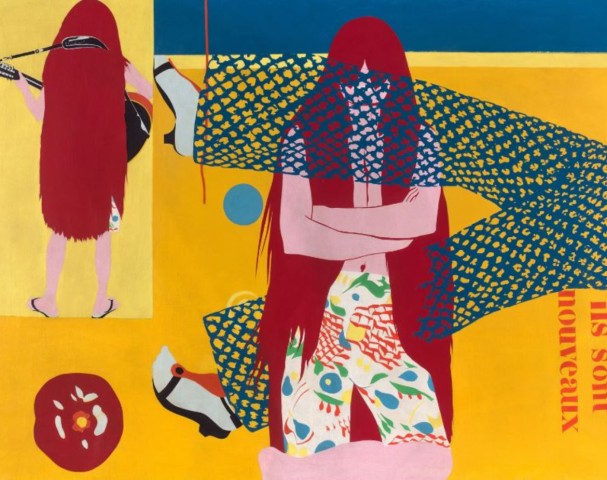
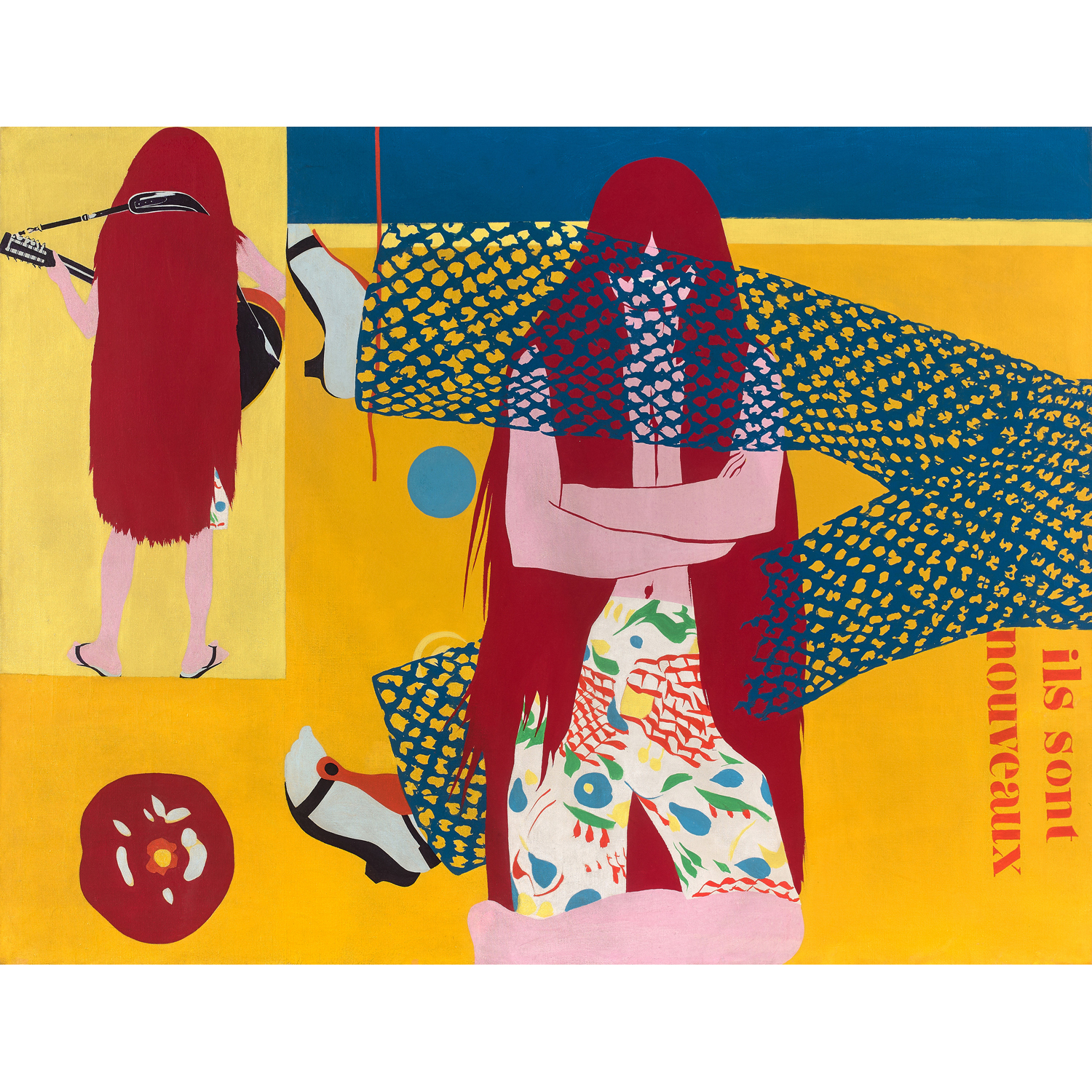
The painting, whose annotation "they are new" evokes the front page of a newspaper, displays a certain carefree optimism, with the strange silhouette of a young hippie woman appearing twice, once from the front in the foreground, and once from the back in the background of the painting. The red cut of her long hair and her rare clothes give rise to a play of abstract motifs to which are added with meticulousness and skill those of an elephant's pants leg crossing the canvas across the entire width.
All relief has been eliminated, the shapes are simplified and juxtaposed without any scale ratio, the whole is dominated by large areas of yellow and blue colours. "Ils sont nouveaux", with its libertarian and pre-1968 hippie spirit, occupies a special place in Rancillac's production. This painting shows that his works from 1966 were not exclusively dedicated to social and political events, contrary to what his exhibition "The Year 1966" at the Blumenthal-Mommaton gallery would suggest.
In this, "Ils sont nouveaux" offers a "delicate counterpoint to the political violence" of the time and announces, twenty years in advance, the works that Rancillac will produce from film magazines in the 1980s under the title "Cinémonde".
