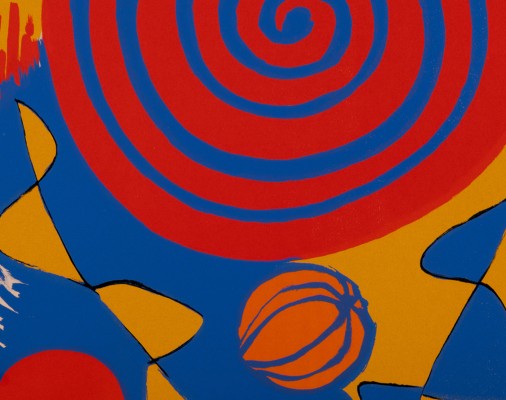
On Thursday June 23, PIASA is holding an auction of editions: prints, illustrated books and other multiple works. Comprising 258 lots, this auction offers a broad view of the world of 20th and 21st century art publishing. The sale is also characterized by the presence of an important collection from the artist Maria Papa Rostkowska. The works in this catalog bear witness to her years in Paris and the friendship she had with many artists.
As a resistance fighter in Poland during the war, the young Maria Papa Rostkowska participated in the rescue of Jews from the Warsaw Ghetto with her husband Ludwik Rostkowski. During the 1944 Warsaw Uprising, she was arrested and deported to the Auschwitz concentration camp, but managed to escape before reaching the fateful destination. At the Liberation, she received one of the highest Polish military distinctions: the Order of Virtuti Militari, in recognition of her actions.
Maria Papa Rostkowska, a recognized artist in Poland, first taught painting at the Academy of Fine Arts in Warsaw before pursuing her career in Paris in the late 1950s. Supported by Edouard Pignon, she frequented the artists of the New School of Paris, including Joan Miró, Sonia Delaunay, Hans Arp, Serge Poliakoff, Nina Kandinsky, Lucio Fontana, Wifredo Lam and Alberto Magnelli. Little by little, she chose sculpture to express an already asserted personality.
It was during this period that she met Gualtieri Papa di San Lazzaro, a gallery owner, writer, journalist and founder of the Revue XXe siècle, whom she married for a second marriage in 1958. The magazine played a key role in the development of the works of artists on the Parisian scene at the time, like other publications such as Verve or Cahiers d'Art. In this context, the couple welcomes many of the most important art historians of the 1950s and 1960s, including Alain Bosquet, Bernard Dorival, Pierre Restany, Alain Jouffroy, André Pieyre de Mandiargues Michel Ragon or Eugene Ionesco.
Pursuing her plastic research, Maria Papa Rostkowska finally turned to the direct cutting of marble after having worked for a time in Albisola terracotta and bronze. In the early 1970s, the artist left Paris and set up her studio in Italy, in the town of Pietrasanta, not far from Carrara.
From her years in Paris, Maria Papa Rostkowska kept tenuous links with many painters and sculptors. Even though she worked alone, she knew how to surround herself with faithful artist friends who were real supporters throughout her life, such as Jean Arp or Marino Marini - who was her working companion - and with whom she corresponded for many years.
The pieces of the collection, which we present to you today, were for the most part offered to Maria Papa Rostkowska by the artists themselves and constitute in this sense much more than a selection of major graphic works of the 20th century. They are above all an evocation of the friendship and admiration that the artists of her time showed to this woman and artist with an extraordinary career.