


The auction dedicated to Modern and Contemporary Art on Thursday April 8th, 2021, presents a selection of the most significant artists of the second half of the 20th century. This new auction organized by PIASA is the opportunity to highlight the work of the artist Anthony Caro.
Major British sculptor, Anthony Caro, after training as an engineer, studied sculpture in the post-war years at Regent Street Polytechnic and the Royal Academy of Arts. When he became Henry Moore's assistant in 1951, his sculpture practice was established in the tradition of figurative bronze. Gradually, he acquired a certain reputation through the evening classes he gave at Saint Martin's School of Art in London. In 1959, he met the American critic Clement Greenberg, a fervent defender of the abstract expressionists and colorfield painters, which was to be no less decisive for his career. The latter encouraged him to go to New York between 1959-1960, during which he met the sculptor David Smith who will lead him to radically change his work : He introduced him to welding, which allowed him to assemble geometric forms of metal.
When his first exhibition was held at the Whitechapel Art Gallery, Anthony Caro had a great success. His sculpture, resulting from the assembly of steel elements, sometimes industrial, covered with paint in a uniform way, is of a completely new kind. According to the critic Clement Greenberg, Caro thus puts "the accent on the abstract character of the sculpture, on its radical dissimilarity with the natural forms".
Very quickly Anthony Caro will assert his specificity by his horizontal approach of the sculpture, which distinguishes him clearly from the vertical and totemic approach of David Smith. The work that we present here, Table Piece Z-40 (1981), is very emblematic of the sculpture of Anthony Caro. It belongs to the "Table Pieces" series, initiated in 1968, where industrial materials are placed in a sort of unstable equilibrium. Here, the metal beam constitutes the base of the work base of the work on which are welded vertical or inclined planes, so as to define a dynamic and open dynamic and open structure. The absence of a base expresses the desire to defy gravity and to give back to the sculpture its autonomy. Anthony Caro surprised his contemporaries by these sculptures made up of industrial elements, with the dark colors, posed on the ground like rails of railroad. Table Piece Z-40 (1981), which is located below the eye, is discovered of top in bottom, and thus proposes to the down, and thus proposes to the spectator an unusual aesthetic experiment which will make the glory of Anthony Caro.
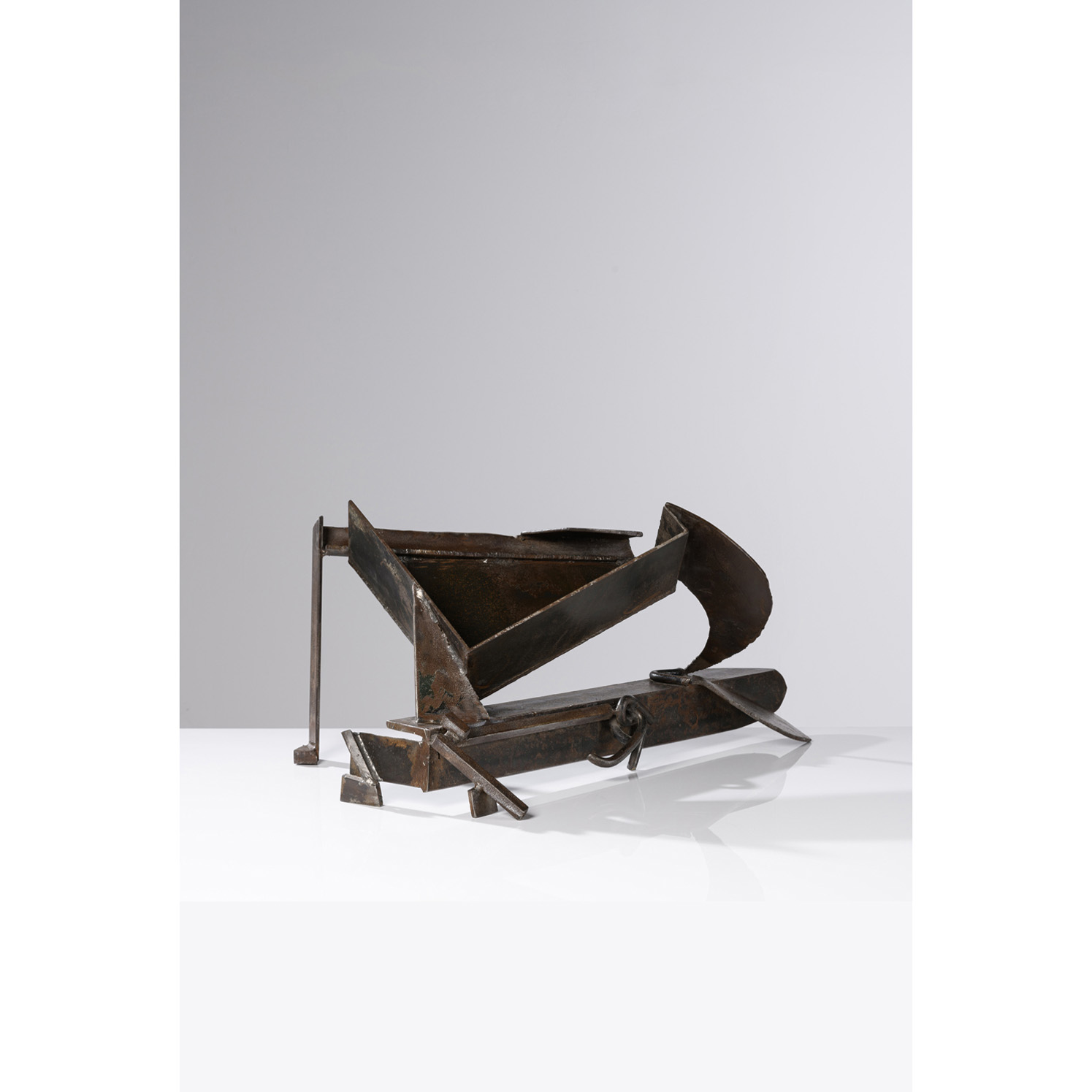 Anthony Caro (1924-2013)
Table Piece Z-40, 1981
Estimate: 40 000 / 60 000 €
From the middle of the 1980s, the artist's interest in architectural sculpture will grow, particularly following the discovery of Greek archeological sites, which made him aware of the fundamental link existing between architecture and sculpture. He will qualify then his new works of sculpitecture, and he will collaborate in 1991 with the architect Frank Gehry to build an "architectural village". Anthony Caro's work has been the subject of major exhibitions, notably at the Museum of Modern Art in New York (1975), at the Museum of Contemporary Art in Tokyo (1995), the National Gallery in London (1998), the Venice Biennale Venice Biennale (1999), the Tate Britain (2005), the Musée des Beaux-Arts d'Angers (2008).
