Born in Poland in 1921 to a family of Russians fleeing the pogroms, Maurice Calka found an early interest for the arts, and was admitted at sixteen at Lille’s academy of arts. His director, Roger Mallet-Stevens, developed a keen interest for his student’s promising work and commissioned him for a monumental bas-relief for the Press Pavilion at Lille’s ‘Exposition du Progrès Social’ in 1939. On the same year, Maurice Calka was admitted in the École des Beaux-Arts in Paris.
Calka interrupted his artistic career in 1942 in order to join General de Gaulle’s FFL (Free French Forces). Imprisoned with the French escapees in the Franquist concentration camp of Miranda, in Spain, he managed to volunteer in the French forces from 1942 to his demobilization in 1945 in Germany. Back in the Beaux-Arts school, he obtained the Prix de Rome in 1950, opening him the doors to the Villa Médicis for four years. There, he experimented with different materials and drew closer to design and architecture.
Maurice Calka (1921-1999)
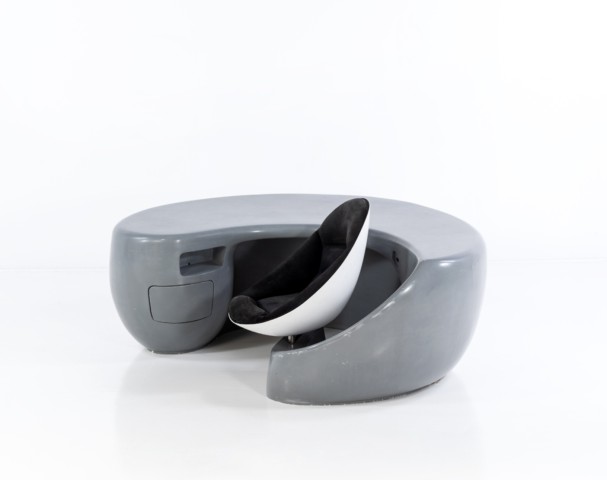
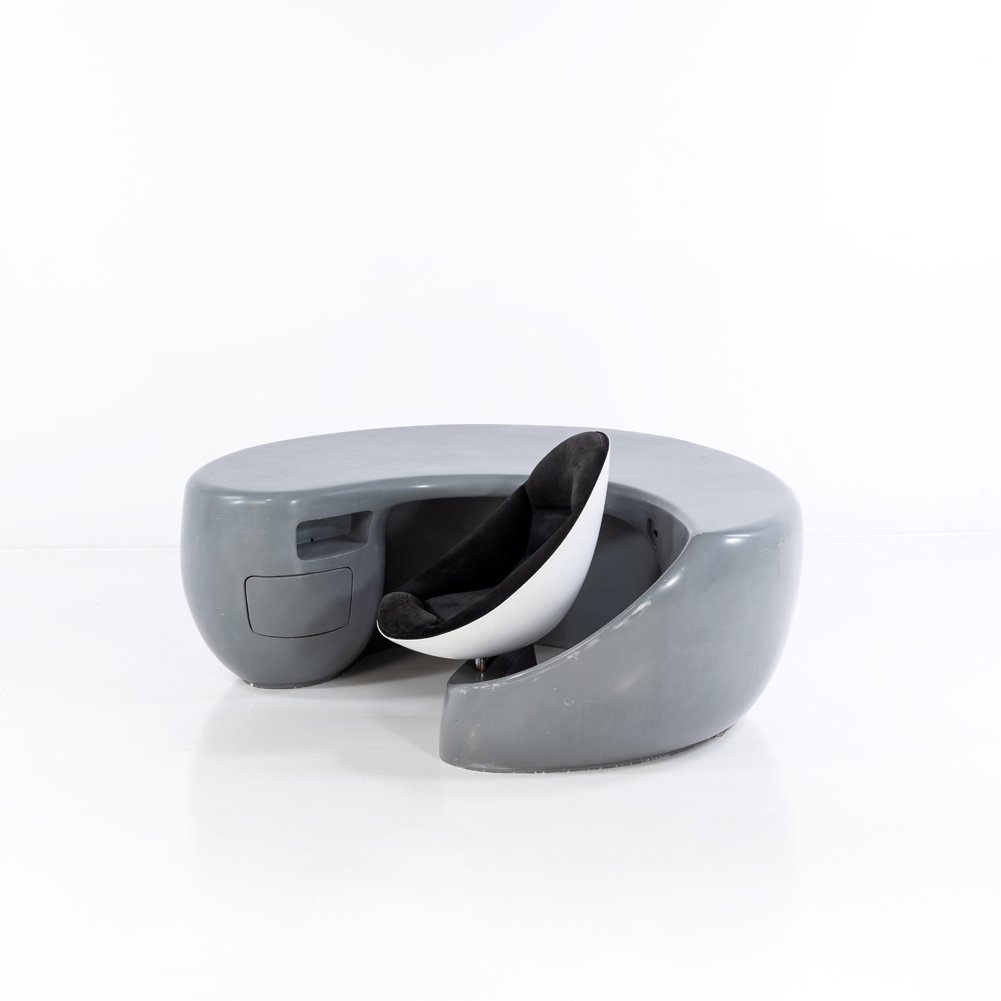
Modèle dit « Grand PDG » Prototype, bureau
In the following years, he received an important order by Emperor Haile Selassie for a Lion of Judah sculpture in Addis-Ababa. His first models drifted from the classical representation one might then expect from a laureate of the Prix de Rome - upon meeting Selassie, the Emperor asked him, “Is this modern ?” “Yes”, answered Calka. “Good, that’s what I want.”
It is this modernity that will bring the sculptor to a certain fame. Calka specialized in public works, integrating his sculptures in the surrounding architecture and urbanism
I never accepted that the work of art be mainly the prerogative of galleries, of sporadic fairs, and that a public art accessible to all would not be encouraged. (...) I made constant and considerable efforts to incite architects and urban planners to collaborate with plastic artists in order to implement a public art scene dense enough to significantly enrich the urban network of towns and cities, whether ancient or modern.
Public art lacking a lucrative aspect, Calka then turned to design which led to his international recognition, despite the limited number of pieces he produced. He created the Boomerang desk for Leleu-Deshays, rounded, sculptural, in moulded plastic. This iconic work was available in 41 different colors. A timeless piece, French president Georges Pompidou had one installed in his office in the Palais de l’Élysée. Kanye West has another, in white, in his Los Angeles office, amongst works by Murakami, Kaws or George Condo. The Grand PDG version, created in a very limited series (six according to the creator’s son, Serge Calka), has special compartments to integrate a telephone or a cigar lighter. This prototype includes a pivoting, rail-mounted chair, and is an exceptionally rare representation of Calka’s multifaceted talent.