


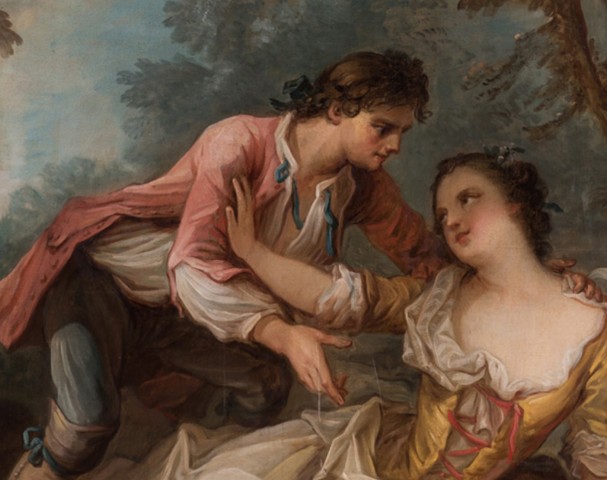
During its Intérieurs sale on Friday, June 8th, PIASA will present a painting by Charles Joseph Natoire titled ‘Le faux pas’. Born in Nîmes on March 3rd, 1700, Charles Joseph Natoire is schooled under Louis Galloche, court painter and and professor at the Royal Painting Academy, and under François Lemoyne.
Winner of the Grand Prix (Rome prize) in 1721, this early success leads him to the Académie de France in Rome. His first royal commission is for the queen’s room in Versailles in 1734, and joins the Académie in the same year. From then on, he begins many decorative ventures and royal commissions, amongst which the small apartments of the Chateau de Fontainebleau, the Chateau de Marly, the Royal Library, the Hôtel Soubise. As soon as 1737, he becomes a teacher at the Painting Academy, end is sent to Rome in 1751 as director of the Académie de France.
If Natoire mainly depicts religious and mythological scenes, he turns here to a more intimate genre. ‘Le faux pas’, also know as ‘La résistance feinte’, represents a romantic scene depicting the amorous exchange of a young girl and her suitor. In this production, Natoire delves into a fashionable genre during the Louis XV era. Indeed, when religious and historical paintings were still the main source of representation, under the Regency the depiction of intimate scenes gains in importance, echoing the more free-tinking spirit of the century. After the Versailles splendor, Paris becomes the center of the arts again, and the more well-of enjoy the luxury and voluptuousness of the more intimate houses of the capital.
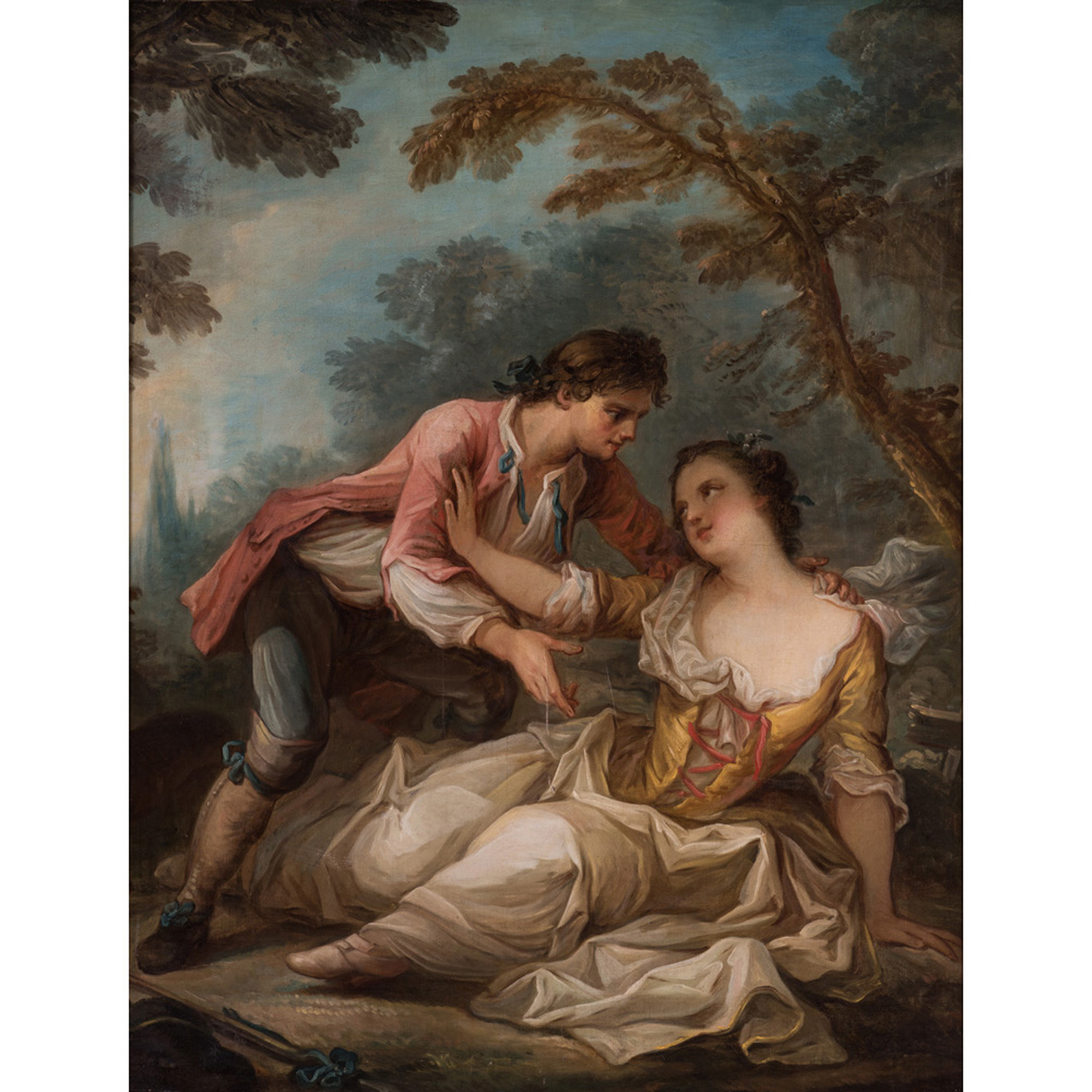
Charles Joseph NATOIRE
(Nîmes 1700 - Castel Gandolfo 1777)
Thus, more and more artists depict the playful and frivolous activities and fantasy of this society. The genre knows great success with the public and with collectors. In this painting, Natoire, through his supple and agitated brush, shows his taste for beautiful fabrics which he illustrates with finesse. The gentle light shines on the young characters, shown voluptuously with warm and sensual touches. The moving bodies give in to frivolous play.
Giving room to a certain freedom, the genre explored by Natoire in this work echoes the literature of the time, which gives growing importance to the libertine spirit. The artist celebrates the hedonism and romanticism of the 18th century, showcasing a certain art of seduction. This painting is estimated between 4000 and 6000 euros.