"What Senghor formulated over half a century ago resonates with current debates on historical and contemporary representations of Africa, African heritage, cultural diversity, dialogue between cultures and the human condition. It is to the organizer of the first Festival des Arts Nègres (Dakar, April 1966) that the renowned American magazine African Arts entrusted the inaugural text of its first issue, published in 1967. In it, Senghor formulated a long-awaited new definition of African art, as Nigerian artist Ben Enwonwu put it in Rome in 1960: "I think it should no longer be the privilege of European critics and artists to lay down the rules of African art. I think one of the questions we have to consider here is how to enable Africans to set the standards of artistic judgment in their own countries and to make them known freely or through governments".

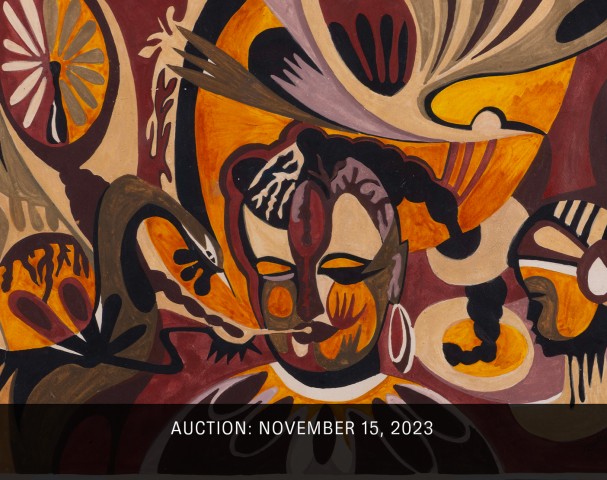
Lot 29 | Souleymane Keita
Untilted, 1972
Estimate : 2000 / 3000€
In 1960, under the impetus of President Léopold Sédar Senghor, a School of Fine Arts was created in Dakar, which would soon give its name to the Ecole de Dakar movement, symbolizing the artistic revival born in Senegal at the dawn of independence between 1960 and 1974. Papa Ibra Tall was its first Director for 7 years, before stepping down to take charge of another equally important institution: the Manufacture Sénégalaise des Arts Décoratifs.
Founded in Thiès in 1966, it is one of the region's oldest and largest textile companies, renowned for its production of high-quality textiles and its role in Senegal's economic and industrial development. The fabrics produced by the factory are often characterized by their colorful patterns and unique lines, reflecting Senegalese culture and traditions.

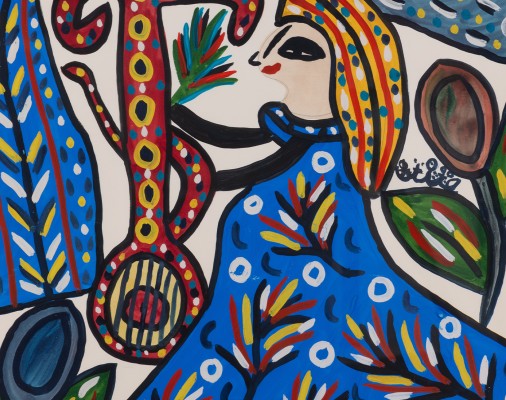
Lot 28 | Souleymane Keita
Untilted, 1972
Estimate: 1500 / 2000€
The following artists embody this revival. Boubacar Goudiaby's tapestry and Baye Mouké Traoré's designs are part of the singular new aesthetic that made the Manufacture de Thiès famous. Both began their careers at the famous factory before setting up their own workshops in Dakar.
Whether they broke with Senghor's thinking, like El Hadji Sy, or embraced the concepts of negritude, like Souleymane Keïta, Amadou Seck or Gora Mbengue, they were all part of the same movement, the dynamism of which is still palpable on the Senegalese art scene today, as evidenced by the works of sculptor Ndary Lo, Cheikh Tidiane Diagne or young painters like Kassou Seydou or Amadou Camara Gueye...