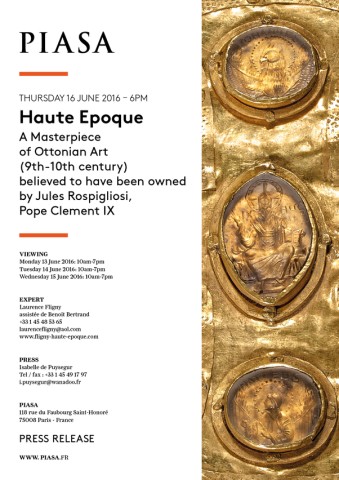
After obtaining a world record price of €2.2m for a Baroque ivory group of The Flagellation last December, PIASA – assisted by the expert Laurence Fligny – are delighted to present a masterpiece of 9th/10th century Ottonian Art: an exceptional gold cross with five rock crystal intaglios featuring Christ in Majesty and the Tetramorph.
The few works of Ottonian Art to have survived count among the most precious of the early Middle Ages – as illustrated by this cross pattée with rounded arms, formed from a sheet of gold leaf. It features five engraved rock crystal intaglios. The central intaglio is of mandorla form, engraved with an enthroned Christ, his arm raised in blessing, and the inscription ΙХФUς. Then there are four oval intaglios on the arms of the cross, engraved: IOHANNES with the eagle of St John (top); LVCAS with the ox of St Luke (right); MARCUS with the lion of St Mark (left); and MATTEUS with the angel of St Matthew (bottom). These intaglios are encased within frames held in place by rivets with stamped heads.
To find a set of five rock 9th/10th century crystal intaglios in private hands is extremely rare. Most of the gemstones from this period to have survived are now only to be found in museums or cathedral treasuries.
According to family tradition, the cross once belonged to Jules Rospigliosi – Pope Clement IX (1667-69). The cross seems to be of homogenous fabrication. It consists of finely cut gold leaf, rimmed with decorative metal strips that provide rigidity. These strips have patterned stamping that must have been applied after they were fixed to the cross, as traces of the patterning can be seen on the back. The heads of most of the rivets – whether used to fasten the strips or the framed mountings around the crystals – are marked with rosettes, reinforcing the cross’s stylistic unity. The edges retain traces of nails in places, suggesting the cross was originally fixed to a (probably wooden) support – either inserted into the binding-cover of a Gospel (in line with the theme of the tetramorph), or to a pectoral cross made for a high-ranking cleric.
The Rospigliosi family were of aristocratic Milanese origin and settled in Tuscany in the 12th century – first at Lamporecchio, then in Pistoia. They held important positions in the papal army and became allied to the Pallavicini family by marriage in 1669. The Rospigliosi family collection is renowned for its wealth of works of art, furniture and Old Master paintings, and has been the subject of numerous publications (some of them recent) charting its importance and diversity.