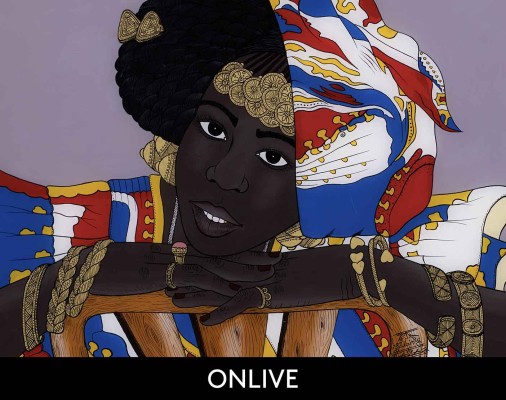
Senegalese Suwèr : From the Collection of Michel and Régine Renaudeau
The technique of painting under glass spread from the eighteenth century, originating from the regions of Central Europe to the Maghreb where, thanks to Turkish and Italian craftsmen settled on the coast, it flourished as an art form, with an original production drawing on religious themes, popular stories and legends.

Gora M'Bengue in his atelier, 1979
© Renaudeau, Strobel, Painting under glass, Senegal
Ed Fernand Nathan, Paris, 1984
In Sub-Saharan Africa, the art of painting under glass was particularly developed in Senegal where it still exists today. Better known under the word now adapted in Wolof which designates this technique, the Suwer testifies with great refinement, of the life and popular concerns of the people of Senegal. At the end of the 19th century, it first featured religious iconography, before introducing secular scenes from everyday life. The technique was also used for a brief period as a frame ornament for the photographs found in St. Louis around the same period, before giving pride of place to the painted portrait. Very quickly, while everywhere else the production of paintings under glass was mostly replaced by the diffusion of printed images, in Senegal, the practice persisted and gave rise to a popular and singular plastic expression.
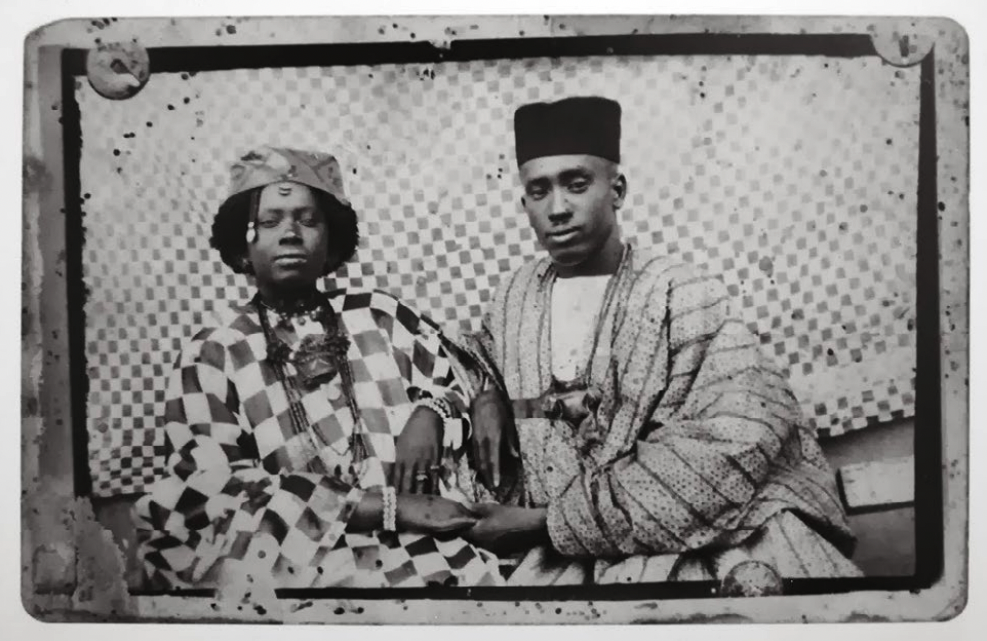
© Meïssa Gaye (1892-1982)
Boubacar Dieng and Astou M'Bodj, the Queen of Waalo's granddaughter
Saint-Louis, Sénégal, Selé Gaye Collection
The Collection of Régine and Michel Renaudeau, of which we are offering today, for the first time on the secondary market, a set of 42 plates divided into 21 lots, is exceptional in more ways than one.
Assembled patiently over a period of more than forty years, this collection includes some of the earliest Senegalese Suwer paintings known to date, and brings together five masters of the discipline: Gora M'Bengue, Babacar Lô, Mor Gueye, Djibril Fall Diene and Fallou Dolly, the latter of whom is still active today. The quality of their preservation is remarkable and the variety of themes addressed draws a formidable panorama of the richness of the topics found in the Senegalese tradition.
Régine and Michel Renaudeau arrived in Senegal in the 1960s and met at the Grand Théâtre Sorano in Dakar. Art at a time, held a special place in a country full of optimism after its newly regained independence. Régine was a teacher with a passion for cinema, and Michel a young photographer who had just arrived in the country, as a volunteer. Very quickly, their life was organized between Gorée and Dakar and they forged deep friendships with the local scene, spending long days in the studios and meeting painters, filmmakers, playwrights and musicians. Régine’s long friendship with master Senegalese filmmaker Sembene Ousmane would eventually land her husband a small role in the iconic film Emitai, in 1971.
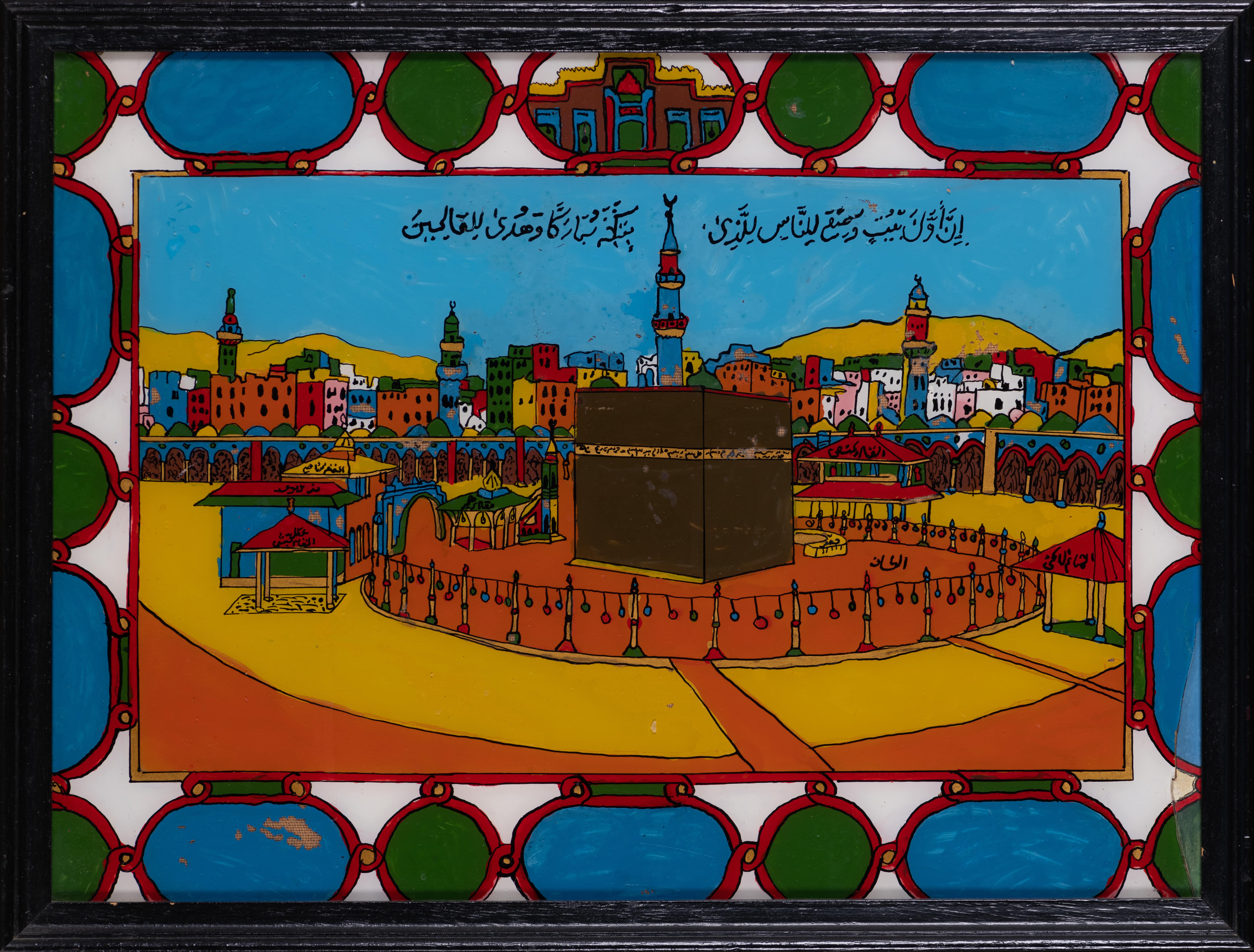
Anonymous artist (Senegal, 20th century)
The Kaaba, 1950
Estimate : 3000 / 5000 €
For nearly 40 years, the couple bought and preserved an exceptional collection of Suwer paintings, tracing the history of this most fragile medium. In 1984, Michel Renaudeau presented "Peinture sous verre du Sénégal", one of the first exhibitions dedicated to the Suwèr, at the gallery of the Centre d'Échange Culturel de Langue Française in Dakar. The exhibition was accompanied by a book published with Michèle Strobel, who studied the history of the medium and created a thematic repertoire testifying to the richness of the iconography. Finally, Michel initiated conferences aiming at popularizing this technique.
From the Drianké, the elegant Senegalese women adorned with sumptuous jewelry, whose sophisticated poses and refinement recall the bijin of Japanese woodblock prints, developed a few decades prior at the other end of the planet, to musicians caught in the middle of a concert, their richly patterned boubous flowing in the wind; from devotional religious figures to sensual couples caught in an embrace, it is the multiple layers of Senegalese life, in all its richness and complexity, that unfold before our eyes.
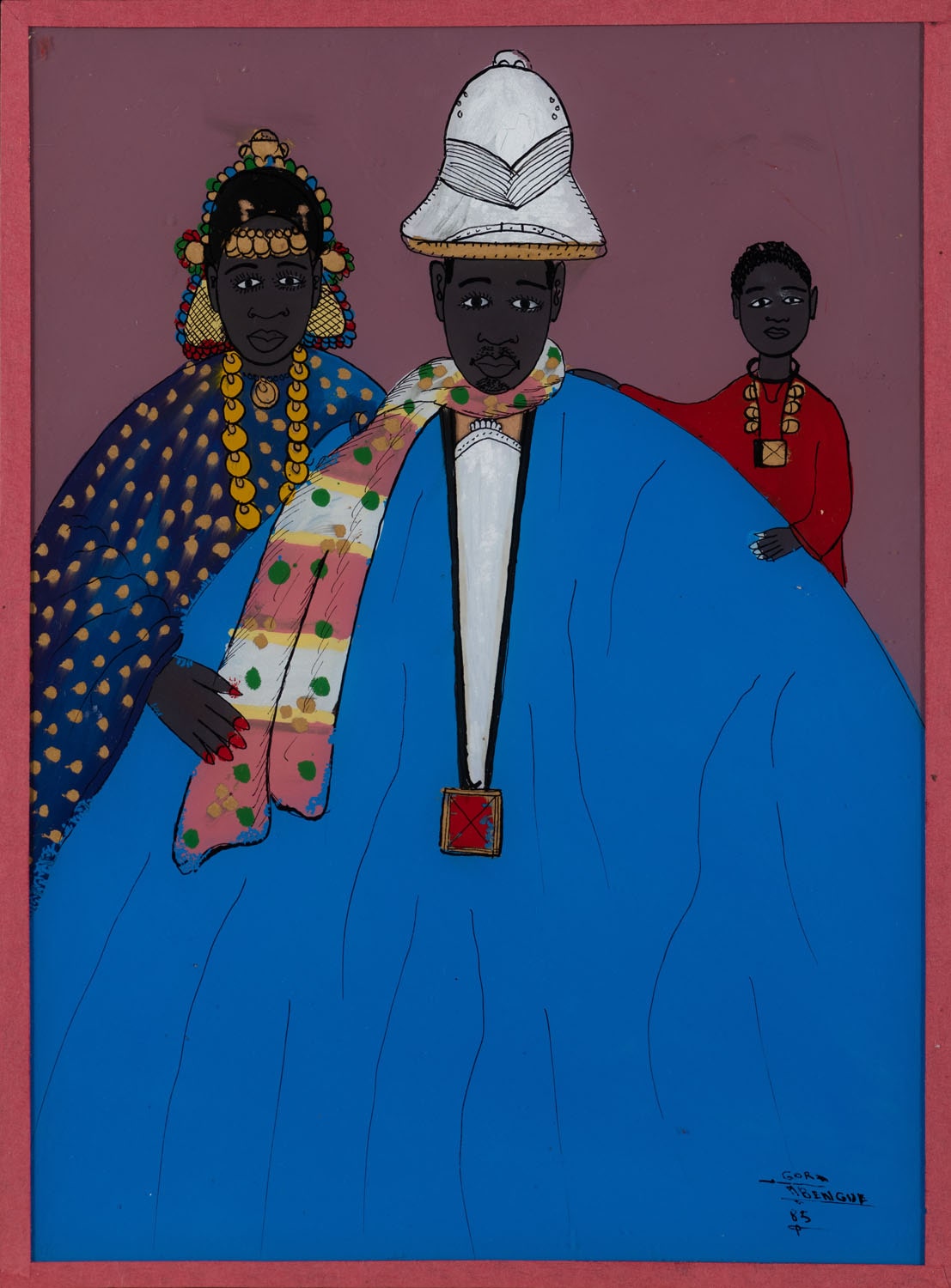
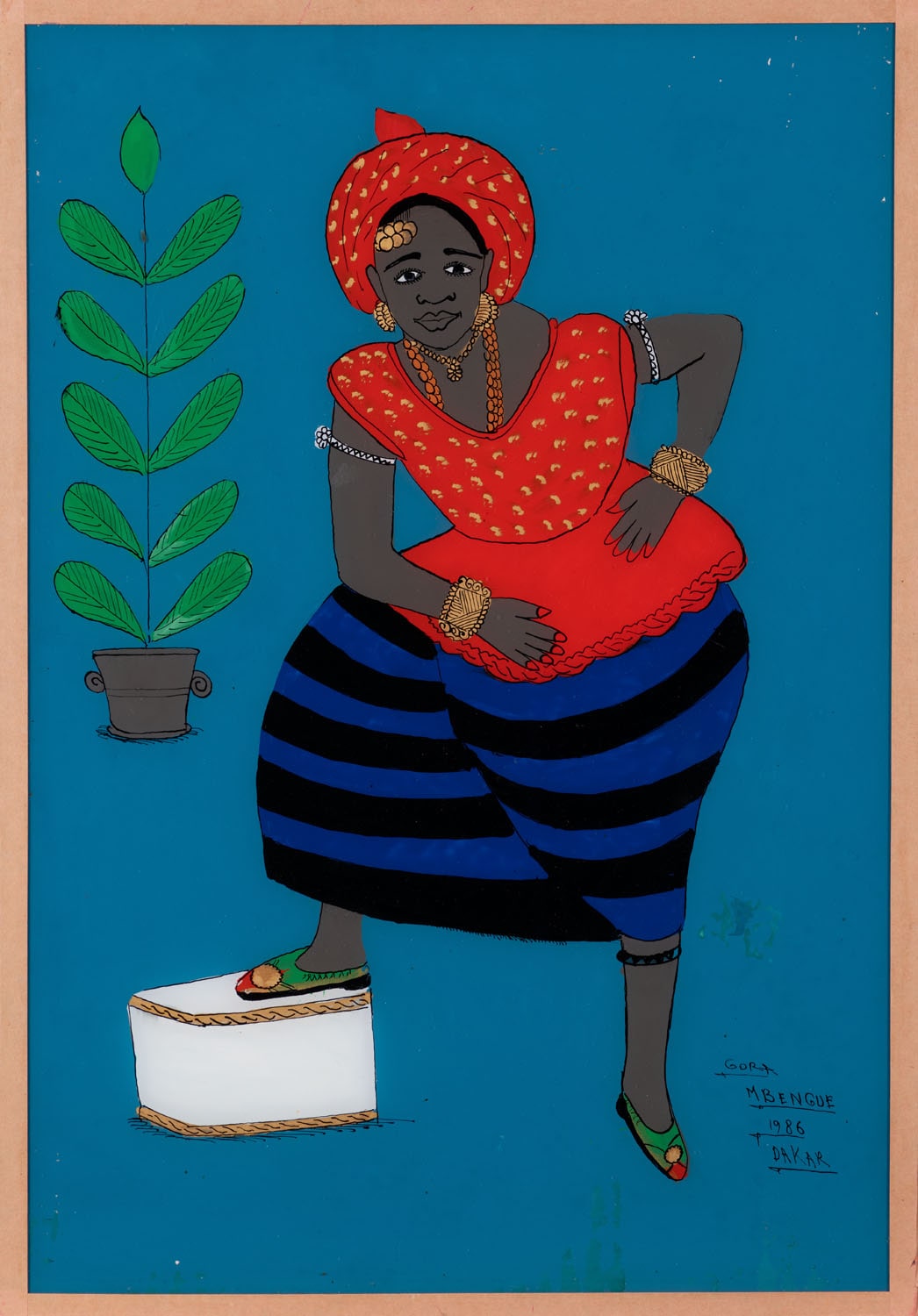
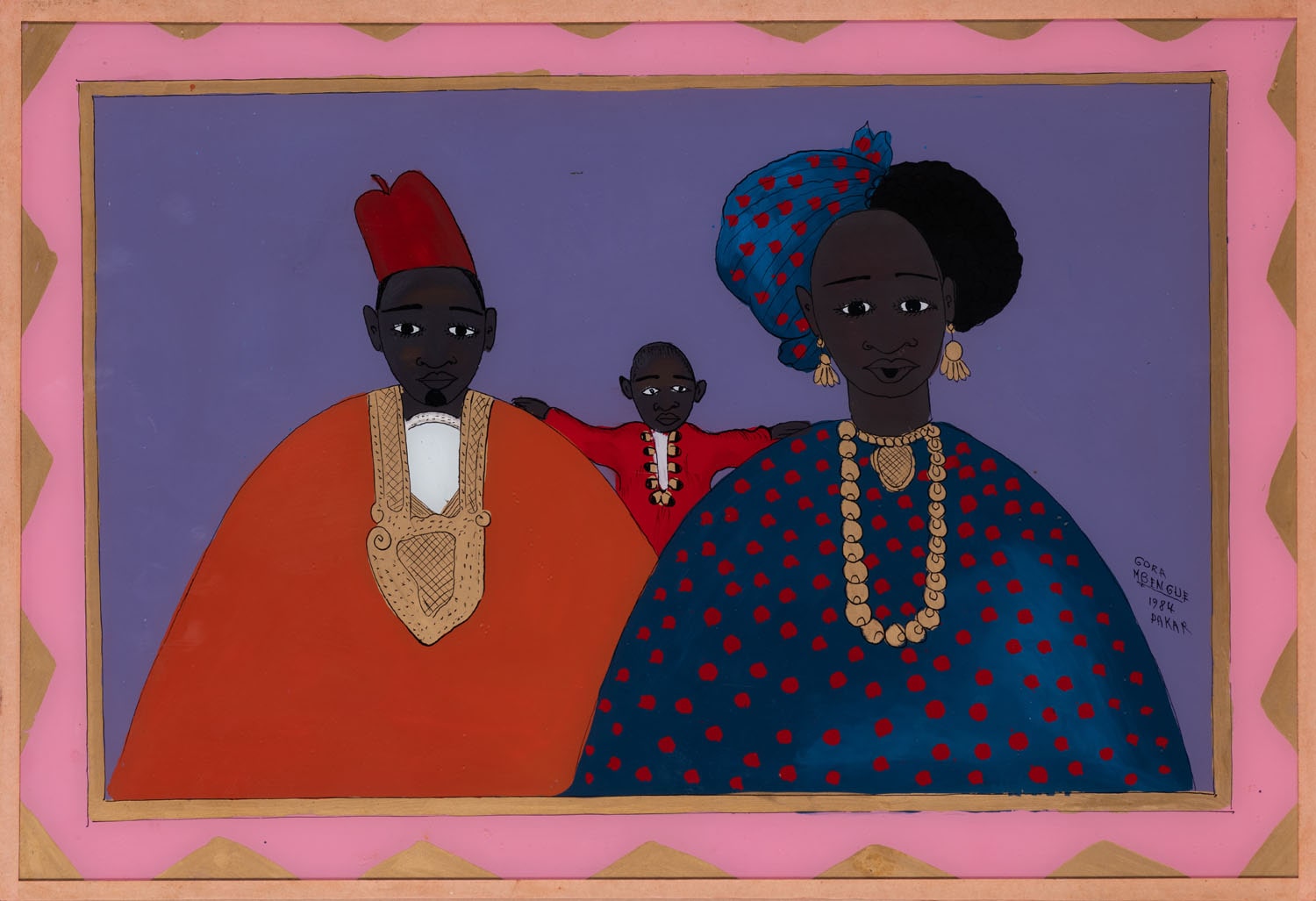
Lot of three paintings fixed under glass
Gora Mbengue (1931-1988, Senegal)
Estimate: 1500 / 2000 €