


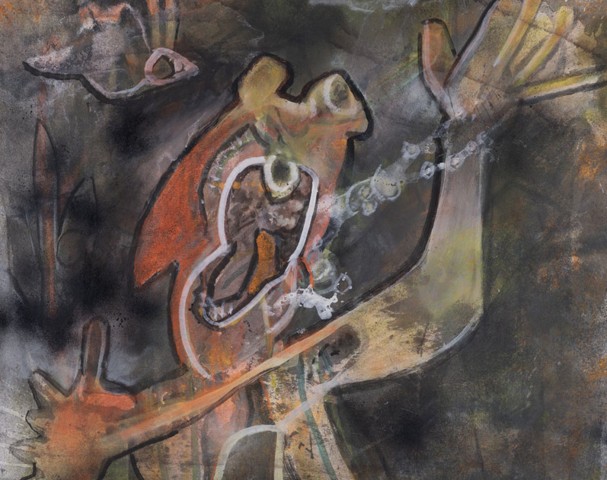
On June 3rd, PIASA is organizing a superb Modern and Contemporary Art auction. On this occasion, the work of the artist Roberto Matta will be highlighted.
After studying architecture in Chile, Roberto Matta arrived in Paris at the age of 22 and quickly met the great figures of the avant-garde. He drew in Le Corbusier's studio, then trained in London with Walter Gropius. Back in Paris in 1937, Matta participated in the vast construction site of the Pavilion of the Spanish Republic, alongside Picasso and Miró. The following year, he joined the Surrealist movement, having met André Breton through Federico Garcia Lorca and Salvador Dali. In 1938 he had the honor of participating in the International Exhibition of Surrealism, where he made the decisive acquaintance of Marcel Duchamp. Throughout his career, Matta was marked by his masterpiece, the Large Glass, which made him realize that "you can paint change". In 1939, he created his first "Psychological Morphologies", a term that designates the new plastic language he developed, made up of organic and vital motifs, whose form in the pictorial field destabilizes our usual visual references. In New York, where Matta found refuge during the war, he met Arshile Gorky, Robert Motherwell, and Jackson Pollock, to whom he showed the way to gestural automatism.
Back in Europe, Matta settled in Italy, while continuing to work between Rome, Paris and London. He distanced himself for a time from André Breton, who reproached him for having openly reintroduced the human figure into his painting. However, in these post-war years, it seems essential for Matta to affirm the place of man in his work: "We are not on the balcony to watch the world. From now on, we must say to ourselves: "I am in the world, I am a dimension of the world...". The painting must therefore contain four elements: a stone, vegetation, a man and an object made by man. "From the 1950s-1960s, Matta, who had become close to the Italian Communist Party, devoted vast compositions to the political issues of his time, which engaged him in all the revolutionary struggles (he denounced, among other horrors, McCarthyism in the United States, the practice of torture during the Algerian war, the atrocities of the Vietnam war ...).
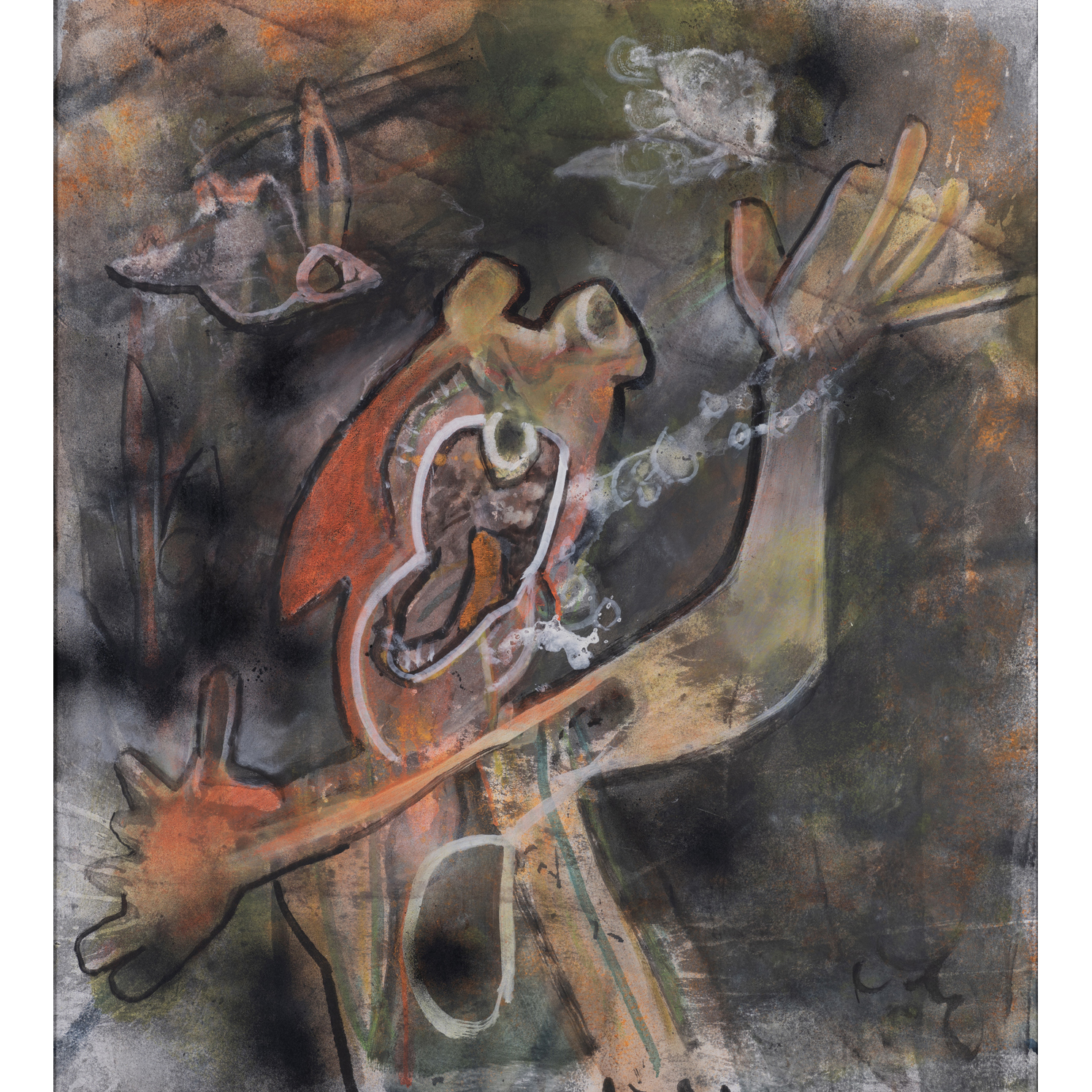
When his painting does not engage with the social and historical reality of his time, it is situated outside of time and proves very convincing by its strong metaphorical power. The artist creates enigmatic spaces, tactile by the variations of color and material, populated by strange beings, oscillating between primitivism and science fiction (see our table above). Sometimes, as here, Matta concentrates on a figure, to transpose as Pierre Gaudibert writes "through the imaginary all the mythology of contemporary history, all its vehement refusal of fascism and imperialism, to make paintings cries and weapons of all the oppressed of the world.
