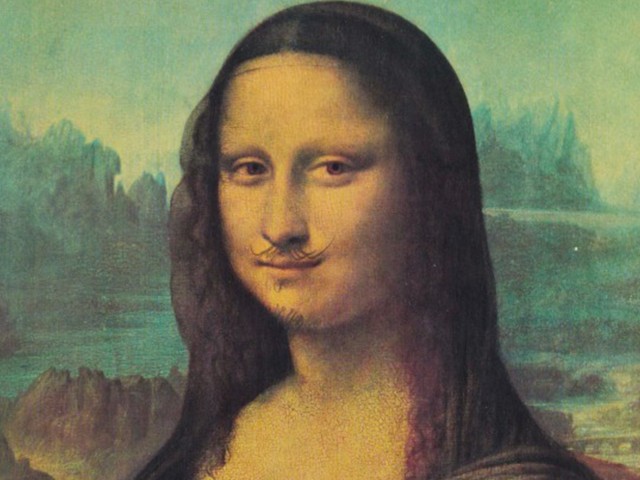
"L.H.O.O.Q" is among Duchamp's most iconic ready-mades. Even before the birth of the Dada movement, Marcel Duchamp disrupted conventions and provoked the art world with his ready-mades, "these manufactured objects elevated to the dignity of art objects by the artist's choice," such as Bicycle Wheel (1913), Bottle Rack (1914), or Fountain (1917). The trivial object is sacralized.
In 1919, upon returning to Paris after the World War, he dared a new provocation with "L.H.O.O.Q." He thus appropriates a reproduction of an art historical icon, namely Leonardo da Vinci's Mona Lisa. In this year, 1919, which celebrates the 400th anniversary of the death of the Renaissance master, Marcel Duchamp, no stranger to provocation, adorns Mona Lisa with a penciled mustache and goatee. This mustached and goateed Mona Lisa is an iconoclastic ready-made/Dadaist combination. "The original, I mean the original ready-made is a cheap 8x5 (inch) chromo on the back of which I wrote four [sic] initials which, when pronounced in French, make a very daring joke about the Mona Lisa: L.H.O.O.Q." Duchamp adds in his Notes, "She has a hot ass like continuously running scissors / swims and continues." Duchamp has just thrown down a challenge to painting.
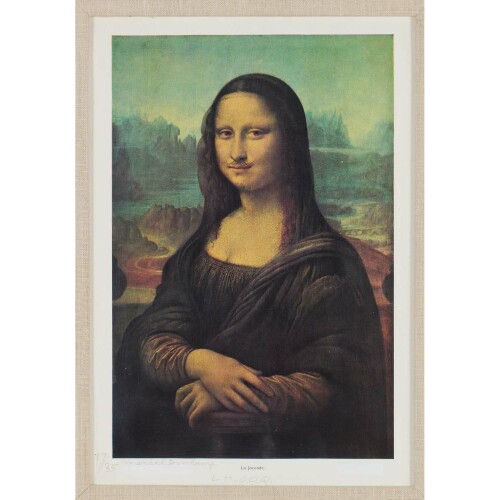
By dressing Mona Lisa as a man, Duchamp alludes to the perennially debated theory that it is a masked portrait of Leonardo da Vinci's lover. An admirer of the Coherent Arts, he was inspired by the illustrator Sapeck, who himself had dared to alter the portrait of Francesco da Gioconda's wife by adding a pipe, to illustrate Coquelin Cadet's remarks in "Rire," which amusingly extol the joyful deformation of a serious object, as "supposing for a moment that, by chance, the master had left in the mouth of this ideal woman, a clothed pipe." This idea of identity change preoccupied Duchamp: thus he invented his fictional female double Rrose Selavy ("Eros, c'est la vie").
This work embodies the post-war spirit of derision of Dada artists such as Tristan Tzara and Francis Picabia, whom Marcel Duchamp reunited with in Paris in 1919. Duchamp tells Pierre Cabanne, "In 1919, when Dada was in full swing, and we were demolishing a lot of things, Mona Lisa became the first victim..."
Marcel Duchamp revisited this ready-made several times. In 1964, the publisher Arturo Schwarz published a book by Pierre Massot entitled "Marcel Duchamp." This book includes a lithographic edition in 35 copies of the ready-made L.H.O.O.Q, including our copy (lot 54).