


On the occasion of the "American / Brazilian / Japanese Design" sale on Thursday, July 2, 2020, PIASA auction house offers for sale 16 pieces by the American designer Isamu Noguchi.
Born in Los Angeles to a poet father and a writer mother, Isamu Noguchi will spend the first years of his life in Japan before beginning medical studies at Columbia University. He turned to sculpture and, from 1924 onwards, took classes at the Leonardo da Vinci Art School in New York alongside the Italian-American artist Onorio Ruotolo (1888-1966).
His work is the subject of a first exhibition. It was then that he opened his own studio. The many trips he undertook, particularly to Asia in the second half of the 1920s, would considerably influence his approach and his practice of art. He became passionate about traditional Chinese painting.
In New York, just as the city was about to supplant Paris as the world capital of art, Isamu Noguchi became familiar with the creation of the Western avant-garde. He will work for a while in the workshop of the Romanian-born sculptor Constantin Brâncuşi.
The artist then takes pleasure in crossing the frontiers of the arts. From the mid-1930s onwards, he collaborated with the American choreographer Martha Graham. The washi paper luminaires he created were inspired by the lamps used by the cormorant preachers of Gifu in Japan.
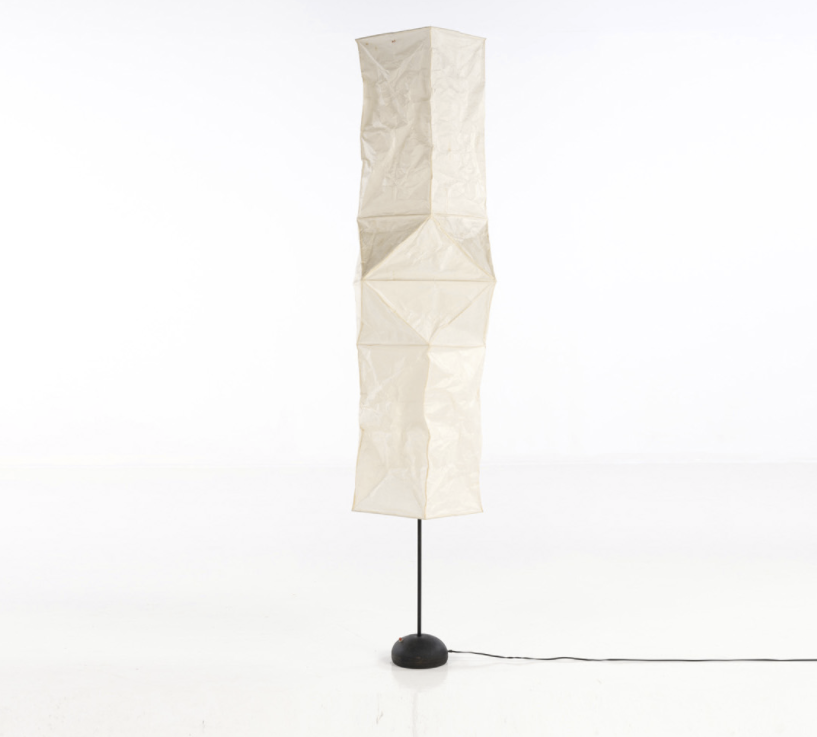
Isamu Noguchi (1904-1988)
Floor lamp
Iron and Washi paper
Akari limited edition
Manufacturer's monogram
Engraved 'Isamu Noguchi - Akari' and dated '1977'
sous la base de type BB1, rare avec cet
interrupteur rouge
Creation date: 1977
Among the pieces offered for sale during the sale on Thursday, July, 2, 2020, the lamp published by Akari in 1977 is estimated at between 6,000 and 9,000 euros. It is a very faithful reflection of the virtuosity of design in its relationship with space.
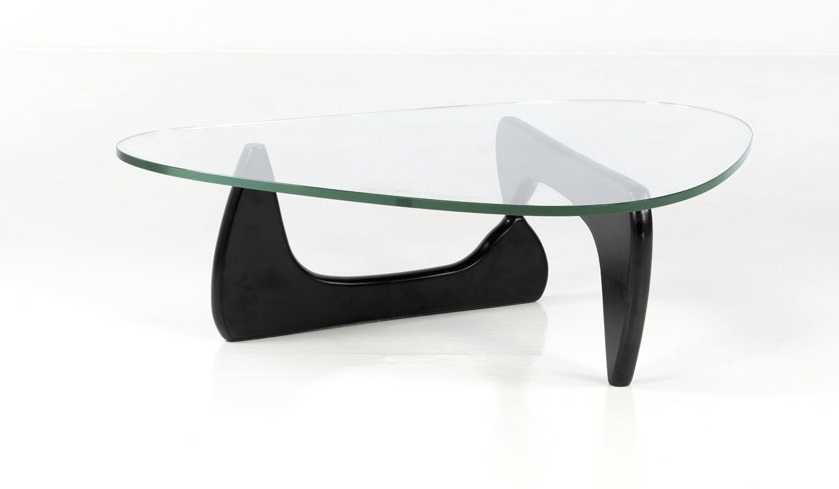
Isamu Noguchi (1904-1988)
Modèle IN 50
Table basse
Bois laqué et verre
Edition Herman Miller
Date de création : 1944
H 40 × L 133 × P 96,5 cm
The coffee table model "IN 50" was edited by Herman Miller in 1944. This piece, made of lacquered wood and glass, reflects his interest in the minimalism of sculptural forms.
