As part of the session dedicated to editions on Tuesday, December 11, 2019, PIASA auction house will offer for sale two works by the American artist Franck Stella.
After graduating from the Phillips Academy in Andover and Princeton University, Franck Stella was alternately magnetized by the lyricism of an exacerbated gesturalism embodied by a Jackson Pollock or a Franz Kline and by the rigorous acetic inspiration of a Barnett Newman. This double polarity is a major characteristic of his work. When he moved to New York, the artist met Jasper Johns and Robert Rauschenberg.
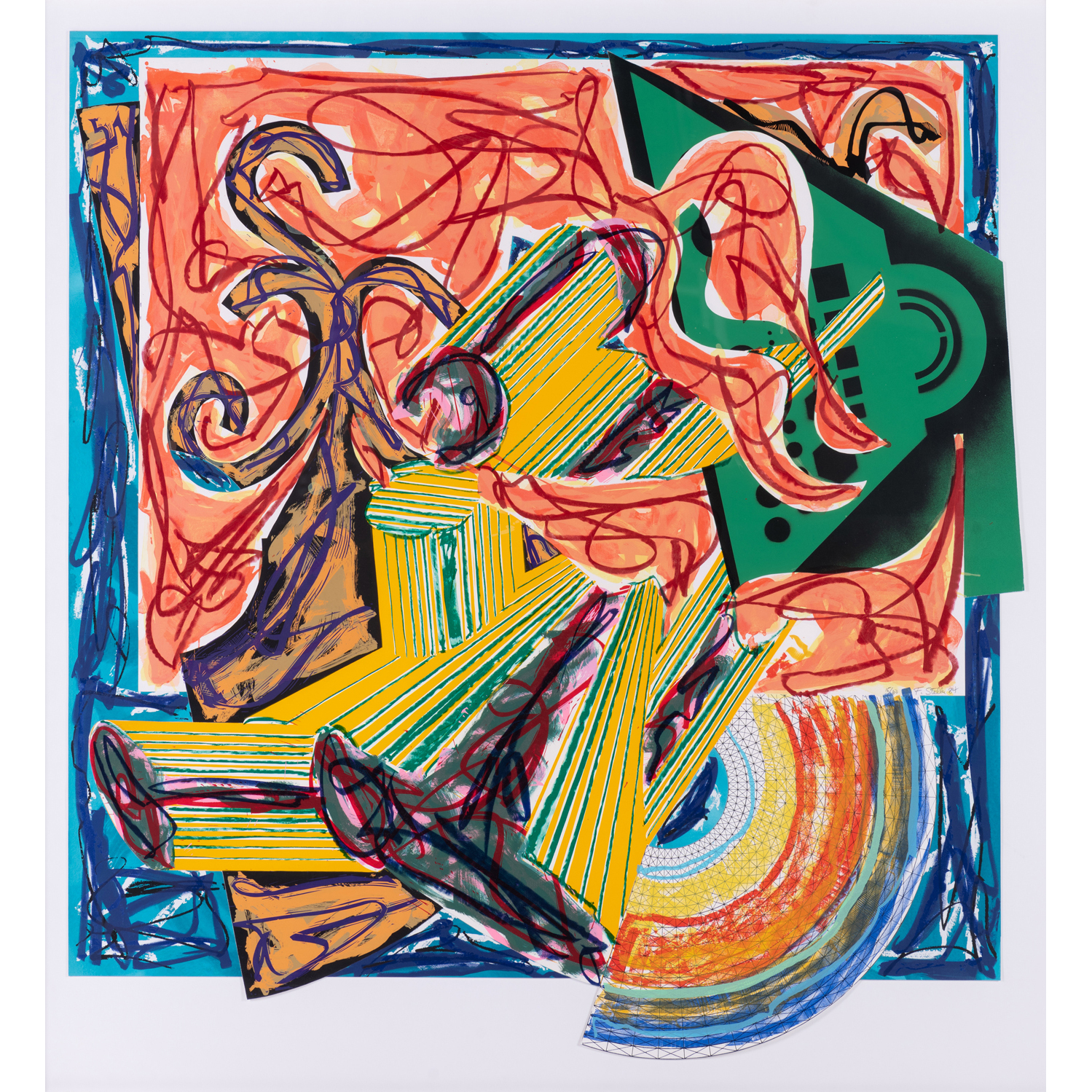
Frank Stella (né en 1936)
The Butcher Came and Slew the Ox, d'après El Lissitzky's "Had Gadya" - 1984
Estimate : 10000 / 15000 €
In his first solo exhibition in 1963, he presented his Black Paintings, which the Museum of Modern Art in New York had included in 1959 in "Sixteen Americans", a collective hanging.
Halfway between the object-image and the image-representation, Franck Stella's works, often produced in large formats and in a serial manner, often question the bidirectionality of the painting.
The two pieces offered for sale by PIASA illustrate passages from a rhyme traditionally sung at the end of the seder (the ritual meal of the Jewish Passover). A mixture of Hebrew and Aramaic, this text contains ten verses in a series of calamities that are ended by divine intervention. It was illustrated on many occasions by the leading figure of the Russian Avant-garde, the painter El Lissitzky (1890-1941).
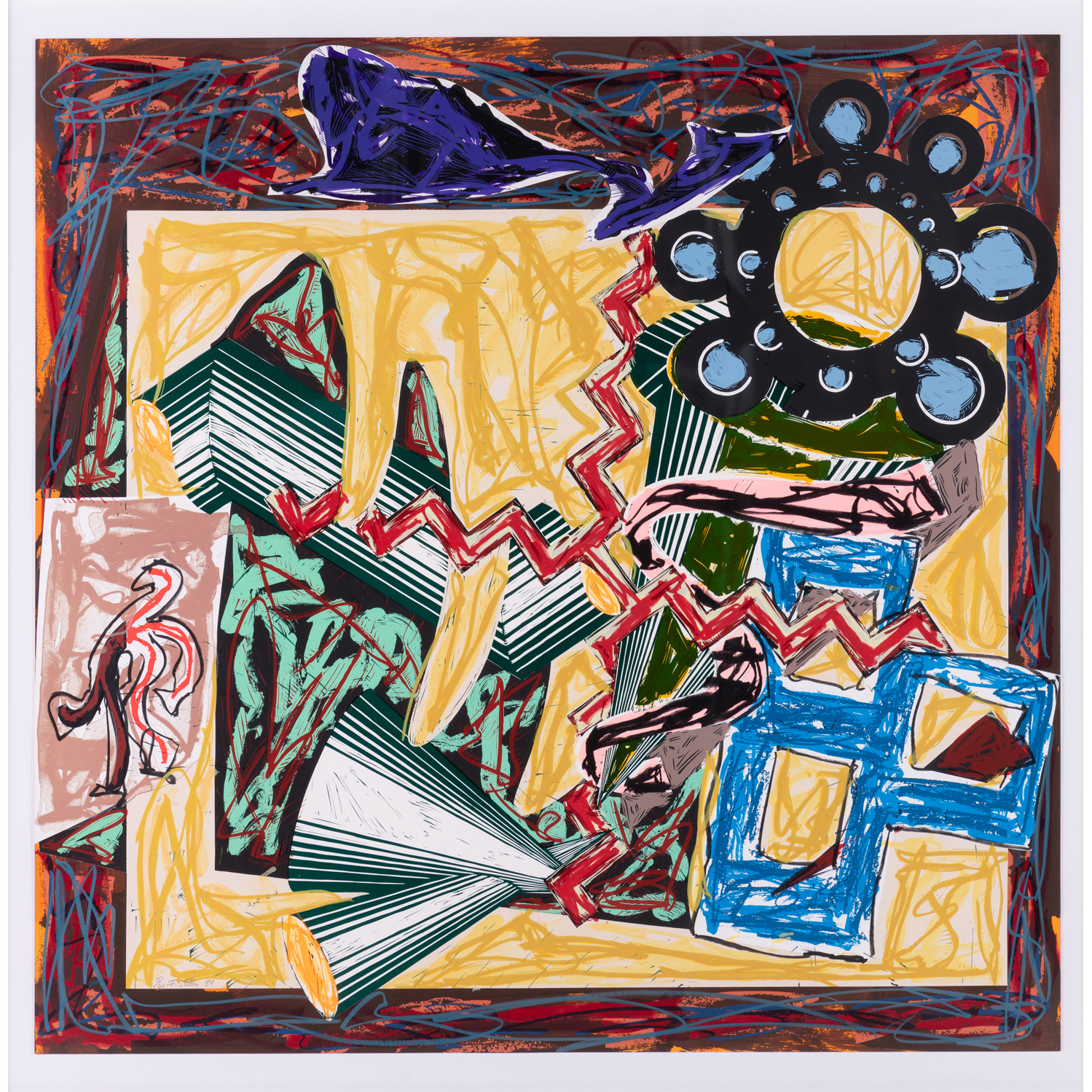
Frank Stella (né en 1936)
Then Came a Fire and Burnt the Stick, d'après El Lissitzky's "Had Gadya" - 1984
Estimation : 10000 / 15000 €
Frank Stella first saw the gouaches of El Lissitzky during a visit to the Tel Aviv Museum in 1981. He was fascinated by the movement and dynamism that came from these very simple graphic forms. Back in New York, Stella began working until 1984 on a series of impressions illustrating each of Had Gadya's verses.
Producing abstract works composed of explosions of bright colours and shapes emerging from their frame, he takes pleasure in multiplying printing techniques such as lithography, silkscreen printing, collage and colouring, in order to give maximum dynamism and rhythm to his compositions.
The Butcher Came and Slew the Ox and Then Came a Fire and Burnt the Stick testify to this technical abundance. Published in only 60 copies, they also see the introduction into the artist's work of motifs that he will reuse in a very large number of compositions.