


“It is on the sample of the old rope that one weaves a new one. I knew this saying as a little kid. I am now getting to understand its import.”
- El Anatsui
In the mid-twentieth century, African nations initiated a collective demand for an end to European hegemony. In the wake of these increasingly pressing demands, emerged a transfer of power that gradually led to independence and a new African vision that drew on historical roots to forge a post-colonial identity for the continent. In line with the leaders and intellectuals of the time, art schools set up a new teaching system emancipated from the techniques learned in Europe.
In the line of the teachings of Uche Okeke and the Zaria Art Society, El Anatsui, a young graduate of the Kwame Nkrumah University of Science and Technology in Kumasi, Ghana, who became a professor at the University of Nsukka, Nigeria in 1975, encouraged his students to observe their immediate environment and to draw on the vernacular and historical practices of the country. It was at this time that he discovered the Akwanshi monoliths in the courtyard of the National Museum of Lagos, the Nok terracottas and the Igbo body painting, known as uli, whose motifs he assimilated to include in his work.
If wood was present since his first years of study, it is during an artist's residency that he carried out in Cummington, Massachusetts, United States in 1980 that the artist integrated the use of the chainsaw for artistic purposes into his practice. On wooden boards that he juxtaposes according to the dimension he wishes to give to his work, the artist finds the ideal form to allow him to explore the expressive and graphic possibilities of his "new tool". "The lacerations obtained are for him a way of speaking about the epistemic, cultural and political violence exerted on Africa by the European empires at the time of colonization".
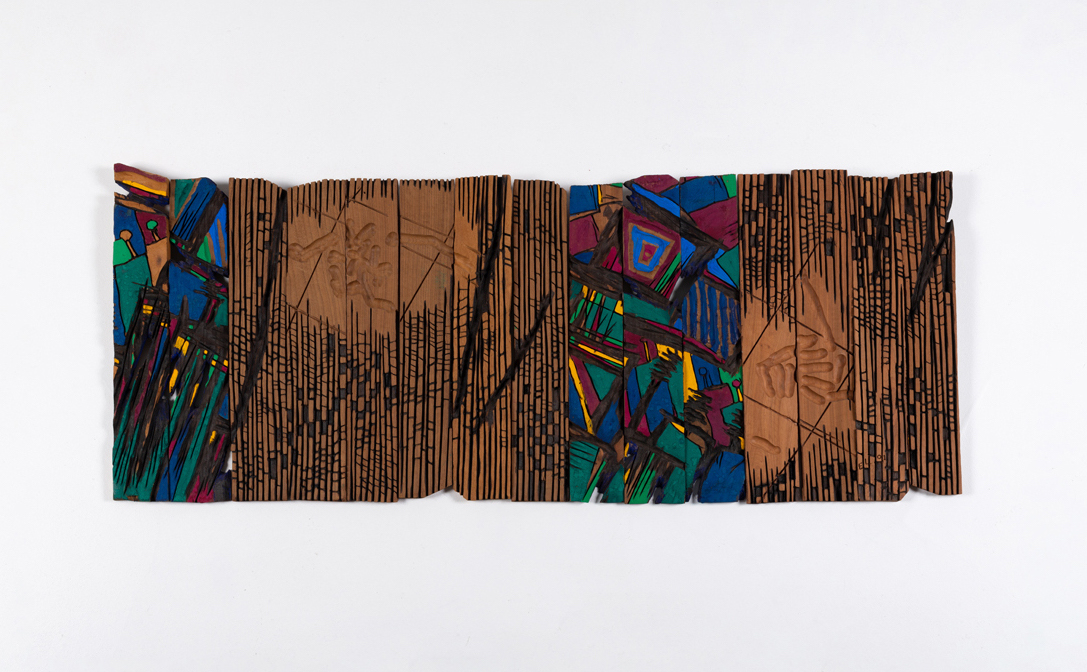
El Anatsui (b. 1944, Ghana)
Untitled, 2001
Estimate: 70000 / 90000 €
With the help of tinned iron, he creates lines in soft, dark colors that are more like drawings than sculptures. Quickly, with the help of a blowtorch, he blackens the whole surface of the wood to underline the contrast.
The resulting paintings in relief recall the warp and weft of the fabrics woven by the Ewe people from which the artist draws his inspiration.
After fifty years of continuous practice and experimentation in a variety of media, El Anatsui was awarded the Golden Lion for Lifetime Achievement at the 56th Venice Biennale.
The award of the Praemium Imperiale Prize for Sculpture by the Japan Art Association soon followed in 2016. That same year, Anatsui received an honorary doctorate from Harvard University (2016), the University of Cape Town (2016), and then in 2017 from the Kwame Nkrumah University for Science and Technology. In 2019, his work was again on display in Venice, masterfully exhibited alongside other artists, in his home country's first pavilion at the Venice Biennale of Contemporary Art. More recently, in 2019, the exhibition El Anatsui, Triumphant Scale, curated by Okwui Enwezor and Chika OkeleAgulu, opened at the Haus der Kunst in Munich. This major monographic exhibition presented the monumental sculptures made of bottle caps, but also lesser-known wooden sculptures and wall reliefs from the mid-1980s to the late 1990s, ceramic sculptures from the 1970s, as well as drawings, prints and sketchbooks. The touring exhibition was also shown at the Kunstmuseum in Bern, the Mathaf in Doha, and the Guggenheim Museum in Bilbao.
