While for many months, amateurs and collectors of African art have been frustrated by the closure of borders and the cancellation of major artistic events on the Continent,PIASA inaugurates the season by offering, on Wednesday, October 7, 2020, a sale of contemporary African art rich with nearly 120 works by several generations of artists from the continent and the Diaspora.
True to its positioning as a precursor and tutor on the market, PIASA will present the works of established artists, artists whose appeal on the international market has been revealed in previous sessions as well as emerging figures.
Once again, the catalog manifests the centrality of societal issues in African creation. For example, representing a fantasized nature, the Ugandan artists Gateja and Joseph Ntensibe reflect the importance of the environmental theme. The use of waste characterizes the production of the Kenyan Dickens Otieno reassembling metal soda cans into precious tapestries or that of the Burkinabé Abou Sidibé creating works from inner tubes, multiple grigris, buttonsor statuettes intended for the tourist market.
The artists Armand Boua and Yéanzi - both from the School of Fine Arts - evoke the difficult living conditions of African youth by depicting silhouettes of street children from tar and melted plastic. In Cameroon, William Tagne, with his series "Enfance Volée, moi aussi j'ai des rêves"(Stolen Childhood, I too have dreams), deals more particularly with the problem of schooling for young people forced to provide for their own needs.
Far from a stereotypical exoticism, new technologies also inspire artists on the African scene, such as the Ugandan Henri Mzili, who depicts young people with augmented reality helmets on their heads. The Ethiopian Kirubel Melke, for his part, denounces television propaganda by questioning the symbol of an empty chair in the center of a richly furnished bookcase.
A vector of identity, the art of SAPE (Société des Ambianceurs et Personnes Élégantes) is staged by Congolese artists Zemba Luzemba and Dolet Malalu. One finds this taste for elegance and this will to escape from its environment in the Swenkas of South African Bambo Sibyiaand the young lookers of Cameroonian Anjel.
The current events around the restitution of classical African art works also find a strong echo among many artists. Sensitive to multiculturalism, Franck Kempeng integrates traditional African figures in the high places of Western culture such as the Pyramid of the Louvre or theItalian Palaces.
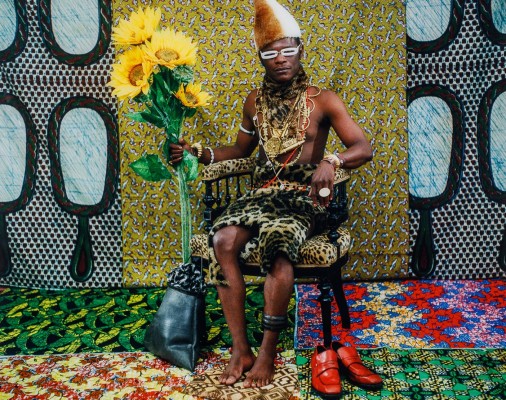
The reinterpretation of the masks and thrones of chiefs is also a recurring subject, particularlyin the work of the Mozambican Gonçalo Mabunda. The tradition and iconography he carries is explicitly addressed by Samuel Fosso with "The Chief (He who sold Africa to the colonists)",a photographic print exhibited at the Musée du Quai Branly.
Samuel Fosso (born in 1962)
After the trauma of a childhood spent in Nigeria, Samuel Fosso joins his brother in the Central African Republic and works in a shoemaking shop. In 1975, he became interested in photography and opened his first studio at the age of thirteen.
Faced with the violence of the war that ravages the country in 2014, Samuel Fosso takes refuge in Paris. From the very first years, his work revolved around self-portraiture. The artist stages himself within an iconography that sometimes refers to the African tradition and sometimes to more Western codes.
In 1994, Samuel Fosso's works were presented for the first time at the Rencontres de la photographie africaine de Bamako where he won first prize. Since then, they have been regularly exhibited in Africa as well as in Europe.
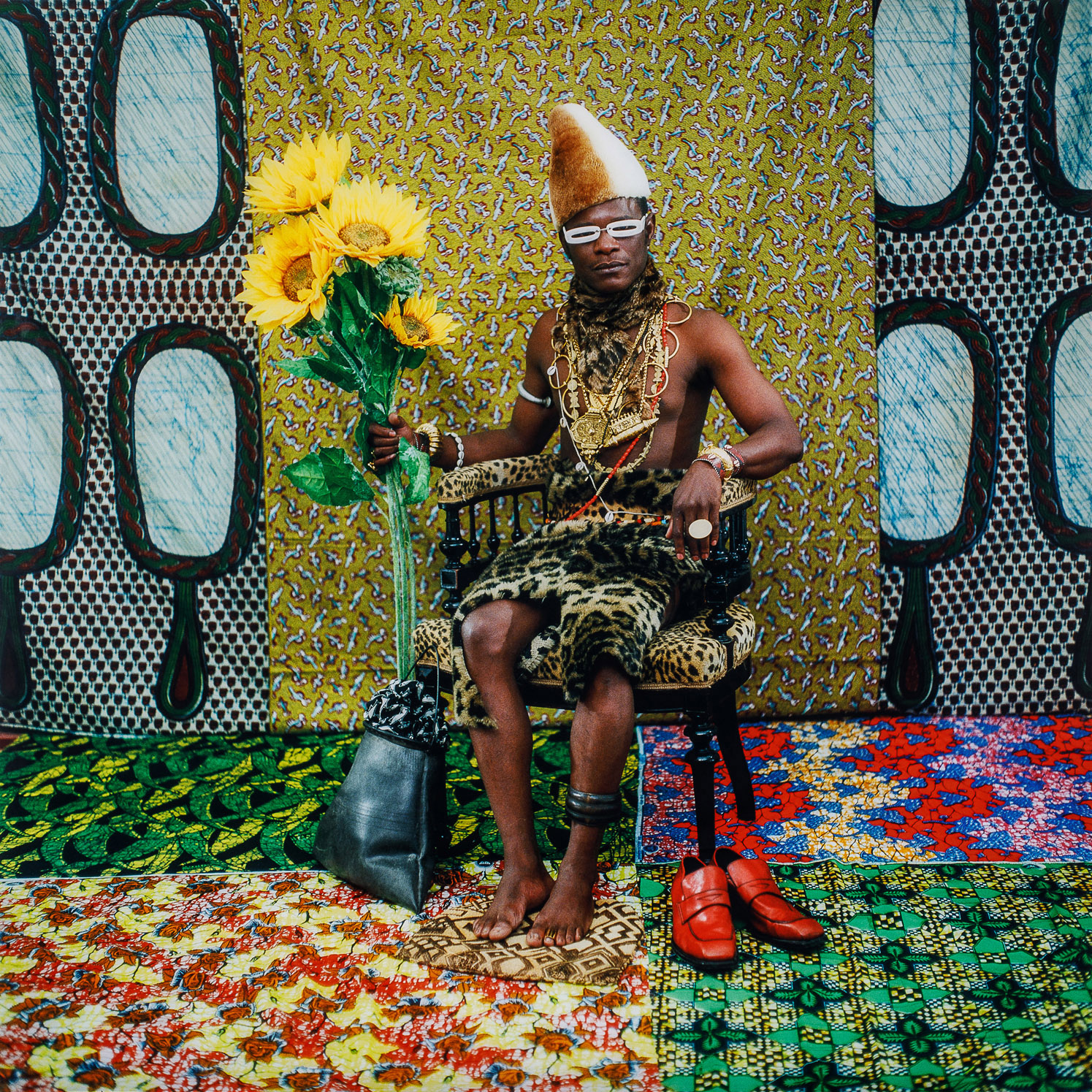
Zemba Luzamba (born in 1973)
Before leaving his native country to study at a business school in Lusaka, Zambia, Congolese artist Zemba Luzamba had attended an art school. In 2000, he moved to South Africa. Hyper realistic, his painting depicts subjects projected in a place where the context, if not totally absent, is very discreet.
Like a relic of the present time, the Sapologie canvas presents the art of SAPE - a very popular clothing practice from the late 1960s - an authentic vehicle of a composite identity.
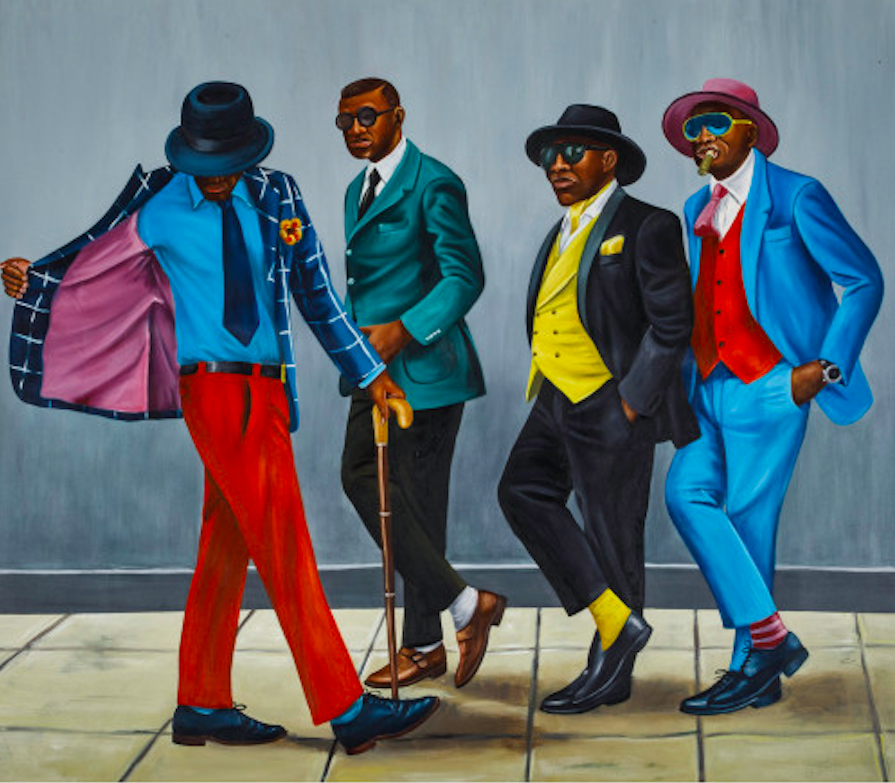 Zemba Luzamba (born 1973, Democratic Republic of the Congo)
Sapologie, 2019
Estimation : 6000 / 8000 €
Paul Ndema (born in 1979, Uganda)
Born in Mbarara - the western region of Uganda - Paul Ndema studied at the Margaret Trowell School of Industrial and then at the Makerere Academy of Fine Arts. Graduated in 2002, he participated in several group exhibitions in Nairobi, Cape Town and more recently at the "AKAA Contemporary Art and Design Fair" in Paris and the "1:54" in London.
His painting Untitled represents a character on a bright red background. The armor and heraldry summon a medieval imagination associated with traditional African culture.
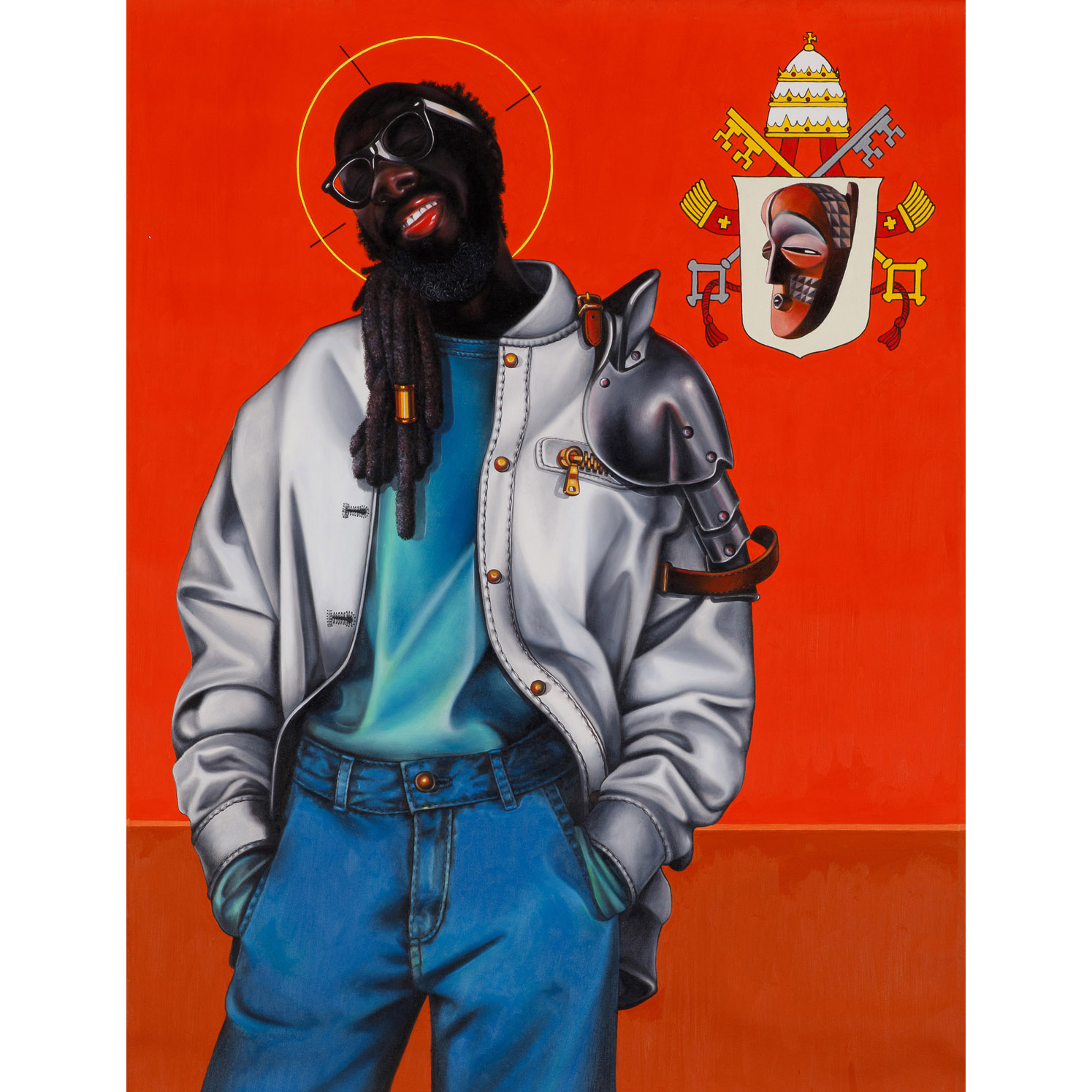
Paul Ndema (born 1979, Uganda)
Gregory XVII, 2019
Estimation : 6000 / 8000 €
Barthélémy Toguo (born in 1967, Cameroon)
It is in Grenoble and then in Düsseldorf that the Cameroonian artist Barthélémy Toguo extends a training started at the School of Fine Arts in Abidjan, Ivory Coast. A multi-media artist, he works with video, photography, painting and watercolor as in this piece for sale.
Delicate and emotionally charged, What's your name Nº 3, the watercolor offered for sale, takes up the composition of playing cards. Produced in 2004, it is offered with an estimate of between 20,000 and 30,000 euros.
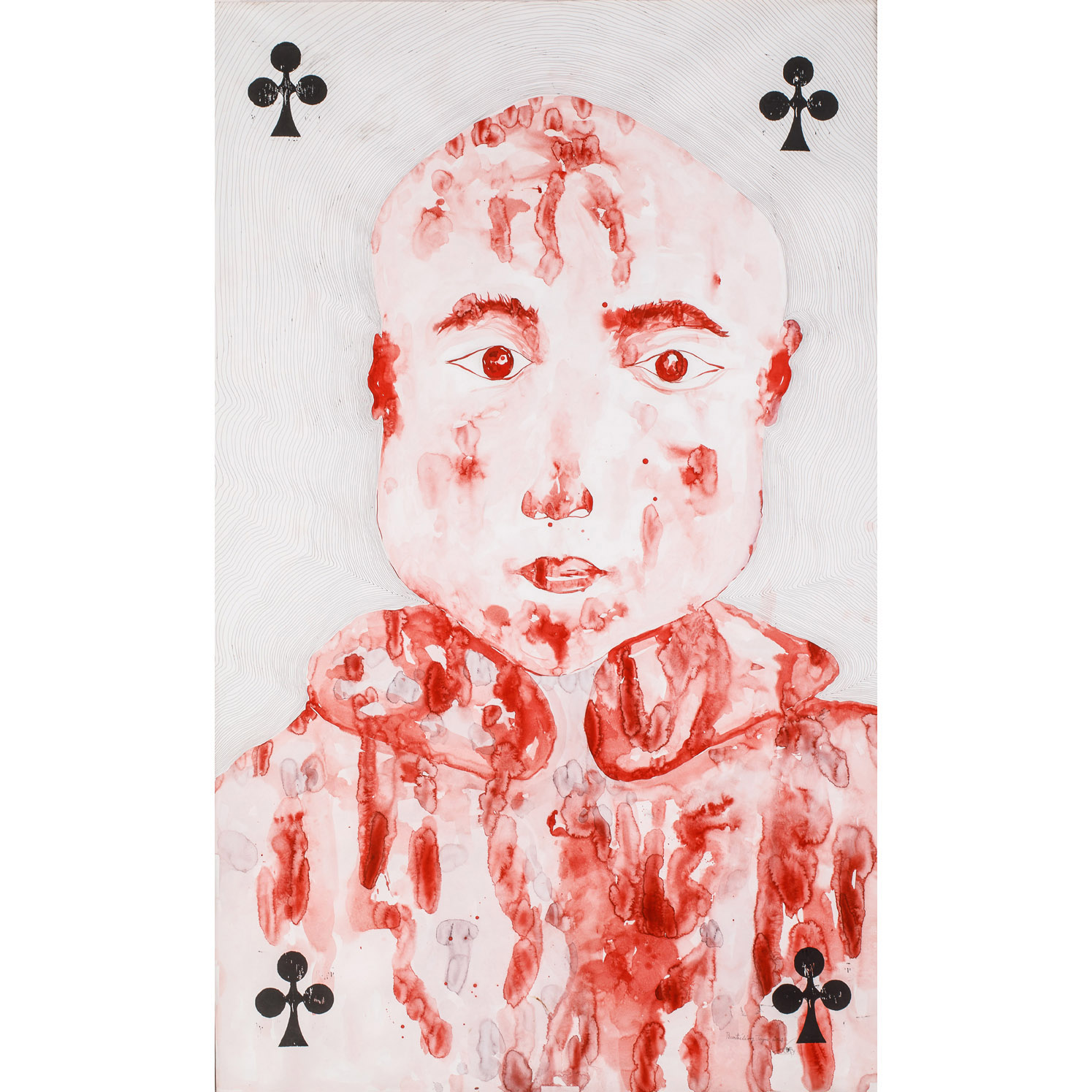 Barthélémy Toguo (born 1967, Cameroon)
What's your name No 3, 2004
Estimation : 20000 / 30000 €
Abdoulaye Konaté (born in 1953, Mali)
Born in 1953 in Diré, Mali, Abdoulaye Konaté lives and works in Bamako. After graduating from the National Institute of Arts in Bamako in 1976, this visual artist continued his studies at the Higher Institute of Plastic Arts in Havana, Cuba in the early 1980s.
After starting out in painting, his practice evolved in the 1990s to move towards textiles. The bazin, this traditional Malian fabric, is dyed with pigments of which he plays with nuances in order to propose a true chromatic symphony.
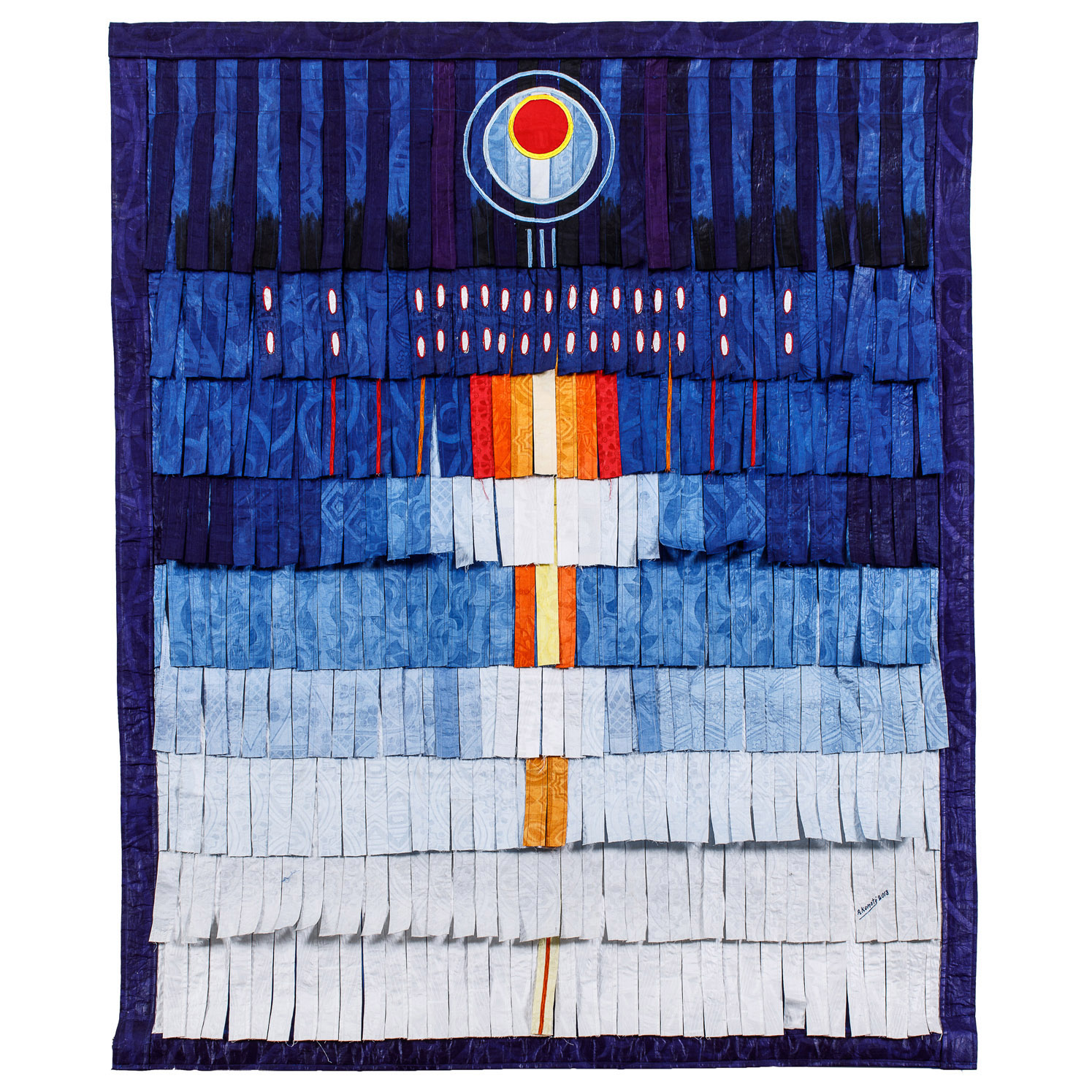 Abdoulaye Konaté (born 1953, Mali)
Bleu au cercle rouge et jaune, 2018
Estimation : 15000 / 25000 €