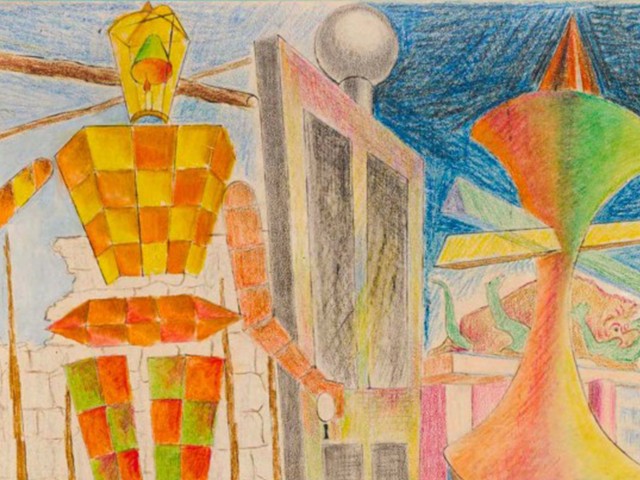
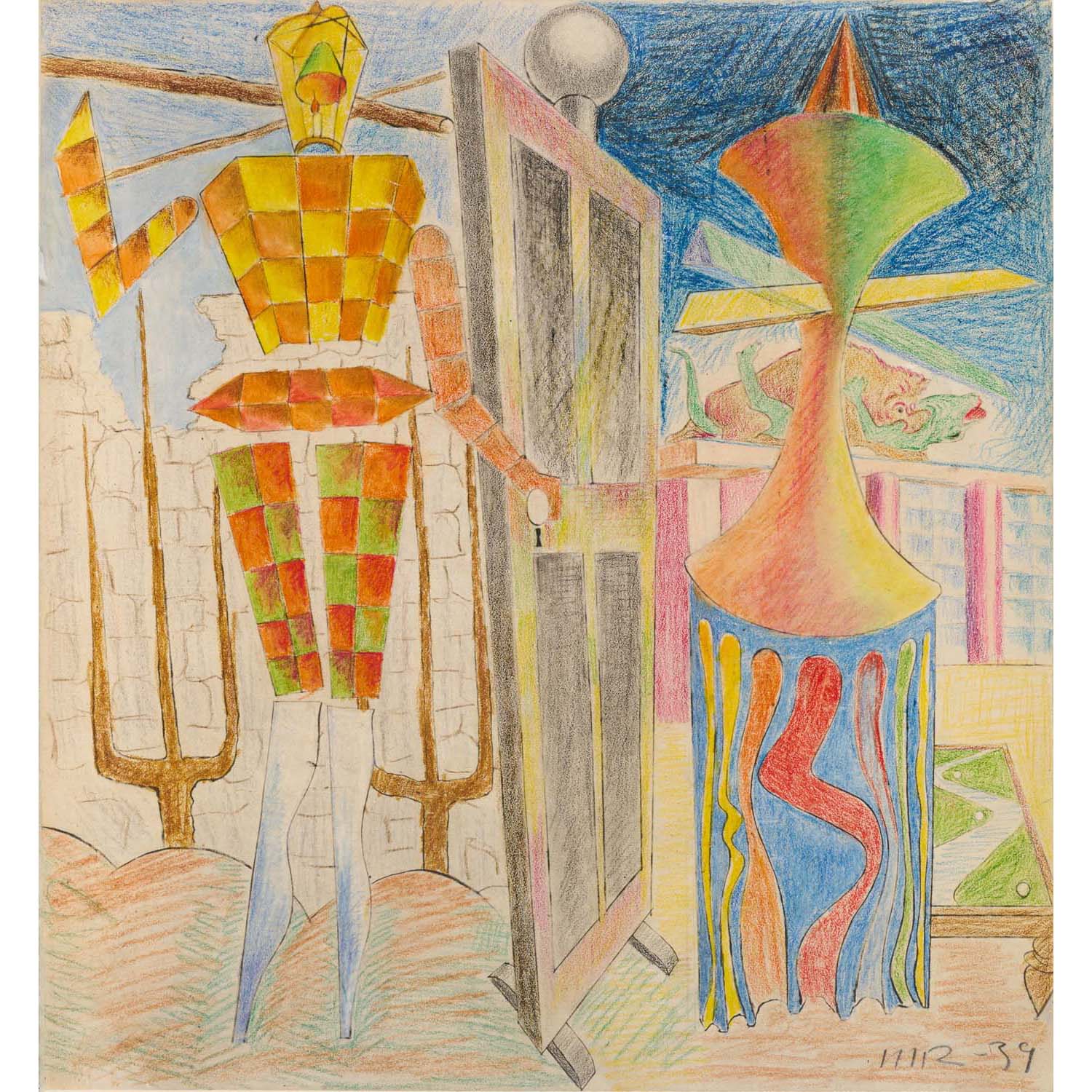
This work (lot 29) is an almost complete study for the monumental painting by Man Ray entitled Le Beau Temps, painted in 1939 and housed in the Philadelphia Museum of Art. It is considered Man Ray's finest surrealist painting, one he kept until the end of his life.
While traveling to Copenhagen in 1933, Man Ray changed trains in Hamburg: "… I passed through Hamburg on the day Hitler came to power. It was as if life had stopped, there was no one in the streets or in the parks." Although he usually refrained from sharing his opinion on political affairs and current events, Man Ray was clearly uneasy. His fears grew over the following years as he observed the Spanish Civil War, the German bombing of Guernica in 1936, the persecution of the Jewish people, and activities in Germany. In 1938, frightening premonitions, some from his dreams, began to appear in his paintings and drawings. These compositions depict domineering hands, fear, flight, barren landscapes, and blood. Being Jewish, he could not stay in France under the occupation and was forced to flee in August 1940 to return to his country of origin, America.
After abandoning commercial photography in 1937, the artist returned to his passion for drawing and painting. "I had almost no (recent) photographic work, so I turned to painting and executed several large canvases. One of them was a composition of several dreams, done in bright colors and using all techniques, from Impressionism to Cubism and Surrealism (...). One night, I heard distant gunshots and, when I fell back asleep, I dreamed that two mythological animals were slashing each other on my roof. I sketched it and incorporated it into the dream painting I called 'Le Beau Temps'." This "dream painting," executed in 1939 and followed by later iterations, was described by Man Ray as the pinnacle of surrealist painting and considered by him one of the most significant achievements of his entire career.
The present study (lot 29), like the painting, reveals a rich iconography, perhaps one of the most complex ever conceived by Man Ray. Gathering all his energy and summarizing many of his current concerns, the artist assembled motifs inspired by dreams, reflecting not only his own situation but also the general atmosphere of the impending world war. As the artist observed, "The painting is less prophetic than it is a testimony of the past, like a barometer with a map in which one can read what happened before, deducing the trend for the future."
Man Ray (Philadelphie, 1890 – Paris, 1976)
Le Beau temps, 1939
Estimate: 60000 / 90000 €
The dividing door, the fight of animals on the roof of the house, the silhouette of Harlequin, as well as the billiards table found in Man Ray's painting La Fortune, 1938 (Whitney Museum of American Art, New York), offer a conflicting scene of uncertainty and anxiety. While the right side of the drawing presents the good times of pre-war life, the left side, separated by the paneled door, depicts a very different scene, one of destruction and violence, consequences of the war. Here, the main figure resembling a harlequin, composed of polyhedral shapes and a head presented as a lantern of light, could be Man Ray himself, since André Breton called him "the Man with the Magic Lantern Head." Embraced in flaming oranges and reds, the mannequin stands in a barren and burned landscape, where tridents represented by bare trees and a broken stone wall testify to the devastation. This figure, along with its geometric counterpart with mathematical traits, is inspired by the mathematical models Man Ray had photographed in 1935 at the Henri Poincaré Institute.
Despite striking fidelity, the present study omits certain elements compared to the painting: there is no blood flowing through the keyhole, no open book representing the mathematical challenge of squaring the triangle, and no embracing couple in the building in the background.
With his visionary and intuitive spirit, Man Ray dismantles the facade of apparent reality and reveals all its ambiguities in this skillfully orchestrated drawing. A mosaic of improbable symbols and a reflection of a crucial historical moment, Le Beau Temps is one of Man Ray's greatest surrealist achievements, where the illusion of "good weather" fades into a mere memory or a last breath of hope.
Fearing the loss or destruction of his 1939 versions of Le Beau Temps left in France, Man Ray painted variations in 1941, once settled in Hollywood.
Man Ray Expertise Committee