One senses in Rossi a resistance to the hierarchy of forms. A drawing is not the prefiguration of a building. A piece of furniture is not an accessory to architecture. A coffee pot is not the memory of a tower. Each is, every time, an equivalent instance of the same line of thought—one that searches, imagines objects that respond to one another horizontally rather than being ordered vertically. The auction on May 12, 2026 at Piasa brings together thirty-seven lots from the architect’s studio. Four of them make this system both perceptible and visible.
Drawing as a habitable space
Una lettera (1990, lot 1, est. €8,000–12,000) does not illustrate architecture—it is architecture. The watercolor stages a dense interior in which a seated figure struggles to finish a letter written under the influence: a bottle of vodka and a coffee pot rest on the table. What strikes the viewer is the structure of the composition: the furniture resembles the façade glimpsed through the window, creating a confusion between interior and exterior. It is a painting conceived as a plan.
An inverse logic appears in lot 29, Studio per un edificio a Berlino, Landsberger Arkaden, 1992 (71 × 121.5 cm, est. €8,000–12,000): the building’s façade, massive and marked by a false symmetry, nearly recedes in order to make room for an exploration of color.
.jpg) LOT 01
LOT 01
The object as theoretical argument
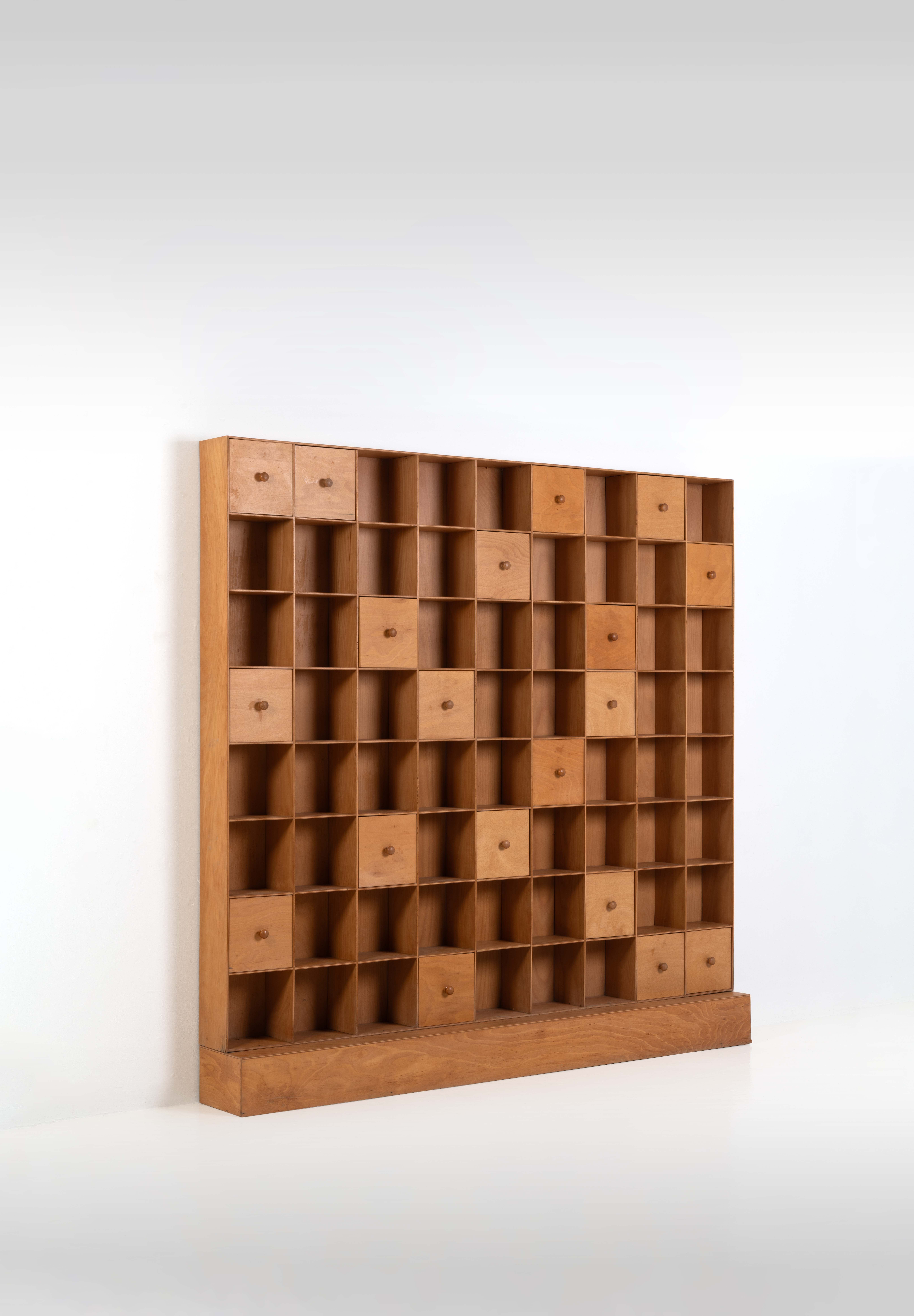
The laminated beechwood bookcase in lot 21 (1990s, unique piece, est. €8,000–12,000) was made by Bruno Longoni to store the architect’s DVD collection. Its form? A grid of regular compartments, almost serial, reproducing exactly the logic of the niches in the columbarium of the San Cataldo cemetery in Modena. Storing films and designing funerary spaces occupy here the same formal register. This is no coincidence: it demonstrates that, for Rossi, use does not determine form—it is form that absorbs all possible uses.
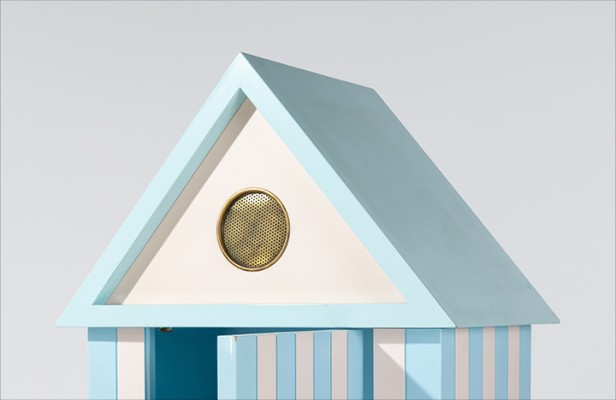
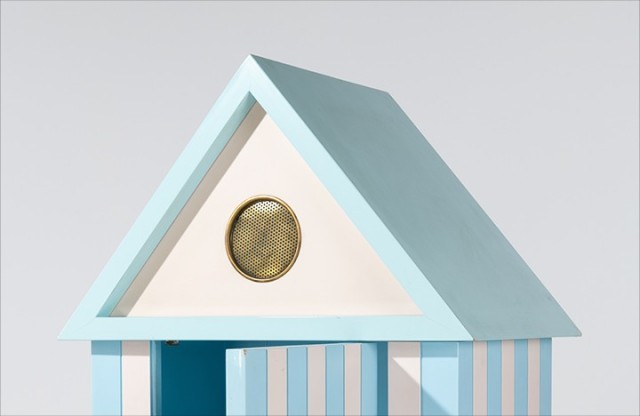
The same principle structures the Cabina dell’Elba (lot 14, personal prototype, est. €7,000–9,000), a lacquered wooden cabin whose design dates back to 1973: a micro-house reduced to its simplest expression—a triangular roof, a façade with vertical stripes, a central door. A prototype made at a reduced scale for the architect’s personal use, who thus possessed both the model and the miniature, the idea and its domestic double.
lot 29
The building as object
The Teatro del Mondo (lot 15, unique piece, 2012, est. €35,000–45,000, sold by designation) closes the loop. Built for the Venice Biennale in 1979, towed to Dubrovnik, then dismantled, the original now exists only in fragments in the Historical Archives of the Biennale. This replica, over three meters high, is neither a model nor a monument: it is the work itself, in its third version.
The Teatro belongs to the same formal family as the Cabina and the bookcase: the same grid of square windows, the same pointed roof, the same logic of the façade treated as an autonomous surface. It is a building that has the appearance of an object—and an object that carries the power of a building..jpg)
lot 15
More than a body of work: a system
What the Piasa sale makes perceptible is that Rossi’s work does not divide into categories—drawings on one side, architecture on the other, with design at the margins. It is not a system of façades. These thirty-seven lots form a continuum in which each piece is a possible answer to the same question posed at a different scale.
Each of these objects reveals part of the singularity of Aldo Rossi’s aesthetic vision: the studio is not a place of production separate from the world, but the precise site where coffee pots become towers, towers become theaters, theaters become furniture, and furniture becomes letters addressed to strangers.