The diversity of Abraham Palatnik's formation is a sign of an artistic production that will never stop reinventing itself.
In Tel Aviv, he studied physics, mechanics, drawing and painting. Stripped, his first works are figurative.
When Abraham Palatnik returned to Brazil in 1947, he moved to Rio de Janeiro. He became friend with Almir Mavignier, who animated a painting workshop at the Rehabilitation Department of the Dom Pedro psychiatric hospital, as well as the intellectual and art critic Màrio Pedrosa (1900-1981). This contact with the hospital environment inflected his aesthetic convictions inherited from a classical education. Between 1949 and 1951, Abraham Palatnik devoted himself to the manufacture of cine-chromatic apparatus, a term coined by Màrio Pedrosa.
Extending his pictorial work by other means, he projects, on plastic screens, colours and shapes animated by electric motors. The artist presents one of his devices, Azul e roxo em primeiro movimento (blue and purple in the first movement), in 1951 at the São Paulo Biennial, the first event of this type to take place outside Europe and North America. The public and the critics are seduced by this kaleidoscopic arrangement of colours in space.
In 1960, one of his pieces is presented at the Museum of Modern Art in Rio de Janeiro. That's when his work crosses the Atlantic. Presented at the Venice Biennale in 1964, it will be part of the collective exhibition Movement 2, organized by Jean Cassou, first director of the National Museum of Modern Art, at the Galerie Denise René in Paris.
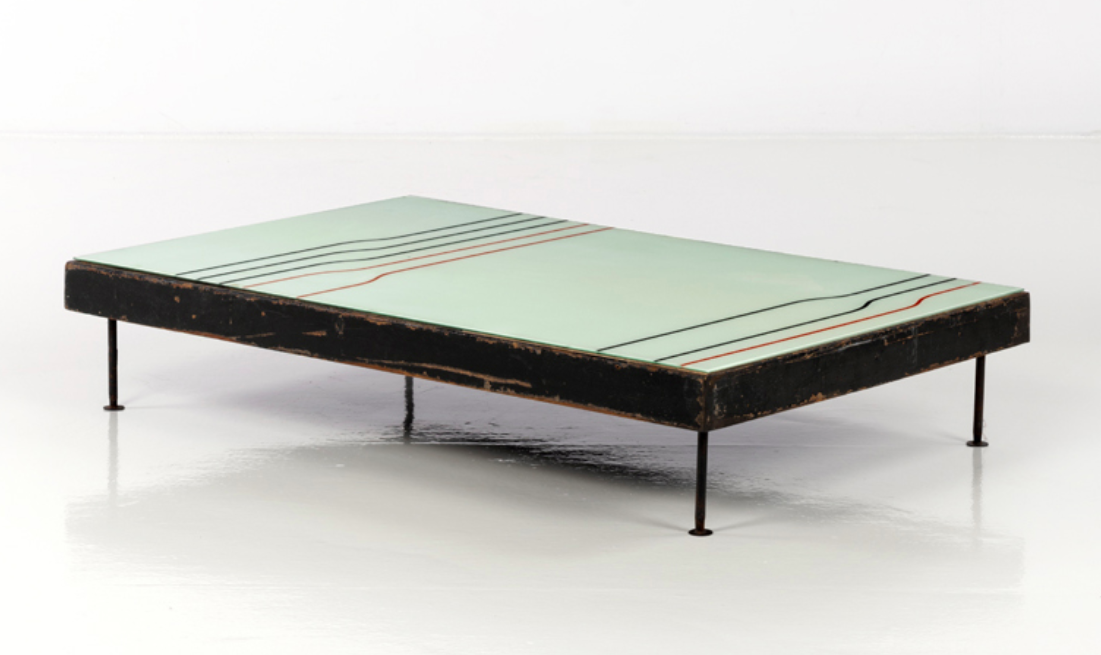
Abraham Palatnik (né en 1929) Table basse - Pièce unique
Estimation : 30 000 / 40 000 €
In order to explore the diversity of materials, Abraham Palatnik embarks on the realization of furniture at the confluence of art, design and mechanics. Unique piece, the table offered for sale by PIASA is emblematic of the artist's desire to cross the boundaries between disciplines. The plywood surface was painted by hand before being covered with glass.